Get Indian Freedom Fighters List, Discover top Indian freedom fighters, their contributions, and a full list of heroes who led India’s independence struggle. Top 10 freedom fighters.
 theIAShub | 15 Jul, 2025 | 6322 | 0 |
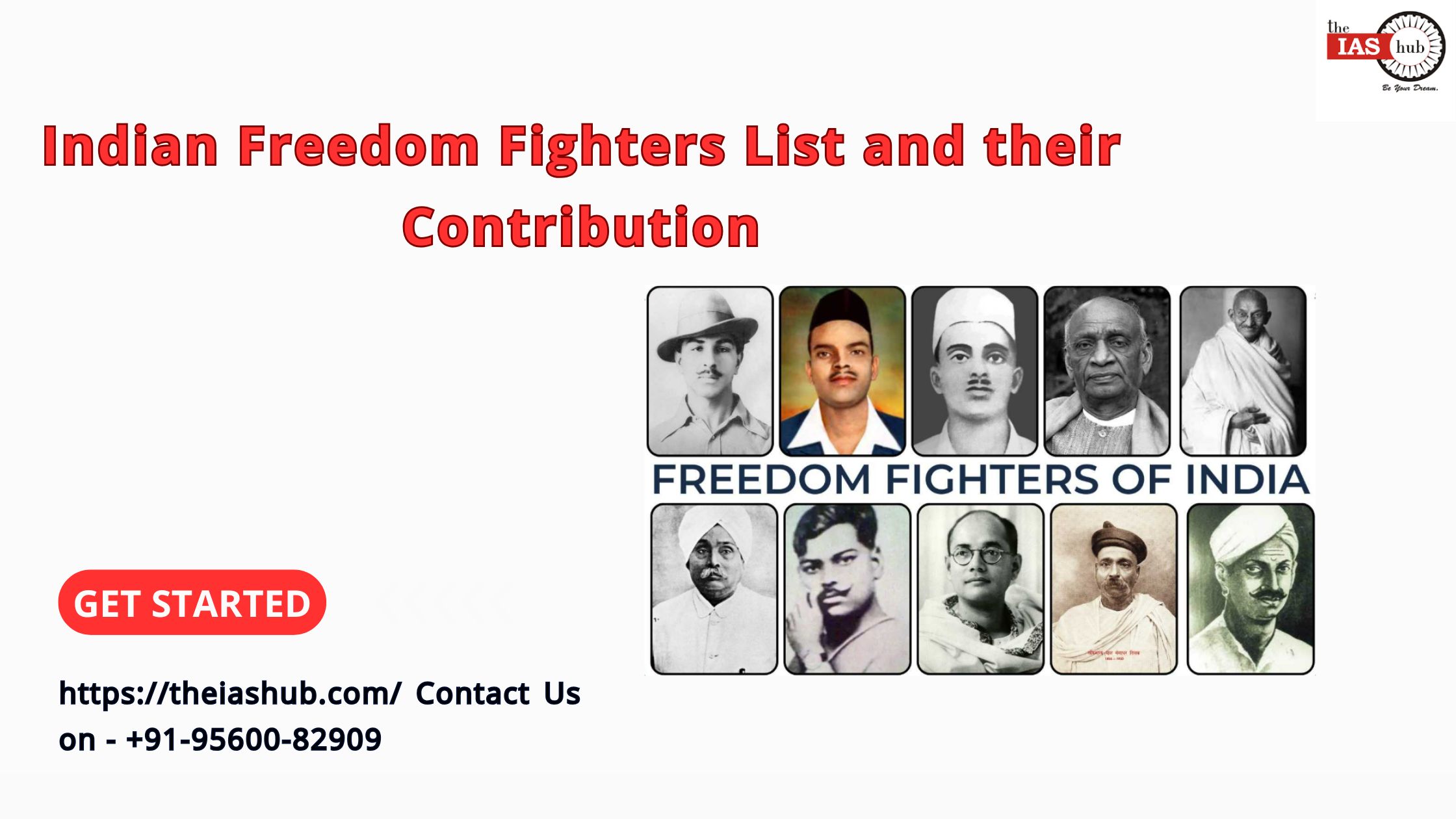


History of our freedom struggle is replete with acts of courage, sacrifice, and dedication to the cause of freedom. The Indian freedom fighters came from every nook and corner of the country. They did not speak one language, and they did not belong to one region or one caste. An intense love for their country and a keen desire to see it free were their common goal.
Also read Important Personalities
India’s freedom movement against the British was witness to an overwhelming participation of people throughout the country. From Kashmir to Kanyakumari, Assam to Gujarat, thousands of men and women fought together against the atrocities of the British Raj. While many selflessly gave their lives to protect the dignity of their motherland, others got injured and embraced imprisonment.
| Name | Contributions | Year |
| Rani Lakshmi Bai | Led the 1857 Revolt in Jhansi, fought valiantly against British forces, symbol of resistance. | 1857–1858 |
| Mangal Pandey | Sparked the 1857 Revolt (First War of Independence) by rebelling against British rule as a sepoy. | 1857 |
| Mahatma Gandhi | Pioneered non-violent resistance; led Champaran Satyagraha, Dandi Salt March, Quit India Movement. | 1915–1947 |
| Jawaharlal Nehru | Key leader in Non-Cooperation, Civil Disobedience, and Quit India Movements; first Prime Minister. | 1916–1947 |
| Subhas Chandra Bose | Formed the Indian National Army (INA), led armed struggle against the British; coined “Give me blood, and I will give you freedom.” | 1920s–1945 |
| Sardar Vallabhbhai Patel | Unified princely states post-independence; led the Bardoli Satyagraha, a key figure in Congress. | 1918–1947 |
| Bhagat Singh | Revolutionary, bombed the Central Legislative Assembly, martyred at 23, inspired youth through the Naujawan Bharat Sabha. | 1920s–1931 |
| Sarojini Naidu | First woman president of the Indian National Congress; led the Salt March, Quit India Movement; poet and orator. | 1916–1947 |
| Dr. B.R. Ambedkar | Architect of the Indian Constitution; fought for Dalit rights, led the Mahad Satyagraha, promoted social justice. | 1920s–1947 |
| Bal Gangadhar Tilak | Advocated “Swaraj is my birthright”; led the Swadeshi Movement, popularised nationalism through education. | 1890s–1920 |
| Lala Lajpat Rai | Part of the Lal Bal Pal trio; led protests against the Simon Commission, founded the Punjab National Bank, and died after police brutality. | 1880s–1928 |
| Chandra Shekhar Azad | Reorganised Hindustan Republican Association; led revolutionary activities, died in a shootout in 1931. | 1920s–1931 |
| Dadabhai Naoroji | Exposed British economic exploitation; advocated Swaraj, the first Indian to become a UK MP and founded the INC.
1880s–1917 |
1880s–1917 |
| Madam Bhikaji Cama | Unfurled the first Indian flag in Germany (1907); co-founded the Paris Indian Society and published revolutionary papers.
1905–1936 |
1905–1936 |
| Pingali Venkayya | Designed the Indian national flag; participated in Vande Mataram and Home Rule Movements. | 1916–1947 |
| Ram Prasad Bismil | Led the Kakori Train Robbery (1925), founded the Hindustan Republican Association, poet and revolutionary. | 1910s–1927 |
| Ashfaqulla Khan | Key figure in the Kakori Train Robbery, a member of Hindustan Republican Association, martyred in 1927. | |
| Pritilata Waddedar | Led an armed attack on the Pahartali European Club (1932), a member of Surya Sen’s revolutionary group. | 1930s–1932 |
| Begum Hazrat Mahal | Led 1857 Revolt in Awadh, collaborated with Nana Saheb and Tantia Tope, resisted British rule. | 1857–1858 |
Also read Birsa Munda Biography

India’s quest for liberation from colonial rule was driven by iconic figures such as Mahatma Gandhi, Bhagat Singh, Subhas Chandra Bose, Jawaharlal Nehru, and Chandra Shekhar Azad, among others. Each revolutionary played a vital role in India’s struggle for independence. key freedom fighters who contributed to India’s battle for sovereignty between 1857 and 1947 are given below:
Mahatma Gandhi
Mohandas Karamchand Gandhi, also known as Mahatma Gandhi, was a prominent leader of the Indian independence movement against the unjust British rule in India. Born and raised in a Hindu family in Gujarat, he was a lawyer and an anti-colonial nationalist. Popularly known as Bapu in India, he wore the traditional Indian Dhoti and shawl, handwoven on the Charkha. In 1930, Gandhi led the Indians in challenging the British-imposed salt tax with the 400km Dandi Salt march. His birthday is celebrated as Gandhi Jayanti on the 2nd of October. He is famous for his non-violent ideologies.

Jawaharlal Nehru
Jawaharlal Nehru was the first prime minister of India and an Indian Independence Activist. He was a graduate of Trinity College, Cambridge, and the Inner Temple, where he trained to be a barrister. Upon his return to India, he took an interest in national politics. Under his leadership, Congress emerged as a dominating party and won consecutive elections.

Sardar Vallabhbhai Patel, often referred to as the ‘Iron Man of India,’ was instrumental in the integration of princely states into the newly independent Indian Union. He played a crucial role in the civil disobedience movement and was a close associate of Mahatma Gandhi. Patel’s organisational skills and unwavering commitment to India’s unity were vital during the Partition of India. His role as a freedom struggle leader has been immortalised in his work to ensure that India remained united post-independence, making him one of the greatest freedom fighters in India.
Subhas Chandra Bose
Subhas Chandra Bose, one of the bravest freedom fighters of India, also known as Netaji, was born in Orissa. He may have been shaken by the Jallianwala Bagh Massacre and forced to leave England for India in 1921. He became a member of the Indian National Congress and participated in the Civil Disobedience Movement. He sought assistance in Germany after becoming dissatisfied with Gandhi Ji’s Non-Violence Method of Freedom and finally founded the Azad Hind Government and Azad Hind Army, now known as the Indian National Army (INA), where he trained and supervised all freedom fighters.

Also read NIA and Shubhas chandra Bose
Bhagat Singh
Bhagat Singh (1907 – 23 March 1931) was an Indian social revolutionist whose acts of violence to end unjust British rule, followed by his ideology proliferation and execution, made him a hero. He was involved in revolutionary activities against the British Raj. It was when Lala Lajpat Rai was killed by the police that Bhagat Singh wanted revenge and got involved in the murder of a British police officer( Lahore conspiracy). His legacy prompted youth in India to keep fighting for independence.

Bal Gangadhar Tilak
Bal Gangadhar Tilak (23 July 1856 – 1 August 1920) was an Indian nationalist, teacher, and activist, and part of the Lal-Bal-Pal trio. Being the first leader of the Indian Independence Movement, he was given the title of “Lokmanya”, which means accepted by people as their leader. He is known for strongly advocating “Swaraj” (Self Rule). His famous slogan, “Swaraj is my birthright, and I shall have it!”, became a rallying cry for freedom.

Bhimrao Ambedkar
Dr. Bhimrao Ambedkar (14 April 1891 – 6 December 1956) was an Indian jurist, economist, politician, and social reformer. He was India’s first Minister of Law and Justice and the primary architect of the Constitution of India. His campaigns against social discrimination towards the untouchables (Dalits) had a huge impact. Later, he became involved in campaigning and negotiations for India’s independence, publishing journals, and advocating political rights.

Maulana Abul Kalam Azad
Mohiuddin Ahmad, better known as Maulana Abul Kalam Azad, ranks high in the political and intellectual history of modern India. His role in the Indian Freedom Struggle, especially as a Muslim, will coexist in a secular India, is well known. He was, at the same time, one of the foremost Islamic intellectuals and scholars of contemporary times. He was also a remarkable journalist and ideologue whose career closed with a long tenure as India’s first Education Minister.

Lala Lajpat Rai
Lala Lajpat Rai, also known as Punjab Kesari (the Lion of Punjab), came to know of the imposition by the colonial regime. He immediately returned to Lahore and led the procession against the Simon Commission in 1928. He was made the target of a brutal lathi-charge by the police; even then, he maintained his presence of mind and requested the people to remain calm and peaceful. He said after a brutal attack on him by the Britishers during the anti-Simon Commission protest.“Every blow aimed at me is a nail in the coffin of British Imperialism.

Sarojini Naidu, known as the ‘Nightingale of India,’ was a prominent freedom fighter, poet, and political leader. She played an essential role in the Civil Disobedience Movement and was the first woman to become the President of the Indian National Congress. Naidu was instrumental in organising women’s participation in the independence movement and fighting for gender equality in India. Her contribution to the Indian freedom movement remains significant, especially in mobilising women to join the fight for freedom.

Surya Sen(1894 -1934)

Popularly known as ‘Master da’, Surya Sen was a leading revolutionary in the Indian independence struggle against British rule. He was actively involved in the Non-Cooperation Movement. He is well-renowned for his leading role in the 1930 Chittagong armoury raid, where he led a group of revolutionaries to raid the police armoury. He was hanged on January 12, 1934, for his attempts to rebel against the British.
Matangini Hazra(1869 -1942)

Matangini Hazra was a revolutionary in the Indian independence movement who fought for upholding Gandhian principles. Actively involved in the Quit India Movement, she led a procession of revolutionaries to seize Tamluk Police Station in West Bengal on September 29, 1942. The police opened fire at the crowd, causing fatal injury to the 73-year-old hero.
Ram Prasad Bismil(1897-1927)

Apart from being a freedom activist, Ram Prasad Bismil was renowned as a patriotic poet who wrote poems using pen names Ram, Agyat and Bismil. He was one of the founders of the Hindustan Republican Association.
He was actively involved in the Mainpur conspiracy and the Kakori conspiracy in UP. He was hanged on December 19, 1927, for his revolutionary activities against the British
Bagha Jatin(1879-1915)

Jatindranath Mukherjee, popularly known as Bagha Jatin, played a crucial role in India’s freedom movement. With a dream of saving his motherland from the clutches of British rule, the revolutionary led the Jugantar party in Bengal. On September 10, 1915, he died after being critically injured in a gunfight with the British police. Inspired by Swami Vivekananda’s ideals, one of the bold statements made by Bagha Jatin was: “We shall die to awaken the nation”.
Bir Tikendrajit Singh(1856-1891)

Bir Tikendrajit Singh was the prince of the independent kingdom of Manipur and the commander of the Manipuri army. The Anglo-Manipur war took place under his leadership.
On March 31, 1891, the British government sent a military force against Manipur from Kohima, Silchar and Tamu. The Manipuri army fought bravely against the British under the leadership of Bir Tikendrajit Singh, but eventually lost. The British arrested him, and he was finally hanged on August 13, 1891.
Pingali Venkayya(1876- 1963 )

Born in Andhra Pradesh, freedom fighter Pingali Venkayya was an ardent follower of Gandhiji’s ideals. Known for his knowledge in geology and agriculture, it was his design on which the Indian national flag is based. In 2009, India Post released a postage stamp in his honour.
Durgawati Devi(1907-1999)

Durgawati Devi was actively engaged in the armed revolution against British rule in India. She was an active member of the revolutionary group “Naujawan Bharat Sabha”. After the assassination of British official JP Saunders, she assisted in the escape of Bhagat Singh and Rajguru via train. As revenge for the hanging of Bhagat Singh, Devi tried to assassinate Lord Hailey, the former Governor of Punjab. However, her attempt was not successful, ultimately leading to her imprisonment.
Tirot Sing Syiem(1802-1835)

A freedom fighter and chief of the Nongkhlaw kingdom in Khasi Hills, Tirot Sing Syiem bravely fought with the British forces. Even though he gave a nod to British officer David Scott for the construction of a road through his kingdom to connect present-day Bangladesh with Assam, he later launched a war with the British after he came to know of their conspiracy. Against the mighty British armed with modern weapons, Syiem fought with traditional swords, shields, bows and arrows, etc. After engaging in the war for four years, Syiem was eventually captured by British forces. He was then deported to Dhaka, where he breathed his last. In 1988, India Post released a stamp in his memory.
Hemu Kalani(1923-1943)

Born in Sindh, Hemu Kalani was a freedom fighter and one of the prominent student leaders of the Quit India Movement in 1942. In order to curb the movement in Sindh, British troops were sent by train to Sindh. To stop the British forces, Kalani, along with his friends, made a plan to derail the train. However, before they could execute their plan, Kalani was caught by the police. Even though he was tortured in an inhumane way, he never divulged the names of other members involved in the plan. On January 21, 1943, he was hanged to death. He was 19 then.
Pritilata Waddedar(1911-1932)

Pritilata Waddedar was a school teacher and a prominent leader of the anti-British movement in Chittagong. As a member of Surya Sen’s revolutionary group, she *led the armed attack* on Pahartali European Club on September 23, 1932. One person died and several others were injured in this attack. The attackers were later caught by the British police. Pritilata was wounded in a shooting that followed and was soon surrounded by the British police. To avoid arrest, she consumed cyanide and embraced death.
Rani Gaidinliu(1915-1993)

Born in Manipur, Rani Gaidinliu was a prominent figure known for her armed resistance against the British Raj. In 1932, the British forces declared her as a ‘terrorist’ for her involvement in the war against them. She was arrested the same year and sentenced to life imprisonment. She was released only after India got her independence, after which she continued to work for uplift of her people. Gaidinliu breathed her last at the age of 78 in 1993.
Khudiram Bose(1889- 1908)

Born at Medinipur in West Bengal, Khudiram Bose was among the youngest martyrs of India’s freedom struggle against the British. At just 15, he had joined Anushilan Samiti and took part in several revolutionary activities against the British Raj. He, along with Prafulla Chaki, attempted to kill British Chief Magistrate Douglas Kingsford at Muzaffarpur in 1908. However, their attempt was unsuccessful, and it accidentally led to the death of two British women. This led to Khudiram’s arrest and subsequent death sentence. On August 11, 1908, at the age of 18, he was hanged to death.
Ashfaqulla Khan(1900-1927)

Ashfaqulla Khan was a freedom fighter who fought against the British forces. He was born in Shahjahanpur. After the Chauri Chaura incident in 1922, when Mahatma Gandhi decided to withdraw the movement, Ashfaqulla was not happy. Along with his friends, he decided to decided to form an organisation named Hindustan Republican Association. He was later arrested for his involvement in the Kakori Train Robbery and sentenced to death. He was hanged on December 19, 1927.
Alluri Sitarama Raju(-1924)

Born in Andhra Pradesh, Alluri Sitarama Raju gave his life for the cause of India’s Independence movement. Through the 1882 Madras Forest Act, the British imposed their restrictions on the free movement of tribal people in the forest. As a reaction to this, Alluri led the Rampa Rebellion of 1922 against the British Raj. This rebellion, which continued till 1924, only came to an end when he was shot dead by the British forces.
Jatindra Nath Das(1904-1929)

Jatindra Nath Das was an Indian revolutionary who took part in Mahatma Gandhi’s Non-Cooperation Movement. He later joined the Anushilan Samiti. Born in Kolkata, he was known as a bright student. He was arrested for his anti-British activities and was imprisoned in Lahore jail. While he was imprisoned there, he went on a hunger strike for 63 days demanding equality for Indian political prisoners. As a result of this hunger strike, Das finally breathed his last on September 13, 1929.
Veer Savarkar
Vinayak Damodar Savarkar, popularly known as Veer Savarkar, was born on May 28, 1883, in Bhagur, Maharashtra. At the age of 12, Savarkar led fellow students in an attack on a mosque during Hindu-Muslim riots. He began his political journey in school and later co-founded the Mitra Mela in 1903, an underground revolutionary group that evolved into the Abhinav Bharat Society in 1906, aiming to overthrow British rule and revive Hindu pride.

Are you preparing for UPSC 2026? Join IAShub’s UPSC coaching batches to boost your preparation. Enrol now!

Mahatma Gandhi was a pivotal figure in India's independence movement, advocating non-violent resistance (Ahimsa) and civil disobedience. He led major campaigns like the Dandi Salt March (1930), Quit India Movement (1942), and Non-Cooperation Movement (1920–22), mobilising millions to challenge British authority through peaceful means.
Bhagat Singh was a revolutionary freedom fighter known for his radical approach against British rule. He was involved in the Lahore Conspiracy Case (1929) and threw bombs in the Central Legislative Assembly to protest oppressive laws. He was executed in 1931 at age 23, becoming a martyr and inspiring youth to join the freedom struggle.
Subhas Chandra Bose, also known as Netaji, led the Indian National Army (INA) to fight British forces during World War II. He sought international support, particularly from Japan and Germany, and formed the Azad Hind Government. His slogan, "Give me blood, and I shall give you freedom," galvanised the nation.
Rani Lakshmibai, the Queen of Jhansi, was a key figure in the Indian Rebellion of 1857. She led her troops against the British, becoming a symbol of resistance. Her bravery in battles, particularly in Jhansi and Gwalior, made her an enduring icon of courage and patriotism.

Refine your answer writing skills and elevate your UPSC preparation with personalized support and expert feedback.
Fill out the form to get started with the program or any other enquiries !





Are you dreaming of becoming an IAS officer? Then, IAShub can be your best guide. It is one of the Best IAS Coaching in Delhi. Many students who want to clear the UPSC exam join IAShub for learning. The institute gives both online and offline classes. Their teachers are experienced and helpful. They easily explain every topic. Students also get notes, tests, and tips to do well in the exam.
IAShub is in Delhi and is trusted by many UPSC students. It offers coaching for every part of the UPSC exam – Prelims, Mains, and Interview. The classes are simple and easy to understand. The teachers are experts and guide students in the right way. IAShub is also known for its helpful notes, test series, and answer-writing practice. IAShub is the best coaching in Delhi and also gives UPSC Online Classes. This helps students from any place in India to learn. The online classes are live and also recorded. So, students can watch them anytime. These classes cover the full UPSC syllabus.
Here are some important services provided by IAShub:
The UPSC Civil Services Exam has three parts:
This exam is tough, but with the right guidance, it becomes easy to manage. Students must study smart and stay regular.
IAShub supports students from the beginning to the end. It gives the right books, tests, and notes. The classes are easy to follow, and the teachers are always ready to help. Students get personal doubt sessions too. The test series and answer checking help students learn where they need to do better. Also, free study materials save time and money.
IAShub also guides students during the final stage – the interview. Experts take mock interviews and give useful tips. This full support makes IAShub one of the best IAS coaching in Delhi.