Get The Important Personalities For UPSC CSE Exam List Covering Key Leaders Freedom Fighters Thinkers And Reformers From Indian And World History Along With Current Affairs Personalities Essential For Prelims And Mains Preparation.
 theIAShub | 16 Jun, 2025 | 2839 | 0 |
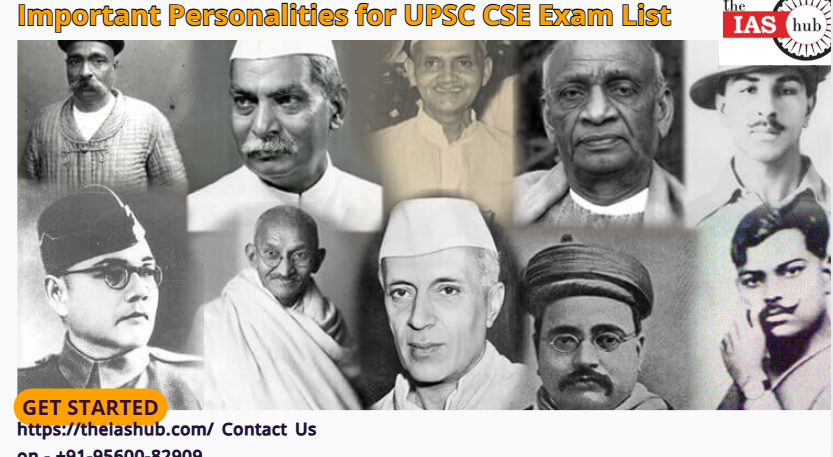


Studying important personalities is crucial for UPSC preparation. Aspirants should review a list of important Indian personalities – freedom fighters, thinkers, and leaders – who shaped India’s history. Similarly, understanding important personalities in world history (like Lincoln or Churchill) provides context to global events. In addition, keeping up with current affairs personalities for UPSC (contemporary leaders and influencers) is vital for current events knowledge.
Also Read: Constitutional bodies in India
Below we organize key figures in Indian history, world history, and current affairs, each with a brief bio.

| Name | Role & Significance |
| Mahatma Gandhi (1869–1948) |
Indian independence activist; leader of nonviolent resistance against British rule; inspired civil rights movements globally. |
| Jawaharlal Nehru (1889–1964) |
First Prime Minister of India (1947–1964); architect of modern India’s democratic institutions; promoted secularism, planned economic development, and education post-independence. |
| B.R. Ambedkar (1891–1956) |
Architect of the Indian Constitution; Dalit leader who fought caste discrimination; chaired the Constituent Assembly; enacted reforms for social justice and labor rights. |
| Sardar Patel (1875–1950) |
Independence leader and India’s first Home Minister; known as “Iron Man of India”; led the peaceful integration of princely states into the Union; key nation-builder. |
| Subhas Chandra Bose (1897–1945) |
Revolutionary nationalist (“Netaji”); led the Indian National Army in World War II; advocated armed struggle for freedom; famous for rallying Indian troops. |
| Rabindranath Tagore (1861–1941) |
Nobel-winning Bengali poet and cultural icon; first Asian Nobel Laureate in Literature (1913); composed India’s national anthem; promoted Indian art, literature, and education. |
| Ashoka the Great (c.304–232 BCE) |
Mauryan emperor who renounced war after the Kalinga conquest; embraced Buddhism and preached nonviolence; set up pillars/edicts spreading moral and welfare programs across ancient India. |
| A.P.J. Abdul Kalam (1931–2015) |
Scientist and President of India (2002–07); led development of India’s missile and nuclear programs (“Missile Man of India”); championed technology and youth education during his presidency. |
Also Read: International Organisations
Indian history is filled with over-achieving, highly distinguished personalities. These can be divided as per the components of history viz. Ancient, Medieval, Modern and Contemporary History.
Following is the table capturing all the important distinguished personalities of Ancient Indian History:

| Name | Period | Dynasty/Region | Contributions/Role |
| Chandragupta Maurya | 322–298 BCE | Maurya Empire | Founder of the Maurya Empire, unified much of India |
| Ashoka the Great | 268–232 BCE | Maurya Empire | Spread Buddhism, erected edicts, promoted Dharma |
| Chanakya (Kautilya) | 4th century BCE | Maurya Empire | Author of Arthashastra, mentor to Chandragupta |
| Harshavardhana | 606–647 CE | Vardhana Dynasty | Ruled North India, patron of arts & Buddhism |
| Kalidasa | 4th–5th century CE | Gupta Empire | Great Sanskrit poet (Abhijnanashakuntalam, Meghaduta) |
| Aryabhata | 476–550 CE | Gupta Empire | Mathematician & astronomer (Aryabhatiya) |
| Panini | 6th–5th century BCE | Gandhara | Sanskrit grammarian (Ashtadhyayi) |
| Gautama Buddha | 563–483 BCE | Magadha | Founder of Buddhism, spiritual teacher |
| Mahavira | 599–527 BCE | Magadha | 24th Tirthankara of Jainism |
| Pulakeshin II | 610–642 CE | Chalukya Dynasty | Defeated Harsha, expanded Chalukya power |
| Samudragupta | 335–380 CE | Gupta Empire | “Napoleon of India,” expanded Gupta territory |
| Kharavela | 1st century BCE | Kalinga (Mahameghavahana) | Kalinga ruler, known from Hathigumpha inscription |
Following is the table capturing all the important distinguished personalities of Medieval Indian History:

| Name | Period | Dynasty/Kingdom | Contributions/Role |
| Prithviraj Chauhan | 1178–1192 CE | Chauhan Dynasty | Fought against Muhammad Ghori (Battles of Tarain) |
| Rana Kumbha | 1433–1468 CE | Mewar (Sisodia) | Built Kumbhalgarh Fort, patron of art & culture |
| Rana Sanga | 1508–1528 CE | Mewar (Sisodia) | Resisted Mughals, united Rajputs against Babur |
| Krishnadevaraya | 1509–1529 CE | Vijayanagara Empire | Golden age of Vijayanagara, patron of Telugu literature |
| Akbar | 1556–1605 CE | Mughal Empire | Founded Din-i-Ilahi, expanded empire, religious tolerance |
| Birbal | 16th century CE | Mughal Court | Navratna of Akbar, known for wit & wisdom |
| Mirabai | 1498–1546 CE | Mewar (Bhakti Saint) | Devotional poetess (Krishna Bhakti) |
| Guru Nanak | 1469–1539 CE | Sikhism | Founder of Sikhism, preached equality |
| Shivaji | 1627–1680 CE | Maratha Empire | Founded Maratha Kingdom, guerrilla warfare tactics |
| Aurangzeb | 1658–1707 CE | Mughal Empire | Last great Mughal, expanded empire but faced revolts |
| Raja Todar Mal | 16th century CE | Mughal Empire | Finance minister under Akbar, land revenue system (Zabt) |
| Rani Durgavati | 1524–1564 CE | Gondwana Kingdom | Fought against Akbar’s forces, symbol of bravery |
| Malik Ambar | 1548–1626 CE | Deccan (Ahmadnagar) | African-origin general, resisted Mughals in Deccan |
| Tansen | 16th century CE | Mughal Court | Legendary musician (Navratna of Akbar) |
| Guru Gobind Singh | 1666–1708 CE | Sikhism | 10th Sikh Guru, founded Khalsa (1699) |

Important Personalities from Indian Modern History
Following is the table capturing all the important distinguished personalities of Modern Indian History:

| Name | Period | Role/Organization | Contributions |
| Raja Ram Mohan Roy | 1772–1833 | Social Reformer | Founder of Brahmo Samaj, campaigned against Sati, advocated modern education |
| Mahatma Gandhi | 1869–1948 | Indian National Congress | Leader of Non-Cooperation, Civil Disobedience, and Quit India Movements |
| Jawaharlal Nehru | 1889–1964 | Indian National Congress | First PM of India, architect of modern India, non-alignment |
| Sardar Vallabhbhai Patel | 1875–1950 | Indian National Congress | Unified princely states, “Iron Man of India” |
| Bhagat Singh | 1907–1931 | Revolutionary | Symbol of youth resistance, executed for Lahore Conspiracy Case |
| Subhas Chandra Bose | 1897–1945 (presumed) | Indian National Army (INA) | Founded Azad Hind Fauj, fought British with Axis support |
| Rani Lakshmibai | 1828–1858 | Revolt of 1857 | Queen of Jhansi, fought British in First War of Independence |
| Bal Gangadhar Tilak | 1856–1920 | Indian National Congress | “Father of Indian Unrest,” promoted Swaraj & Ganesh Utsav |
| B.R. Ambedkar | 1891–1956 | Dalit Reformer | Drafted Indian Constitution, fought for Dalit rights |
| Sarojini Naidu | 1879–1949 | Indian National Congress | “Nightingale of India,” first woman president of INC |
| Lala Lajpat Rai | 1865–1928 | Arya Samaj | Punjab Kesari, protested Simon Commission |
| Dadabhai Naoroji | 1825–1917 | Indian National Congress | First Asian in British Parliament, wrote “Poverty and Un-British Rule in India” |
| Maulana Abul Kalam Azad | 1888–1958 | Indian National Congress | First Education Minister, promoted secularism |
| Chandrashekhar Azad | 1906–1931 | Hindustan Socialist Republican Association (HSRA) | Revolutionary, vowed never to be captured alive |
| Khan Abdul Ghaffar Khan | 1890–1988 | Khudai Khidmatgar (Non-violent Pashtun movement) | “Frontier Gandhi,” ally of Gandhi in NWFP |
Following is the table capturing all the important distinguished personalities of Ancient Indian History:

| Name | Field | Key Contributions | Era/Achievement |
| Dr. A.P.J. Abdul Kalam | Science & Politics | “Missile Man of India,” 11th President, promoted youth education | 1990s–2015 |
| Indira Gandhi | Politics | First female PM, Green Revolution, 1971 Bangladesh War | 1966–1984 (PM) |
| Narendra Modi | Politics | Longest-serving non-Congress PM, economic reforms (GST, Demonetization) | 2014–Present |
| Sachin Tendulkar | Sports | Cricket legend, first to score 100 intl. centuries | 1989–2013 |
| M.S. Dhoni | Sports | Captain who led India to 2007 T20 & 2011 ODI World Cup wins | 2004–2020 |
| Ratan Tata | Business | Expanded Tata Group globally, philanthropist | 1991–2012 (Tata Chairman) |
| Mary Kom | Sports | Olympic boxer, 6-time World Champion | 2000s–Present |
| Lata Mangeshkar | Arts (Music) | Legendary playback singer (“Nightingale of India”) | 1940s–2022 |
| A.R. Rahman | Arts (Music) | Oscar-winning composer (Slumdog Millionaire) | 1990s–Present |
| Satyajit Ray | Arts (Cinema) | Oscar-winning filmmaker (Pather Panchali) | 1950s–1992 |
| Kiran Bedi | Civil Services | First female IPS officer, prison reforms | 1970s–Present |
| Elattuvalapil Sreedharan | Infrastructure | “Metro Man,” built Delhi/Kochi Metro | 1990s–2010s |
| Arvind Kejriwal | Politics | AAP founder, Delhi CM (education/health reforms) | 2012–Present |
| Sundar Pichai | Technology | CEO of Google & Alphabet | 2010s–Present |
| Kalpana Chawla | Science | First Indian-origin woman in space (NASA) | 1990s–2003 |
| N.R. Narayana Murthy | Business | Founder of Infosys, IT revolution pioneer | 1980s–Present |
| Medha Patkar | Social Activism | Narmada Bachao Andolan leader | 1980s–Present |
| P.V. Sindhu | Sports | First Indian woman Olympic silver medalist (badminton) | 2010s–Present |
Also Read: Cooperative Federalism in India
Aspirants should also study major global figures whose actions shaped world events. For example, Winston Churchill (U.K.) and Abraham Lincoln (USA) are often asked in UPSC due to their roles in world wars and governance. Many world leaders and thinkers are relevant for comparative analysis in the syllabus. Below are some pivotal world personalities:

Winston Churchill
| Name | Role & Significance |
| Abraham Lincoln (1809–1865) |
16th President of the United States (1861–65); led the Union during the American Civil War; preserved the U.S. by defeating the Confederacy; issued the Emancipation Proclamation abolishing slavery. |
| Winston Churchill (1874–1965) |
British Prime Minister during WWII (1940–45, 1951–55); renowned orator and leader; galvanized the UK (“We shall fight on the beaches”) to stand firm against Nazi Germany; led Britain to victory. |
| Adolf Hitler (1889–1945) |
German dictator and Nazi Party leader (1933–45); instigated World War II by invading Poland and perpetrated the Holocaust. His policies of expansionism and racial ideology had catastrophic global impact. |
| Mao Zedong (1893–1976) |
Chinese communist revolutionary; founding Chairman of the People’s Republic of China (1949–76); led the Chinese Communist Party to victory in 1949; launched movements like the Great Leap Forward and Cultural Revolution. |
| Nelson Mandela (1918–2013) |
South African anti-apartheid leader and statesman; spent 27 years in prison for fighting racial segregation; became South Africa’s first Black president (1994–99); symbol of reconciliation and justice. |
| Napoleon Bonaparte (1769–1821) |
French general and emperor; rose to prominence in the French Revolution; conquered much of Europe (Napoleonic Wars); instituted legal (Napoleonic Code) and administrative reforms; his defeat shaped 19th-century Europe. |
Also Read: Digital Arrest
In addition to historical figures, UPSC aspirants should know contemporary leaders and public figures who dominate current events. These include national and international personalities influencing today’s political and economic affairs:

| Name | Role & Significance |
| Narendra Modi (b.1950) | 14th Prime Minister of India (2014–present); leader of the BJP; known for policy initiatives like GST, Swachh Bharat, and digital infrastructure. Stands central in national and international affairs. |
| Joe Biden (b.1942) | 46th President of the United States (2021–25); climate, social, and foreign policy figure. Drives U.S. ties with India and global governance issues. |
| Xi Jinping (b.1953) | President of China since 2013 and CCP General Secretary; campaigns global power, Belt & Road, regional diplomacy, and border stance with India. |
| Elon Musk (b.1971) | U.S. entrepreneur and innovator (Tesla, SpaceX, X); central to discussions on AI, electric mobility, social media influence, and tech regulation. |
| Donald Trump (b.1946) | 45th U.S. President (2017–21); known for America First diplomacy, trade strategy, and lasting global influence post-office. Often cited in bilateral and multilateral policy debates. |
| Benjamin Netanyahu (b.1949) | Long-serving Israeli leader; central to Middle East geopolitics, security policy, and expanding India-Israel ties. |
| Ayatollah Ali Khamenei (b.1939) | Supreme Leader of Iran since 1989; key architect of Iran’s foreign, energy, and defense policy. Vital in understanding West Asia dynamics. |
| Vladimir Putin (b.1952) | President of Russia since 2000; leads Russia’s military strategy, Eurasian policy, energy exports, and partnership with India. |
| Volodymyr Zelenskyy (b.1978) | President of Ukraine since 2019; wartime leader with major diplomatic relevance; his presidency affects global security and international relations. |
| Recep Tayyip Erdoğan (b.1954) | President of Türkiye since 2014; shaped modern Turkish politics, security strategies, and engagement with Europe and West Asia. |
| Ursula von der Leyen (b.1958) | President of the European Commission; leading the EU on strategic issues like climate, defense, trade, and unitary foreign policy. Important in EU–India relations. |
| Olaf Scholz (b.1958) | Chancellor of Germany; key policy figure in Europe on economic reforms, energy strategy, and sustainable transitions. Influences global alignment with India on climate and technology. |
| Pope Francis (b.1936) | Head of the Roman Catholic Church; globally significant on moral, environmental, migration, and peace advocacy. His statements often influence global social-policy debates. |
| Joko Widodo (b.1961) | President of Indonesia since 2014; advancing Southeast Asia’s largest economy, maritime agenda, and strategic ties with India. Vital for regional geopolitics and economic diplomacy. |
Each of these contemporary personalities frequently appears in UPSC current affairs questions due to policy changes or international developments involving them.
Are you preparing for UPSC 2025? Join IAShub’s UPSC coaching batches to boost your preparation. Enroll now!
A clear understanding of important personalities — from Indian history, world affairs, and current events — remains vital for UPSC CSE preparation. These figures offer context to policies, movements, and international developments shaping contemporary governance.

Current affairs personalities regularly appear in Prelims, Mains, and Interview questions as they impact global diplomacy, national policy, and governance trends that UPSC expects aspirants to understand.
Use structured tables, short biographies, and theme-based classifications like freedom fighters, reformers, and rulers to organize and revise important names effectively.
Leaders like Narendra Modi, Joe Biden, Xi Jinping, Vladimir Putin, Volodymyr Zelenskyy, and Recep Tayyip Erdoğan are central to current international affairs and regularly feature in UPSC discussions.
Aspirants should update their list monthly by tracking prominent political, economic, and international figures from reliable current affairs sources to stay exam-read.

Refine your answer writing skills and elevate your UPSC preparation with personalized support and expert feedback.
Fill out the form to get started with the program or any other enquiries !
Are you dreaming of becoming an IAS officer? Then, IAShub can be your best guide. It is one of the Best IAS Coaching in Delhi. Many students who want to clear the UPSC exam join IAShub for learning. The institute gives both online and offline classes. Their teachers are experienced and helpful. They easily explain every topic. Students also get notes, tests, and tips to do well in the exam.
IAShub is in Delhi and is trusted by many UPSC students. It offers coaching for every part of the UPSC exam – Prelims, Mains, and Interview. The classes are simple and easy to understand. The teachers are experts and guide students in the right way. IAShub is also known for its helpful notes, test series, and answer-writing practice. IAShub is the best coaching in Delhi and also gives UPSC Online Classes. This helps students from any place in India to learn. The online classes are live and also recorded. So, students can watch them anytime. These classes cover the full UPSC syllabus.
Here are some important services provided by IAShub:
The UPSC Civil Services Exam has three parts:
This exam is tough, but with the right guidance, it becomes easy to manage. Students must study smart and stay regular.
IAShub supports students from the beginning to the end. It gives the right books, tests, and notes. The classes are easy to follow, and the teachers are always ready to help. Students get personal doubt sessions too. The test series and answer checking help students learn where they need to do better. Also, free study materials save time and money.
IAShub also guides students during the final stage – the interview. Experts take mock interviews and give useful tips. This full support makes IAShub one of the best IAS coaching in Delhi.