Comprehensive Nuclear-Test-Ban Treaty (CTBT) 1996 – Learn about the CBT full form, objectives, key provisions, member countries, verification mechanisms, CTBTO’s role, India’s stance, Russia’s withdrawal, and current challenges. Understand CTBT’s significance in nuclear disarmament and global security.
 theIAShub | 07 Jul, 2025 | 1799 | 0 |
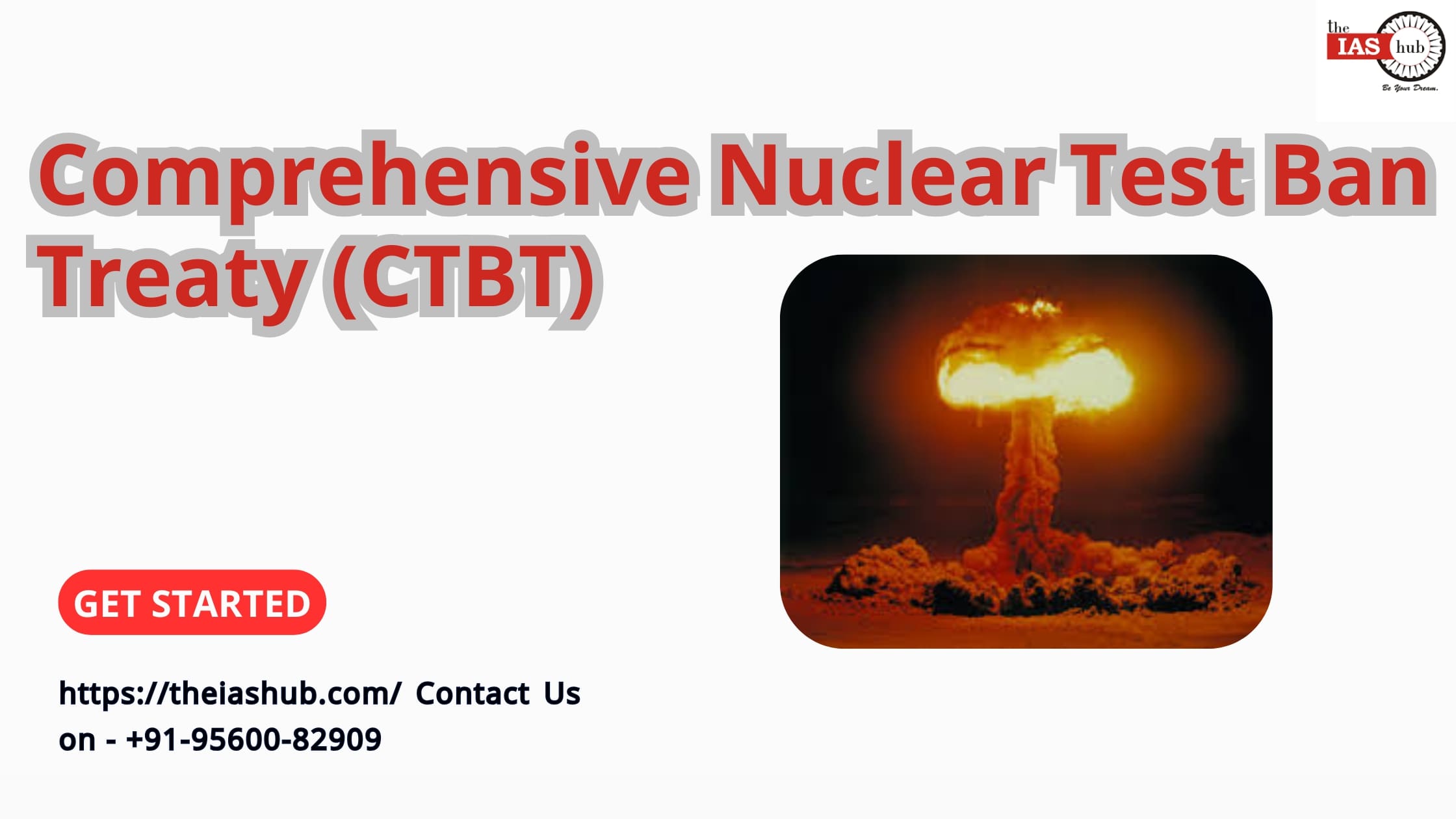


Comprehensive Nuclear Test Ban Treaty (CTBT) bans all nuclear test explosions, whether for military or civilian purposes. The Treaty was opened for signature in 1996 to stop the development of new nuclear weapons and prevent upgrades to existing ones, supporting global efforts in non-proliferation and disarmament. The treaty was opened for signature in September 1996, and has been signed by 187 nations and ratified by 178.
Comprehensive Nuclear Test Ban Treaty (CTBT) is a multilateral treaty to ban nuclear weapons test explosions and any other nuclear explosions, for both civilian and military purposes, in all environments. It was adopted by the United Nations General Assembly on 10 September 1996, but has not entered into force, as nine specific nations have not ratified the treaty.The treaty requires ratification by 44 specific states listed in Annex 2, which had nuclear capabilities at the time of negotiation. Eight of these—China, Egypt, India, Iran, Israel, North Korea, Pakistan, and the United States—have not ratified, and India, North Korea, and Pakistan have not signed. Russia ratified in 2000 but withdrew its ratification in 2023.
Comprehensive Nuclear Test Ban Treaty (CTBT), adopted in 1996, aims to ban all nuclear explosions globally to promote non-proliferation, disarmament, environmental protection, and international security. Here brief overview of CTBT:
| Aspect | Details |
| Full Name | Comprehensive Nuclear-Test-Ban Treaty |
| Adopted | September 10, 1996 (UN General Assembly) |
| Objective | Bans all nuclear explosions (military or civilian) in all environments |
| Key Goals | Non-proliferation, Nuclear disarmament, Environmental protection, Global security |
| Signatories | 187 states (as of 2025) |
| Ratifications | 178 states (as of 2025, Solomon Islands latest in January 2025) |
| Entry into Force | Not in force; requires ratification by all 44 Annex 2 states |
| Non-Signatories | India, North Korea, Pakistan ,recentlyRussia withdrawn(ratified 2000, withdrew ratification 2023) |
| Implementing Agency | Comprehensive Nuclear-Test-Ban Treaty Organization (CTBTO), Vienna |
Comprehensive Nuclear Test Ban Treaty (CTBT) has been signed by 187 countries and ratified by 178 countries as of the latest available data. The treaty, opened for signature on September 24, 1996, bans all nuclear explosions in any environment. However, it has not entered into force because nine specific countries listed in Annex 2 (out of 44 required) have not yet ratified it. Below is a breakdown of the member countries :
Comprehensive Nuclear Test Ban Treaty (CTBT) is an international agreement aimed at banning all nuclear explosions. Key provisions are given below:
International Monitoring System (337
seismic, hydroacoustic, infrasound, and
radionuclide stations).
Comprehensive Nuclear Test Ban Treaty (CTBT) came up with lofty objective to disarmament of the world to protect humanity key objective are given below:

Comprehensive Nuclear Test Ban Treaty (CTBTO) is a global institution headquartered in Vienna, Austria, created to enforce the Comprehensive Nuclear-Test-Ban Treaty (CTBT), which seeks to prohibit all nuclear detonations worldwide.Key roles of CTBTO:
CTBT has significantly advanced global peace initiatives by fostering cooperation among nations. Numerous countries have signed the treaty, with a substantial number ratifying it. The agreement prohibits the development of new nuclear weapons and prevents signatory states from upgrading existing nuclear arsenals.Key benefits of the nuclear testing ban include:
Comprehensive Nuclear Test Ban Treaty (CTBT), aimed at banning all nuclear explosions worldwide, faces several challenges that have prevented its full implementation and effectiveness :
In November 2023, Russia withdrew its ratification of the Comprehensive Nuclear Test Ban Treaty (CTBT), signed into law by President Putin. The move aimed to align with the U.S., which signed but never ratified the treaty. Russia cited an “imbalance” in obligations. Though symbolic, as Russia pledged to maintain a testing moratorium unless the U.S. tests, the withdrawal raised fears of weakening global arms control amid Ukraine tensions. The CTBT, banning nuclear test explosions, remains unratified by nine key states, preventing its enforcement.
India championed a prohibition on nuclear testing long before the CTBT was established.
In 1954, Prime Minister Jawaharlal Nehru was the first to propose an immediate “halt” to nuclear testing between the United States and the former Soviet Union.However, this proposal was undermined by nuclear-armed nations, who argued that creating a reliable verification mechanism was challenging.
Following China’s 1964 nuclear test, India initiated discussions on the advantages and disadvantages of supporting a test ban and pursuing global nuclear disarmament.
Subsequent events, such as China’s development of ballistic missile capabilities and the United States’ efforts to pressure India during the 1971 War, further heightened India’s security concerns.
India’s refusal to sign the CTBT stems primarily from national security priorities.India considers nuclear weapons essential for deterring potential threats from neighboring countries, particularly Pakistan and China.India believes that endorsing the CTBT would compromise its national security and strategic independence by limiting its ability to conduct nuclear tests.India’s stance is grounded in it commitment to fair and comprehensive global nuclear disarmament.
The Comprehensive Nuclear Test Ban Treaty (CTBT) is vital in today’s global landscape. While nations often present it as a beacon of peace, the ongoing arms race underscores the need for robust safeguards. It is essential that all countries adhere to the CTBT’s requirements. Admittedly, obstacles exist, with nations like India pointing out issues of inequity. However, by resolving these challenges , suggestions given below:

CTBT was adopted by the United Nations General Assembly on September 10, 1996, and opened for signature on September 24, 1996.Treaty is not into force, it will enter into force 180 days after all 44 countries listed in Annex 2 (states with nuclear capabilities at the time of negotiation) ratify.
As of June 2025 According to CTBT 187 countries have signed and 177 countries have ratified.While most countries support the treaty, the holdout of the eight Annex 2 states delays its entry into force.
44 Annex 2 countries include states that participated in the 1996 negotiations and possessed nuclear reactors or research facilities. Eight of these have not ratified the treaty as of June 2025:Not signed: North Korea, India, Pakistan.Signed but not ratified: China, Egypt, Iran, Israel, United States.
Comprehensive Treaty Organization (CTBTO), based in Vienna, oversees the treaty’s verification regime, which is designed to detect any nuclear explosion.


Refine your answer writing skills and elevate your UPSC preparation with personalized support and expert feedback.
Fill out the form to get started with the program or any other enquiries !




Are you dreaming of becoming an IAS officer? Then, IAShub can be your best guide. It is one of the Best IAS Coaching in Delhi. Many students who want to clear the UPSC exam join IAShub for learning. The institute gives both online and offline classes. Their teachers are experienced and helpful. They easily explain every topic. Students also get notes, tests, and tips to do well in the exam.
IAShub is in Delhi and is trusted by many UPSC students. It offers coaching for every part of the UPSC exam – Prelims, Mains, and Interview. The classes are simple and easy to understand. The teachers are experts and guide students in the right way. IAShub is also known for its helpful notes, test series, and answer-writing practice. IAShub is the best coaching in Delhi and also gives UPSC Online Classes. This helps students from any place in India to learn. The online classes are live and also recorded. So, students can watch them anytime. These classes cover the full UPSC syllabus.
Here are some important services provided by IAShub:
The UPSC Civil Services Exam has three parts:
This exam is tough, but with the right guidance, it becomes easy to manage. Students must study smart and stay regular.
IAShub supports students from the beginning to the end. It gives the right books, tests, and notes. The classes are easy to follow, and the teachers are always ready to help. Students get personal doubt sessions too. The test series and answer checking help students learn where they need to do better. Also, free study materials save time and money.
IAShub also guides students during the final stage – the interview. Experts take mock interviews and give useful tips. This full support makes IAShub one of the best IAS coaching in Delhi.