Explore Chandigarh's history, polity, culture, and economic profile. Known for its modern architecture, green spaces, and administrative significance, the Union Territory is a symbol of India's urban planning and cultural fusion.
 theIAShub | 04 Jul, 2025 | 3770 | 0 |
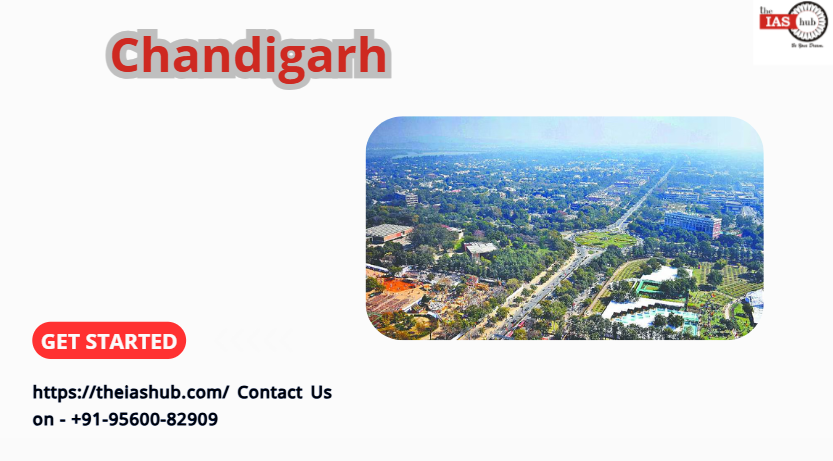

Chandigarh, a union territory and the capital of both Punjab and Haryana, is a well-planned city known for its modern architecture and urban design. Designed by the Swiss-French architect Le Corbusier, it stands as a symbol of post-independence India’s progressive vision. Covering an area of 114 square kilometers, Chandigarh is one of India’s smallest union territories. As per the 2011 Census, it has a population of over 1 million. The city serves as an administrative, cultural, and educational hub for the northern region.
Also Reads: Indian States and Their Capitals 2025
Chandigarh was conceived after India’s partition in 1947 when Lahore, the former capital of undivided Punjab, became part of Pakistan. The need for a new capital led to the creation of Chandigarh, with construction beginning in the 1950s. The city was officially inaugurated in 1953 and later declared a union territory in 1966 after the reorganization of Punjab.
Also Read: Union Territories of India List 2025 With Capitals

Image Credit: Maps of India
Also Read: Andhra Pradesh

Chandigarh is located in the northern plains, bordered by Punjab to the north, west, and south, and Haryana to the east. The city experiences a humid subtropical climate with hot summers, a monsoon season, and cool winters. The Shivalik Hills lie to the northeast, contributing to the region’s scenic beauty.
| Category | Details |
| Geographical Features | – Indo-Gangetic Plain (dominant landform) – Shivalik Hills (foothills of Himalayas in northeast) – River systems: Sutlej (~1,500 km, longest in Punjab), Beas, Ravi (~725 km, shortest major river), Chenab, Jhelum – Highest point: Pathankot district (Shivalik foothills, ~1,000 m) – Lowest point: Fazilka (near India-Pakistan border, ~180 m) – Soil: Fertile alluvial soil (world’s most extensive irrigation system) – Resources: Limited minerals but rich groundwater reserves |
| Climate Type | Semi-arid to Sub-tropical |
| Seasons | – Summer (Apr-Jun): Hot and dry (up to 45°C) – Monsoon (Jul-Sep): Moderate rainfall (SW monsoon) – Post-Monsoon (Oct-Nov): Pleasant with occasional showers – Winter (Dec-Feb): Cold (can drop to 0°C in some areas) |
| Climate Variation | – Northern foothills (Shivaliks): Cooler with moderate rainfall – Central plains: Extreme temperatures (hot summers, cold winters) – Southwestern regions (Malwa): Drier with less rainfall – Border areas (Fazilka, Ferozepur): Semi-arid conditions |
Also Read: Arunachal Pradesh
As per the 2011 Census, Punjab had a population of 27.7 million. The population density stands at 551 persons per square kilometer. The sex ratio is 895 females per 1000 males, below the national average.
| Category | Details |
| Population (2011 Census) | 1.055 million |
| Population Density | 9,252 persons/km² |
| Sex Ratio | 818 females per 1000 males |
| Literacy Rate | 86.05% (Male: 89.99%, Female: 81.19%) |
| Languages Spoken | – Hindi (official) – Punjabi – English |
Also Read: Chattisgarh

Each state has its own symbols. Following are the state symbols of Punjab:

| Symbol | Name |
| State Animal | Indian Grey Mongoose |
| State Bird | Indian Grey Hornbill |
| State Tree | Mango Tree |
| State Flower | Dhak (Flame of the Forest) |
These symbols reflect Chandigarh’s cultural heritage and ecological diversity.
Also Read: Assam

As a union territory, Chandigarh is administered directly by the Central Government of India, with an Administrator appointed by the President. It has its own legislature and is known for its efficient urban governance. The city is divided into sectors, each planned with residential, commercial, and recreational spaces.
| Category | Details |
| Union Territory Formation | November 1, 1966 (Punjab Reorganisation Act) |
| Administrator | Banwarilal Purohit (since August 31, 2021) |
| Chief Justice (High Court) | Hon’ble Justice Ravi Shankar Jha (since October 10, 2023) – High Court: Chandigarh (shared with Punjab and Haryana) |
| Legislature Type | Union Territory (No Legislative Assembly) |
| Lok Sabha Representation | 1 Member |
| Rajya Sabha Representation | N/A |
| Local Governance Units | Municipal Corporation |
Also Read: Bihar
Chandigarh reflects a cosmopolitan culture, blending Punjabi traditions with modern urban influences. The city hosts various cultural festivals, art exhibitions, and literary events. Key attractions include the Rock Garden, Sukhna Lake, and Capitol Complex, showcasing its architectural heritage.

| Category | Details |
| Classical Dance of Chandigarh | Kathak is prominent. |
| Folk Dances | – Bhangra (performed during festivals) – Giddha (women’s folk dance) |
| Theatre Art of Chandigarh | Chandigarh has a growing modern theatre scene. |
| Folk Music | Reflects the urban and cosmopolitan culture. |
| Festivals | – Rose Festival: Annual flower festival in February/March – Baisakhi: Celebrated with cultural programs – Diwali, Christmas, Eid widely celebrated |
| Arts and Crafts | Showcases modern and traditional crafts. |
| Architecture | Famous for Le Corbusier’s modernist designs. |
| Rock Garden | Unique sculpture garden made from industrial waste. |
| Sukhna Lake | Man-made lake and popular cultural spot. |
These reflect Chandigarh’s unique blend of modernity and tradition.
Chandigarh is known as “The City Beautiful” for its well-planned urban spaces and greenery.
| Category | Details |
| National Parks in Chandigarh | Chandigarh does not have any designated national parks. |
| Wildlife Sanctuaries | Sukhna Wildlife Sanctuary |
| Diversity | Key Features: Protects species like sambar deer, wild boar and peafowl. Located near Sukhna Lake. |
| Neighboring States and Boundaries | Punjab to the north, Haryana to the east and south. |
| Ramsar Sites in Chandigarh | Chandigarh does not have any Ramsar sites. |
| UNESCO World Heritage Sites | Chandigarh does not have any UNESCO World Heritage Sites. |
| Tiger Reserves in Chandigarh | Chandigarh does not have any tiger reserves. |
Key Points:
The economy of Chandigarh is primarily agrarian, with strong contributions from agriculture, food processing, and manufacturing, supported by a robust transport network.
| Category | Details |
| Key Sectors | Government Services: Major employer as UT capital |
| Information Technology: Growing IT park and startups | |
| Education: Premier institutions like PGI and Panjab University | |
| Healthcare: Advanced medical facilities | |
| Tourism: Architectural landmarks and gardens | |
| Major Projects | Chandigarh International Airport expansion |
| Rajiv Gandhi Chandigarh Technology Park Phase III | |
| Metro Rail Project (proposed) | |
| Smart City initiatives | |
| Economic Overview | GSDP for 2023-24: ₹0.45 lakh crore |
| Sector-wise Contribution (2023-24): | |
| – Services: 65% | |
| – Industry: 25% | |
| – Others: 10% | |
| Major Economic Centres | Industrial Area Phase I & II |
| IT Park | |
| Educational and Medical Hub | |
| Commercial markets in Sector 17 and 35 |
Key Points:
Chandigarh, with its rich historical legacy, cultural traditions, and economic initiatives, remains one of India’s significant states. the UT exemplifies a harmonious blend of heritage and progress. Understanding Chandigarh’s geography, polity, and social customs is essential for competitive exam aspirants and anyone seeking to learn about India’s regional diversity.

Chandigarh was India's first post-independence planned city, designed by Le Corbusier with a grid layout of organized sectors. Its systematic urban planning includes wide avenues, consistent architecture, and abundant green spaces. The city serves as a model of modern urban design in India.
Chandigarh features Le Corbusier's iconic brutalist concrete structures like the Capitol Complex (UNESCO site) and Open Hand Monument. Government buildings showcase innovative sun-breakers and ramps blending functionality with art. The city's museums and galleries reflect its unique architectural philosophy.
Chandigarh serves as the joint capital of Punjab and Haryana under a unique arrangement since the 1966 state reorganization. As a Union Territory, it hosts both state governments and their shared High Court. This neutral, well-planned city was ideal for shared administration.
The Rock Garden's recycled-art wonder and Sukhna Lake's waterscapes draw most visitors. Capitol Complex showcases architectural brilliance while Sector 17 plaza buzzes with activity. Asia's largest Rose Garden displays 1,600 varieties in bloom.
With 35% green cover, Chandigarh maintains parks in every sector and 30km of green belts. Strict tree protection laws and urban forestry make it India's cleanest city. Its tree-lined avenues create unique urban forests.

Refine your answer writing skills and elevate your UPSC preparation with personalized support and expert feedback.
Fill out the form to get started with the program or any other enquiries !
Are you dreaming of becoming an IAS officer? Then, IAShub can be your best guide. It is one of the Best IAS Coaching in Delhi. Many students who want to clear the UPSC exam join IAShub for learning. The institute gives both online and offline classes. Their teachers are experienced and helpful. They easily explain every topic. Students also get notes, tests, and tips to do well in the exam.
IAShub is in Delhi and is trusted by many UPSC students. It offers coaching for every part of the UPSC exam – Prelims, Mains, and Interview. The classes are simple and easy to understand. The teachers are experts and guide students in the right way. IAShub is also known for its helpful notes, test series, and answer-writing practice. IAShub is the best coaching in Delhi and also gives UPSC Online Classes. This helps students from any place in India to learn. The online classes are live and also recorded. So, students can watch them anytime. These classes cover the full UPSC syllabus.
Here are some important services provided by IAShub:
The UPSC Civil Services Exam has three parts:
This exam is tough, but with the right guidance, it becomes easy to manage. Students must study smart and stay regular.
IAShub supports students from the beginning to the end. It gives the right books, tests, and notes. The classes are easy to follow, and the teachers are always ready to help. Students get personal doubt sessions too. The test series and answer checking help students learn where they need to do better. Also, free study materials save time and money.
IAShub also guides students during the final stage – the interview. Experts take mock interviews and give useful tips. This full support makes IAShub one of the best IAS coaching in Delhi.