Explore the role of the Attorney General of India including Article 76, appointment, duties, qualifications, powers, and limitations. Check the complete Attorney General of India list from 1950 to present and know the current Attorney General of India
 theIAShub | 04 Jul, 2025 | 7747 | 0 |
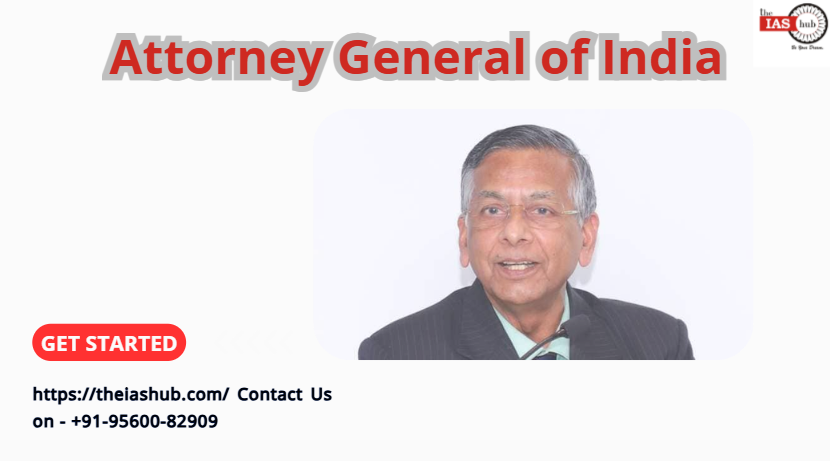


Attorney General of India is the highest law officer of the country, serving as the chief legal advisor to the Government of India and its primary representative in the Supreme Court and High Courts. Appointed by the President under Article 76 of the Indian Constitution. The Attorney General (AG) of India is a part of the Union Executive. The Attorney General of India is the highest law officer in the country.
Attorney General of India is the chief legal advisor to the Government of India and its primary lawyer in the Supreme Court of India. Appointed by the President of India under Article 76(1) of the Constitution, the Attorney General holds a constitutional post and serves at the pleasure of the President. The current Attorney General is R. Venkataramani, who assumed office on October 1, 2022, succeeding K.K. Venugopal.
Attorney General of India is the highest law officer of the country, appointed by the president under Article 76 of the Indian Constitution. Here is a brief overview of the Attorney General of India:
| Aspect | Details |
| Position | Chief legal advisor to the Government of India, primary advocate in the Supreme Court |
| Appointed by | President of India |
| Article | Article 76 of the Indian Constitution |
| Current Attorney General | R. Venkataramani (since Oct 1, 2022) |
| Eligibility | Indian citizen, qualified for Supreme Court Judge (5 yrs High Court judge/10 yrs advocate/eminent jurist) |
| Tenure | No fixed term; serves at the President’s pleasure |
| Privileges | Right of audience in all courts, parliamentary privileges (no voting) |
Shri R. Venkataramani is the current Attorney General of India, serving as the country’s top law officer. He assumed office on October 1, 2022, for a term of three years, appointed by the President of India under Article 76(1) of the Constitution.

President of India appoints an individual who meets the eligibility criteria for a Supreme Court Judge. The appointment is made based on the recommendation of the government. The qualifications include:
The Attorney General of India does not have a fixed term of office. The Constitution does not specify a duration for the role, nor does it outline a specific process or grounds for removal. Key terms are given below:
Constitution of India has provided detailed provisions related to Attorney General of India as given below:
| Articles | Description |
| Article 76 | Attorney-General for India
|
| Article 88 | Rights of Ministers and Attorney-General as to The Houses
Participation Rights: Every Minister and the Attorney-General of India shall have the right to:
Limitation: Neither Ministers nor the Attorney-General shall be entitled to vote in these proceedings by virtue of this provision. |
As a principal legal officer of the Government of India, the Attorney General (AG) undertakes the following responsibilities:
The President has entrusted the AG with these specific roles:

Constitution of India has provided the privileges to the Attorney General while performing his duty; further, it has also placed limitations for preserving Constitutionalism.
In executing their official responsibilities, the Attorney General is entitled to:
To prevent conflicts of interest or complications, the Attorney General is subject to the following constraints:
While performing his function Attorney General of India faces the following challenges as given below:
Since the inception of the Constitution, there have been 16 Attorney Generals of India. Here detailed list of all Attorney Generals of India gi
| Attorney General of India | Name of the Attorney General | Duration |
| 1st Attorney General | M.C. Setalvad 28 | 28 January 1950 – 1 March 1963 |
| 2nd Attorney General | C.K. Daftari | 2 March 1963 – 30 October 1968 |
| 3rd Attorney General | Niren de | 1 November 1968 – 31 March 1977 |
| 4th Attorney General | S.V. Gupte | 1 April 1977 – 8 August 1979 |
| 5th Attorney General | L.N. Sinha | 9 August 1979 – 8 August 1983 |
| 6th Attorney General | K. Parasaran | 9 August 1983 – 8 December 1989 |
| 7th Attorney General | Soli Sorabjee | 9 December 1989 – 2 December 1990 |
| 8th Attorney General | J. Ramaswamy | 3 December 1990 – November 23 1992 |
| 9th Attorney General | Milon K. Banerji | 21 November 1992 – 8 July 1996 |
| 10th Attorney General | Ashok Desai | 9 July 1996 – 6 April 1998 |
| 11th Attorney General | Soli Sorabjee | 7 April 1998 – 4 June 2004 |
| 12th Attorney General | Milon K. Banerjee | 5 June 2004 – 7 June 2009 |
| 13th Attorney General | Goolam Essaji Vahanvati | 8 June 2009 – 11 June 2014 |
| 14th Attorney General | Mukul Rohatgi | 12 June 2014 – 30 June 2017 |
| 15th Attorney General | K. Venugopal | 30 June 2017 – September 22, 2022 |
| 16th Attorney General | R. Venkataramani | since Oct 1, 2022, to till now |

AGI is the chief legal advisor to the Government of India and represents the Union Government in the Supreme Court and High Courts in critical cases.
Attorney General of India is appointed by the President of India under Article 76(1) of the Constitution.
The person must be qualified to be a Judge of the Supreme Court (i.e., must have been a judge of a High Court for 5 years or an advocate in a High Court for 10 years, or a distinguished jurist).
Attorney General of India must be qualified to be appointed as a Judge of the Supreme Court, meaning they should:
Be a citizen of India.
Have served as a Judge of a High Court for at least 5 years, or have been an advocate of a High Court for at least 10 years, or have been a distinguished jurist in the opinion of the President.
Yes, the AG is not barred from private legal practice and is not considered a government servant, which may raise concerns about potential conflicts of interest.
The AG has the right to appear and be heard in all courts in India.They can participate and speak in both Houses of Parliament, their joint sittings, or parliamentary committees (without voting rights). They enjoy the same privileges and immunities as a Member of Parliament.

Refine your answer writing skills and elevate your UPSC preparation with personalized support and expert feedback.
Fill out the form to get started with the program or any other enquiries !
Are you dreaming of becoming an IAS officer? Then, IAShub can be your best guide. It is one of the Best IAS Coaching in Delhi. Many students who want to clear the UPSC exam join IAShub for learning. The institute gives both online and offline classes. Their teachers are experienced and helpful. They easily explain every topic. Students also get notes, tests, and tips to do well in the exam.
IAShub is in Delhi and is trusted by many UPSC students. It offers coaching for every part of the UPSC exam – Prelims, Mains, and Interview. The classes are simple and easy to understand. The teachers are experts and guide students in the right way. IAShub is also known for its helpful notes, test series, and answer-writing practice. IAShub is the best coaching in Delhi and also gives UPSC Online Classes. This helps students from any place in India to learn. The online classes are live and also recorded. So, students can watch them anytime. These classes cover the full UPSC syllabus.
Here are some important services provided by IAShub:
The UPSC Civil Services Exam has three parts:
This exam is tough, but with the right guidance, it becomes easy to manage. Students must study smart and stay regular.
IAShub supports students from the beginning to the end. It gives the right books, tests, and notes. The classes are easy to follow, and the teachers are always ready to help. Students get personal doubt sessions too. The test series and answer checking help students learn where they need to do better. Also, free study materials save time and money.
IAShub also guides students during the final stage – the interview. Experts take mock interviews and give useful tips. This full support makes IAShub one of the best IAS coaching in Delhi.