Stubble Burning Issue In India: Impacts, Government Initiatives

Learn about the stubble burning issue in India, its environmental impacts, and government initiatives like CRM schemes, bio-decomposer usage, and sustainable solutions.

THEIASHUB

Stubble (parali) burning is a practice used to clear paddy crop residues from fields in preparation for sowing wheat, typically occurring from the last week of September to November, aligning with the end of the southwest monsoon. 
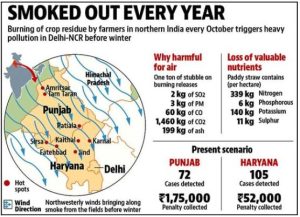
  • This process involves setting fire to the straw stubble left behind after harvesting crops like paddy and wheat.


Impacts Of Stubble Burning: Pollution, Soil Fertility, Heat Penetration

  • Pollution: Stubble burning emits toxic pollutants in the atmosphere containing harmful gases like Carbon Monoxide (CO), methane (CH4), carcinogenic polycyclic aromatic hydrocarbons, volatile organic compounds (VOC). 
  • Soil Fertility: Soil becomes less fertile and its nutrients are destroyed when the husk is burned on the ground.
  • Heat Penetration: Stubble burning generates heat that penetrates into the soil, causing an increase in erosion, loss of useful microbes and moisture. 
  • Water Quality Concerns: Ash and pollutants from burnt fields can contaminate water bodies, harming aquatic life and affecting ecosystems reliant on these water sources.
  • Reduced Biodiversity: The intense heat damages soil-dwelling organisms, reducing biodiversity and disrupting critical ecological processes.

Stubble Burning

WAY FORWARD

  • Mechanical Residue Management: Encourage the use of modern farm machinery like straw balers and choppers to process crop residues into mulch or bales, providing an eco-friendly alternative to burning.
  • Constructive Use of Stubble: Technologies like the Turbo-Happy Seeder Machine and Bio-Decomposer can facilitate these processes.
  • As Animal Feed (Fodder): Agricultural leftovers can be processed into animal feed, though rice stubble requires special treatment due to its high silica content. 
  • In southern India, ground rice husk is commonly fed to cattle.
  • Composting: Crop leftovers can be composted to produce nutrient-rich compost, enhancing soil fertility. 
  • Bran Oil and Ethanol Production: Rice straw can be converted into bran oil and bioethanol. While the conversion to ethanol is complex due to the high lignin content, it offers a renewable fuel source and reduces pollution from stubble burning.
  • Biogas Production: Rice straw can be converted into biogas, a renewable energy source, through anaerobic digestion, providing a sustainable alternative to fossil fuels and enriching soil with digestate.
  • Biofuel Production: Paddy straw can be processed into biofuels, reducing dependence on fossil fuels and offering an environmentally friendly energy source.
  • Chopping and Spreading Straw: Incorporating straw into the soil helps maintain soil health and fertility. Various machinery, such as the Happy Seeder, can assist in this process, promoting sustainable agriculture practices.


GOVERNMENT INITIATIVES

  • Subsidy for purchase of crop residue management machinery and establishment of custom hiring centres (CHCs) in NCT of Delhi and the States of Punjab, Haryana and Uttar Pradesh.
  •  Setting up of paddy straw based pelletization and Torrefaction plants which may help in addressing the supply chain issues and the issue of open burning of paddy straw in agriculture fields in Northern Region. 
  • In-situ and Ex-situ Crop Residue Management- Supported by CRM Scheme 
  • Commission on Air Quality Management: It aims at better coordination, research, identification, and resolution of problems related to air quality in NCR and adjoining areas.
  • National Policy for Management of Crop Residue: – In 2014, the Ministry of Agriculture developed the NPMCR to prevent agricultural residue burning and circulated the same to all the states/union territories.
  • Crop Residue Management Initiative: The CII Foundation’s Crop Residue Management initiative, launched in 2018, aims to reduce stubble burning in Punjab and promote sustainable agriculture.

Join theIAShub’s Mains Answer Writing Program

Refine your answer writing skills and elevate your UPSC preparation with personalized support and expert feedback.

Fill out the form to get started with the program or any other enquiries !

Let's Connect with Counselor

Best IAS Coaching In Delhi, UPSC Online & Offline Classes by IAShub

Are you dreaming of becoming an IAS officer? Then, IAShub can be your best guide. It is one of the Best IAS Coaching in Delhi. Many students who want to clear the UPSC exam join IAShub for learning. The institute gives both online and offline classes. Their teachers are experienced and helpful. They easily explain every topic. Students also get notes, tests, and tips to do well in the exam.

UPSC Online Classes by IAShub

IAShub is in Delhi and is trusted by many UPSC students. It offers coaching for every part of the UPSC exam – Prelims, Mains, and Interview. The classes are simple and easy to understand. The teachers are experts and guide students in the right way. IAShub is also known for its helpful notes, test series, and answer-writing practice. IAShub is the best coaching in Delhi and also gives UPSC Online Classes. This helps students from any place in India to learn. The online classes are live and also recorded. So, students can watch them anytime. These classes cover the full UPSC syllabus.

Key Offerings Provided by IAShub

Here are some important services provided by IAShub:

  • UPSC Prelims: IAShub teaches for Prelims with a focus on basics. It also gives daily current affairs and monthly magazines.
  • Classroom Courses: IAShub has classroom learning for students in Delhi. The environment is good and peaceful for study.
  • Live Classes: Students who live far can join live UPSC online classes. These classes are just like real classes.
  • QEP for Mains: The Quality Enrichment Program (QEP) is special for Mains preparation. It helps students write better and faster.
  • Answer Writing: Regular answer writing practice is given. Teachers also check answers and give tips to improve.
  • Free Resource: IAShub gives free notes by toppers and helpful Main Booster material.
  • Test Series: Test series are available for every subject. These help students know their weak points and improve.
  • Interview Guidance Session: IAShub also gives interview practice sessions with experts. These help students feel confident.

UPSC Exam Overview

The UPSC Civil Services Exam has three parts:

  • Prelims: It has two papers: General Studies and CSAT.
  • Mains: It has nine papers, including essays and optional subjects.
  • Interview: It tests the personality and confidence of the student.

This exam is tough, but with the right guidance, it becomes easy to manage. Students must study smart and stay regular.

How IAShub Helps in the UPSC Journey

IAShub supports students from the beginning to the end. It gives the right books, tests, and notes. The classes are easy to follow, and the teachers are always ready to help. Students get personal doubt sessions too. The test series and answer checking help students learn where they need to do better. Also, free study materials save time and money.
IAShub also guides students during the final stage – the interview. Experts take mock interviews and give useful tips. This full support makes IAShub one of the best IAS coaching in Delhi.

Best IAS Coaching In Delhi FAQs

Yes, IAShub offers live and recorded online classes. Students can attend from any part of India.

Classes are available in both English and Hindi, so students can choose the language they are comfortable with.

The classroom centre is located in Delhi. Students can visit and join offline batches there.

IAShub gives interview guidance sessions to help students prepare for the final round of UPSC.
Footer Image