
















The Punjab PCS exam 2025 syllabus provides a detailed breakdown of subjects for both Prelims and Mains, including General Studies, CSAT and Punjab-specific topics.
 theIAShub | 06 Aug, 2025 | 31419 | 0 |

The Punjab Public Service Commission (PPSC) conducts the Punjab PCS exam to recruit candidates for prestigious administrative positions in the state. Understanding the detailed syllabus is crucial for effective preparation. This article provides a comprehensive breakdown of the Punjab PCS syllabus for the 2025 examination, including subject-wise topics for Prelims and Mains.
The Punjab PCS exam comprises two stages: Prelims and Mains. Each stage assesses candidates’ knowledge, analytical abilities, and writing skills across a range of subjects. The Punjab PCS Prelims Exam 2025 is scheduled to take place on 26 October 2025, making it imperative for aspirants to familiarize themselves with the syllabus early for effective preparation.
The Prelims consist of objective-type questions, while the Mains emphasize essay-style answers across various papers. This structured approach evaluates candidates’ overall aptitude and suitability for administrative positions.
The Punjab PCS Preliminary Examination consists of two papers:
| Section | Topics |
| Everyday Science | States of matter, structure of atom, versatile nature of carbon. Acids, bases, salts, corrosion in metals, action of soaps. Life on Earth – evolution, marine & terrestrial life. Human body and life processes, nutrition, disease – its causes & prevention. |
| Infectious diseases, lifestyle diseases. Public health initiatives, mother and child health, immunisation & vaccination, AIDS, TB, polio etc. Force-laws of motion & gravitation, Archimedes principle. Energy – kinetic & potential. | |
| Light – reflection & refraction – concepts and applications. Sound – propagation & reflection – concepts and applications. Electric current – concepts and applications. Computers and telecommunication – concepts and applications. | |
| Environmental Studies | Composition and structure of the atmosphere. Solar system – heat balance & temperature. Atmospheric circulation & weather system, water cycle. Climate change – fossil fuels, greenhouse gases, renewable energy, clean development mechanism, carbon credits. |
| Water – oceans, rivers, glaciers, lakes, groundwater etc. Biodiversity & conservation. Soil – types, crops, food chain etc. Pollution and toxicity etc. | |
| Political Theory & International | Basic concepts of freedom, equality, social justice, rights & duties, citizenship, nationalism, secularism etc. United Nations and its organs/agencies, other international organisations like the World Bank, IMF, WTO, EU, G20, BRICS etc. |
| Order | Their role in World peace, trade & development. |
| Indian Polity | Basic features, provisions, schedules of the Indian Constitution, key amendments. Panchayati Raj. Elections – People’s Representation Act, electoral reforms. Rise of regionalism and coalition politics. Armed challenges to the Indian state since independence. |
| History of India/World History | The Indus Valley civilisation. The Aryan and the Vedic age. Jainism and Buddhism. The Maurya Gupta period. The advent of Islam and the Sultanate period (political, social & cultural). The Bhakti Movement. The Mughals (political, social & cultural till Aurangzeb). |
| The coming of the European Powers and the advent of British rule. The Mutiny of 1857. The British rule and the Indian National Movement (1857-1947). World History: The Renaissance and the Industrial Revolution in Europe. | |
| The American Revolution 1776. The French Revolution 1789. The Russian Revolution 1917. World Wars I & II. | |
| Indian Economy | Indian economic development (1950-1991) – key economic policies, public sector dominance, bank nationalisation etc. Five-year plans – key goals and main achievements. Liberalisation, privatisation and globalisation era since 1991 – key policies, decisions and results. |
| Performance of Indian economy since 1991 – Growth, fiscal & revenue deficits, trade, commerce & balance of payments, inflation, growth of service sector. Key challenges and responses – agriculture and food security, industrialisation, poverty alleviation & employment. | |
| Rural & urban infrastructure, social sector – health, education etc. | |
| Geography | Population – distribution, density, growth and comparison. Migration – types, causes and consequences. Human development. Human settlements. Land resources and agriculture. Water resources. Mineral and energy resources. Manufacturing industries. |
| Planning and sustainable development in India. Transport and communication. International trade. A geographical perspective on selected issues and problems. | |
| Current Events | National and international importance from any newspaper. |
| Punjab | Geography: Geographical and agro-climatic regions, rivers, water resources, sharing of waters, demographics, human development indices. People, Society and Culture: Major personalities in the history of Punjab, religious movements, major religions. |
| Spiritual personalities, Punjabi literature, folklore, performing arts, fine arts and crafts. History: Sufis, saints and gurus, Lodhis and Mughals, Sikh rulers, the British period, nationalist movement in Punjab, Punjab in independent India. | |
| Economy: Agriculture, animal husbandry, industrial & service sectors, major occupations, development & economic growth, public finance (including central-state fiscal issues), public sector institutions, cooperatives etc. |
Also Read: Punjab PCS Course 2025
[metaslider id=”5575″]
The Civil Services Aptitude Test (CSAT) is qualifying in nature, requiring candidates to score a minimum of 33% to qualify for the Mains exam. The punjab pcs CSAT syllabus focuses on assessing a candidate’s aptitude, logical reasoning, and numerical ability. It covers:
| Topic | Details |
| Reading Comprehension | Punjabi and English language comprehension; antonyms and synonyms; grammar and sentence formation. |
| Interpersonal Skills | Includes communication skills. |
| Logical Reasoning | Logical reasoning, analytical, and mental ability. |
| Basic Numerical Skills | Numbers, magnitudes, percentages, numerical relation appreciation. |
| Data Analysis | Graphic presentations, charts, tables, spreadsheets. |
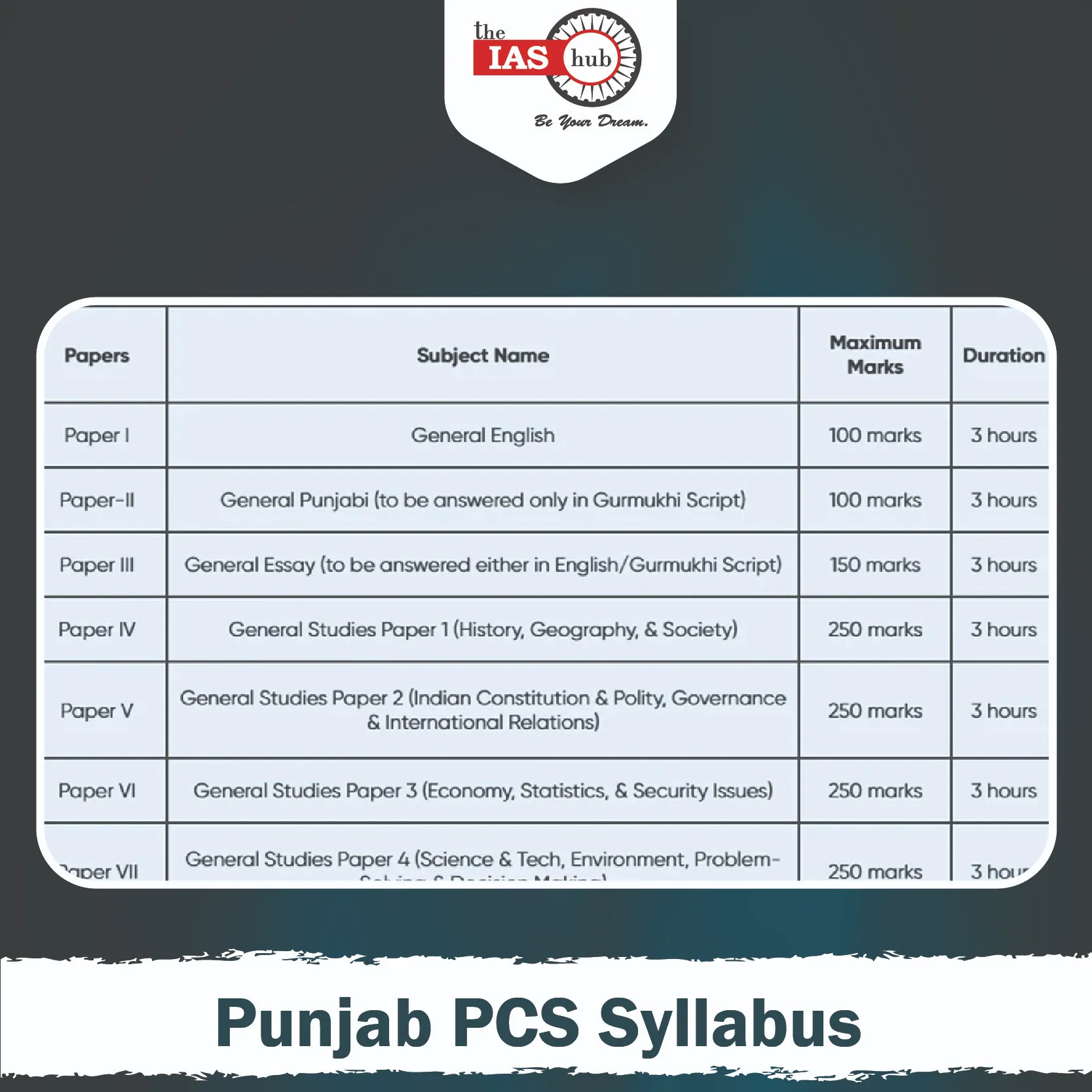
The Punjab PCS Mains Examination consists of descriptive papers covering various subjects. Below is the subject-wise syllabus:
| Paper | Syllabus |
| English Language Paper | Section A: Comprehension (Unseen Passage), Precis Writing, Letter Writing, Essay Writing, Translation Section B: Grammar |
| Punjabi Language Paper | Comprehension Passage Summary Writing Application or Letter Writing Essay Writing Translation Grammar |
| Essay Paper | Candidates must write three short essays in English or Punjabi on designated topics.
A selection of subjects will be provided. They are expected to adhere closely to the essay topic, organize their ideas logically, and write concisely. Marks will be awarded for the quality of content, clarity, and precision of expression. |
| General Studies Paper I | History: World history (18th century onwards), Indian culture, Modern Indian history, Socio-religious reform movements, Freedom Struggle, Post-independence consolidation, History of Punjab Geography: Physical Geography, Distribution of resources, Geophysical phenomena, Geography of Punjab Society: Features of Indian Society, Women & Women’s organizations, Globalization, Social empowerment, Human Values, Vulnerable sections, Social sector issues |
| General Studies Paper II | Indian Constitution & Polity: Evolution, features, amendments, federal structure, Parliament & State Legislatures, Executive and Judiciary structure, Constitutional bodies, District Administration Governance: Regulatory bodies, Government policies, e-Governance, Ethical concerns in governance, Accountability International Relations: India and its neighborhood, International institutions |
| General Studies Paper III | Indian Economy: Planning, mobilization of resources, growth, development, agriculture, subsidies, Food Security, Infrastructure, Human Resource Development, Punjab Economy Security Issues: Development and extremism, Cybersecurity, Security forces, Border security |
| General Studies Paper IV | Science & Technology: Developments in IT, Space, Nanotechnology, Biotechnology, Genetic Engineering, Immunity and Vaccination Environment: Environmental issues, Climate change, Water management, Natural Hazards, Risk reduction Problem Solving & Decision Making: Handling natural disasters, public protests, PSU reviving, education, urban issues, sanitation |
The detailed Punjab PCS syllabus for 2025 can be downloaded from the official website of the Punjab Public Service Commission (PPSC). A PDF version of the syllabus is usually available in the notifications section for easy access.
The Punjab PCS Prelims Exam includes two papers: General Studies and Civil Services Aptitude Test (CSAT). The General Studies paper covers topics such as everyday science, environmental studies, Indian polity, history, geography, and current events, with specific focus on Punjab-related topics.
Yes, the CSAT paper in the Punjab PCS Prelims is qualifying in nature. Candidates need to score at least 33% to pass this paper and proceed to the Mains exam. The CSAT evaluates candidates' reasoning ability, problem-solving skills, and basic mathematical aptitude.
The Punjab PCS Mains syllabus includes several descriptive papers. These papers cover English and Punjabi language proficiency, essay writing, and general studies.

Refine your answer writing skills and elevate your UPSC preparation with personalized support and expert feedback.
Fill out the form to get started with the program or any other enquiries !



Are you dreaming of becoming an IAS officer? Then, IAShub can be your best guide. It is one of the Best IAS Coaching in Delhi. Many students who want to clear the UPSC exam join IAShub for learning. The institute gives both online and offline classes. Their teachers are experienced and helpful. They easily explain every topic. Students also get notes, tests, and tips to do well in the exam.
IAShub is in Delhi and is trusted by many UPSC students. It offers coaching for every part of the UPSC exam – Prelims, Mains, and Interview. The classes are simple and easy to understand. The teachers are experts and guide students in the right way. IAShub is also known for its helpful notes, test series, and answer-writing practice. IAShub is the best coaching in Delhi and also gives UPSC Online Classes. This helps students from any place in India to learn. The online classes are live and also recorded. So, students can watch them anytime. These classes cover the full UPSC syllabus.
Here are some important services provided by IAShub:
The UPSC Civil Services Exam has three parts:
This exam is tough, but with the right guidance, it becomes easy to manage. Students must study smart and stay regular.
IAShub supports students from the beginning to the end. It gives the right books, tests, and notes. The classes are easy to follow, and the teachers are always ready to help. Students get personal doubt sessions too. The test series and answer checking help students learn where they need to do better. Also, free study materials save time and money.
IAShub also guides students during the final stage – the interview. Experts take mock interviews and give useful tips. This full support makes IAShub one of the best IAS coaching in Delhi.

Join 50,000+ UPSC Aspirants! 🚀
Get Free UPSC/IAS Study Materials, Daily Current Affairs, Editorial Summaries & Exam Updates.
Join Telegram Channel