Nuclear Waste In India: Impact, Challenges, Nuclear Energy Programme

Explore the challenges and impact of nuclear waste in India, including radioactive contamination, management issues, and the role of nuclear energy programs.

THEIASHUB

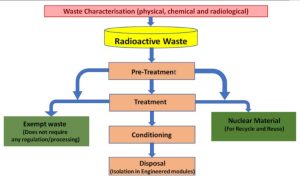
Nuclear waste consists of radioactive atoms produced as a byproduct when large atoms split. This waste is generated during the operation of nuclear reactors. 
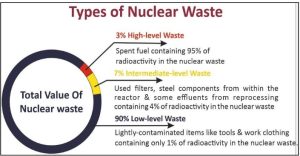
  • When a nuclear fuel nucleus breaks into two within a reactor, it releases nuclear energy. The primary component of nuclear waste is the smaller nuclei left behind, known as fission products. 

Nuclear waste

Impact Of Nuclear Waste: Long-Term Radioactivity, Groundwater Pollution

  • Long-Term Radioactivity and environmental degradation: Nuclear waste contains radioactive materials that can remain hazardous for thousands of years, leading to long-term environmental contamination.
  • Example: The 1986 Chernobyl disaster resulted in radioactive waste contaminating land, air, and water across Europe, creating an exclusion zone that remains uninhabitable.
  • Exposure to Radiation & Health impacts: Improper management of nuclear waste can lead to exposure to harmful radiation, increasing the risk of cancers, genetic mutations and other health issues.
  • Example: The 2011 Fukushima disaster in Japan illustrates the catastrophic consequences of nuclear waste leaks.
  • Groundwater Pollution: Radioactive isotopes from nuclear waste can leach into groundwater, affecting water supplies and ecosystems.
  • Impact on Local Communities: Communities near nuclear waste disposal sites often face social and ethical dilemmas regarding their safety and future.
  • Economic Impacts: Including transportation, storage, and long-term monitoring, decline in property values due to the stigma associated with radioactive contamination and costly clean-up efforts, legal liabilities, and loss of economic activity in affected regions.

Challenges In Managing Nuclear Waste: Spent Fuel, Long-Term Storage, Accident Hazards

  • Spent Fuel: It is highly radioactive and generates significant heat, necessitating underwater storage for several decades to allow cooling.
  • Long-Term Storage: After cooling, spent fuel is transferred to dry casks for extended storage. Countries with nuclear power programs have substantial amounts of spent fuel.
  • As of recent years, the U.S. had 69,682 tonnes of spent fuel (2015), Canada 54,000 tonnes (2016), and Russia 21,362 tonnes (2014).
  • Liquid Waste Facilities: Nuclear power plants process liquid waste, with small quantities of aqueous wastes containing short-lived radionuclides being released after treatment.
  • Japan is currently discharging treated liquid waste from the Fukushima nuclear plant into the Pacific Ocean.
  • Accident Hazards: The storage of liquid waste poses potential accident hazards, a concern noted by Dr. Ramana regarding India’s handling of nuclear waste.
  • Capacity Issues: The IPFM report highlighted operational delays at Tarapur and Kalpakkam facilities, with a combined average capacity factor of around 15%.

WAY FORWARD

  • Separation Process: Reprocessing involves chemically treating spent fuel to separate fissile material from non-fissile material. This method increases fuel efficiency but requires specialized facilities and personnel.
  • Example: India operates reprocessing plants in Trombay, Tarapur, and Kalpakkam. 
  • Long-Term Storage: Geological disposal involves sealing the waste in special containers and burying it underground in granite or clay, providing long-term storage away from human activity.
  • International Collaboration: Collaborating with international organizations and sharing best practices can provide valuable insights and expertise in addressing nuclear waste challenges.
  • Public Engagement: Engaging with stakeholders and the public to raise awareness about nuclear waste management and address concerns regarding safety and environmental impact is crucial.

Nuclear waste

  • Recycling Nuclear Waste: Spent nuclear fuel, which is over 90% uranium, can be chemically processed to close the fuel cycle, significantly reducing waste and increasing energy extraction from the raw ore.
  • France currently recycles their spent fuel.


PYQ

  1. With growing energy needs should India keep on expanding its nuclear energy programme? Discuss the facts and fears associated with nuclear energy (2018)
  2. Give an account of the growth and development of nuclear science and technology in India. What is the advantage of the fast breeder reactor programme in India? (2017)

Are you preparing for UPSC 2025? Join IAShub’s UPSC coaching batches to boost your preparation. Enroll now!
Join theIAShub’s Mains Answer Writing Program

Refine your answer writing skills and elevate your UPSC preparation with personalized support and expert feedback.

Fill out the form to get started with the program or any other enquiries !

Let's Connect with Counselor

Best IAS Coaching In Delhi, UPSC Online & Offline Classes by IAShub

Are you dreaming of becoming an IAS officer? Then, IAShub can be your best guide. It is one of the Best IAS Coaching in Delhi. Many students who want to clear the UPSC exam join IAShub for learning. The institute gives both online and offline classes. Their teachers are experienced and helpful. They easily explain every topic. Students also get notes, tests, and tips to do well in the exam.

UPSC Online Classes by IAShub

IAShub is in Delhi and is trusted by many UPSC students. It offers coaching for every part of the UPSC exam – Prelims, Mains, and Interview. The classes are simple and easy to understand. The teachers are experts and guide students in the right way. IAShub is also known for its helpful notes, test series, and answer-writing practice. IAShub is the best coaching in Delhi and also gives UPSC Online Classes. This helps students from any place in India to learn. The online classes are live and also recorded. So, students can watch them anytime. These classes cover the full UPSC syllabus.

Key Offerings Provided by IAShub

Here are some important services provided by IAShub:

  • UPSC Prelims: IAShub teaches for Prelims with a focus on basics. It also gives daily current affairs and monthly magazines.
  • Classroom Courses: IAShub has classroom learning for students in Delhi. The environment is good and peaceful for study.
  • Live Classes: Students who live far can join live UPSC online classes. These classes are just like real classes.
  • QEP for Mains: The Quality Enrichment Program (QEP) is special for Mains preparation. It helps students write better and faster.
  • Answer Writing: Regular answer writing practice is given. Teachers also check answers and give tips to improve.
  • Free Resource: IAShub gives free notes by toppers and helpful Main Booster material.
  • Test Series: Test series are available for every subject. These help students know their weak points and improve.
  • Interview Guidance Session: IAShub also gives interview practice sessions with experts. These help students feel confident.

UPSC Exam Overview

The UPSC Civil Services Exam has three parts:

  • Prelims: It has two papers: General Studies and CSAT.
  • Mains: It has nine papers, including essays and optional subjects.
  • Interview: It tests the personality and confidence of the student.

This exam is tough, but with the right guidance, it becomes easy to manage. Students must study smart and stay regular.

How IAShub Helps in the UPSC Journey

IAShub supports students from the beginning to the end. It gives the right books, tests, and notes. The classes are easy to follow, and the teachers are always ready to help. Students get personal doubt sessions too. The test series and answer checking help students learn where they need to do better. Also, free study materials save time and money.
IAShub also guides students during the final stage – the interview. Experts take mock interviews and give useful tips. This full support makes IAShub one of the best IAS coaching in Delhi.

Best IAS Coaching In Delhi FAQs

Yes, IAShub offers live and recorded online classes. Students can attend from any part of India.

Classes are available in both English and Hindi, so students can choose the language they are comfortable with.

The classroom centre is located in Delhi. Students can visit and join offline batches there.

IAShub gives interview guidance sessions to help students prepare for the final round of UPSC.
Footer Image