
















Glaciers & Climate Change: Impact, Policy Measures, Adaptation strategies

Explore the link between glaciers and climate change, their melting impacts, adaptation strategies, and global efforts to protect these fragile ecosystems.

THEIASHUB

The Intergovernmental Panel on Climate Change (IPCC) reports that glaciers worldwide have lost approximately 9000 billion metric tons of ice since the early 20th century. This has contributed significantly to the observed rise in sea levels which have increased by an average of 15-20 centimeters. 

Importance: Glaciers, sculpted over millennia, hold valuable information about past climates and offer insights into our planet’s future. However, rising temperatures are rapidly melting these icy giants, impacting water resources, sea-level rise, and ecological balance.
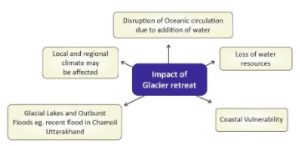
 

Climate Change And Its Impact On Glaciers: Global Warming, Acceleration of Glacier Melting

  • Global warming: Climate change leads to global warming, causing increased temperatures and altering precipitation patterns, which contribute directly to the glacial retreat.
  • Acceleration of glacier melting: Rising temperatures accelerate glacier melting, leading to retreat, thinning, and loss of ice mass.


Glacier Tourism And Its Environmental Implications: Activities, Consequences 

  • Activities: Glacier tourism involves activities like hiking, mountaineering, and skiing in glacier-covered regions.
  • Consequences:
    High visitor numbers and infrastructure development can have detrimental effects on fragile glacial ecosystems, causing habitat disruption and pollution.
    Climate change impacts, such as glacier retreat, pose a threat to the future of glacier tourism.

Glaciers

  • Example: The Swiss Alps, known for their scenic glaciers, attract millions of tourists each year, contributing to the local economy but also exerting pressure on the environment.

CURRENT CONNECT

How Venezuela Lost Its Last Glacier?

  • Venezuela has likely become the first country to lose all its glaciers, with its last Humboldt glacier melting faster than anticipated. Although scientists predicted it would last another decade, the rapid melting has surpassed expectations.
  • Venezuela was home to six glaciers located about 5,000 meters above sea level in the Andes mountains.
  • By 2011, five of these glaciers had already disappeared. The Humboldt glacier was expected to last another decade.

Why are Glaciers Disappearing?

  • Greenhouse Gas Emissions: The burning of fossil fuels since the Industrial Revolution has released large amounts of greenhouse gases (GHGs) like carbon dioxide and methane into the atmosphere.
  • Heat Trapping: These GHG gases act as a blanket, trapping heat in the atmosphere. While they allow sunlight to pass through, they prevent the heat from escaping back into space, leading to a rise in global temperatures.
  • The global average temperature has increased by at least 1.1 degrees Celsius since 1880 due to the skyrocketing emissions of GHGs in recent decades.
  • Consequences of Temperature Rise: The temperature rise has resulted in devastating consequences such as more frequent and intense heat waves, floods, droughts, and a rise in sea levels.
  • Accelerated Melting: Glaciers, like ice cubes exposed to heat, are melting at accelerated rates due to the warmer temperatures caused by global warming.
  • Natural Climate Phenomena: Natural climate phenomena like El Nino can exacerbate glacier melting by causing abnormal warming of surface waters, as observed in the case of the Humboldt glacier in Venezuela.

Adaptation Strategies for Glacier-Dependent Communities: Strategies, Example

Glacier-dependent communities need to adapt to the changing conditions and reduced glacial resources.

  • Strategies: Strategies may include: Water conservation, diversification of livelihoods, improving water storage and management, promoting sustainable practices.
  • Engaging local communities in decision-making and providing them with necessary resources and support is also crucial.
  • Example: In the Peruvian Andes, communities are implementing water storage systems, terracing for agriculture, and sustainable tourism initiatives to adapt to glacial retreat.

Policy measures for mitigating climate change and preserving glaciers: Reducing greenhouse gas emissions, Implementing policies

Policymakers need to prioritize climate change mitigation by 

  • Reducing greenhouse gas emissions and transitioning to renewable energy sources.
  • Implementing policies:  to protect and preserve glacier ecosystems, including establishing protected areas and regulating tourism activities.
  • Investing in research, technology, and infrastructure to promote sustainable practices and resilience in glacier-dependent regions.
  • Example: The Swiss government has implemented strict regulations on tourism, waste management, and emissions to protect its glaciers and mitigate climate change.
                                                                          Case studies/ Example

  • People in Ladakh are implementing innovative adaptation strategies to cope with glacier retreat, including constructing artificial glaciers (Ice Stupas).


Conclusion 

Climate change intertwines with the fate of glaciers, showcasing the delicate relationship between human activities and Earth’s ecosystems. Preserving dwindling ice formations requires innovative solutions and collective action. By forging sustainable paths and nurturing resilient societies, we navigate ecological challenges and safeguard our planet’s fragile equilibrium.

Are you preparing for UPSC 2025? Join IAShub’s UPSC coaching batches to boost your preparation. Enroll now!


Join theIAShub’s Mains Answer Writing Program

Refine your answer writing skills and elevate your UPSC preparation with personalized support and expert feedback.

Fill out the form to get started with the program or any other enquiries !

Let's Connect with Counselor

Best IAS Coaching In Delhi, UPSC Online & Offline Classes by IAShub

Are you dreaming of becoming an IAS officer? Then, IAShub can be your best guide. It is one of the Best IAS Coaching in Delhi. Many students who want to clear the UPSC exam join IAShub for learning. The institute gives both online and offline classes. Their teachers are experienced and helpful. They easily explain every topic. Students also get notes, tests, and tips to do well in the exam.

UPSC Online Classes by IAShub

IAShub is in Delhi and is trusted by many UPSC students. It offers coaching for every part of the UPSC exam – Prelims, Mains, and Interview. The classes are simple and easy to understand. The teachers are experts and guide students in the right way. IAShub is also known for its helpful notes, test series, and answer-writing practice. IAShub is the best coaching in Delhi and also gives UPSC Online Classes. This helps students from any place in India to learn. The online classes are live and also recorded. So, students can watch them anytime. These classes cover the full UPSC syllabus.

Key Offerings Provided by IAShub

Here are some important services provided by IAShub:

  • UPSC Prelims: IAShub teaches for Prelims with a focus on basics. It also gives daily current affairs and monthly magazines.
  • Classroom Courses: IAShub has classroom learning for students in Delhi. The environment is good and peaceful for study.
  • Live Classes: Students who live far can join live UPSC online classes. These classes are just like real classes.
  • QEP for Mains: The Quality Enrichment Program (QEP) is special for Mains preparation. It helps students write better and faster.
  • Answer Writing: Regular answer writing practice is given. Teachers also check answers and give tips to improve.
  • Free Resource: IAShub gives free notes by toppers and helpful Main Booster material.
  • Test Series: Test series are available for every subject. These help students know their weak points and improve.
  • Interview Guidance Session: IAShub also gives interview practice sessions with experts. These help students feel confident.

UPSC Exam Overview

The UPSC Civil Services Exam has three parts:

  • Prelims: It has two papers: General Studies and CSAT.
  • Mains: It has nine papers, including essays and optional subjects.
  • Interview: It tests the personality and confidence of the student.

This exam is tough, but with the right guidance, it becomes easy to manage. Students must study smart and stay regular.

How IAShub Helps in the UPSC Journey

IAShub supports students from the beginning to the end. It gives the right books, tests, and notes. The classes are easy to follow, and the teachers are always ready to help. Students get personal doubt sessions too. The test series and answer checking help students learn where they need to do better. Also, free study materials save time and money.
IAShub also guides students during the final stage – the interview. Experts take mock interviews and give useful tips. This full support makes IAShub one of the best IAS coaching in Delhi.

Best IAS Coaching In Delhi FAQs

Yes, IAShub offers live and recorded online classes. Students can attend from any part of India.

Classes are available in both English and Hindi, so students can choose the language they are comfortable with.

The classroom centre is located in Delhi. Students can visit and join offline batches there.

IAShub gives interview guidance sessions to help students prepare for the final round of UPSC.
Footer Image

