Greenhouse Gas Effect, Global Warming, Climate Change, Adaptation And Mitigation

Understand the greenhouse gas effect, global warming, and climate change, including impacts, adaptation and mitigation strategies, and India's initiatives.

THEIASHUB

The greenhouse gas effect is a natural process where certain gases in Earth’s atmosphere trap heat from the sun, maintaining the planet’s warm, habitable temperature. 
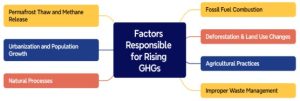
  • However, human activities, notably the burning of fossil fuels and deforestation, have significantly increased concentrations of greenhouse gases like carbon dioxide and methane. 

Greenhouse Gas Effect

  • This enhanced greenhouse effect is causing the Earth’s average temperature to rise, a phenomenon known as global warming.


Global Warming: Natural Causes, Anthropogenic Causes

  • Global warming refers to the long-term increase in the Earth’s average temperature. While this warming trend has been ongoing for an extended period, its rate has notably accelerated over the past century due to the burning of fossil fuels.
  • This term is not interchangeable with the term “climate change.”


Natural Causes of Greenhouse Gas Effect and Global Warming

Anthropogenic Causes of Greenhouse Gas Effect and Global Warming

  • Volcanic Eruptions: While relatively small contributors compared to anthropogenic sources, volcanoes can release large quantities of greenhouse gases, such as CO2 and sulfur dioxide, into the atmosphere.
  • Release of Methane from Wetlands and Other Natural Processes: Natural processes in wetland ecosystems, the digestive processes of certain termites and ruminants, and the release of methane from hydrates in ocean sediments contribute to greenhouse gas emissions.
  • Changes in Solar Radiation: Variations in solar energy received by the Earth can influence our planet’s climate. However, the current trend of global warming cannot be explained by solar changes alone, and the impact of increased greenhouse gas concentrations is much more significant.
  • Natural Carbon Dioxide Sources: Natural CO2 sources include respiration from plants and animals, decay of organic matter, wildfires, and release from the oceans.
  • Burning of Fossil Fuels: The combustion of coal, oil, and natural gas for electricity, heat, and transportation is the largest single source of global greenhouse gas emissions. This process releases carbon dioxide (CO2) and other pollutants into the atmosphere, enhancing the greenhouse effect.
  • Deforestation and Land Use Changes: Trees absorb CO2, reducing its concentration in the atmosphere. However, when forests are cut down for agriculture or logging and the wood is burned or decomposes, that stored CO2 is released back into the atmosphere, contributing to global warming.
  • Industrial Processes: Certain industries like cement production, steel making, and chemical production release significant amounts of CO2 and other greenhouse gases. 
  • Waste Management: Organic waste in landfills decomposes to produce methane, a potent greenhouse gas. Inefficient waste treatment and disposal processes can thus contribute significantly to global warming.


Impact Of Global Warming: Rising Global Surface Temperature, Rising Ocean, Health Risks

  • Rising Global Surface Temperature: The global surface temperature has been increasing, with the last decade (2011-2020) being the warmest on record. 
  • Rising Ocean: The ocean absorbs most of the heat from global warming, with an increased warming rate over the past two decades.
  • Warming oceans and melting ice sheets are causing sea levels to rise, threatening coastal communities.
  • Impact on Agriculture: Changes in temperature and precipitation patterns reduce crop yields, potentially driving up food prices🡺threat to food security and increasing poverty.
  • Habitat Disruption and Extinction: Disruption of habitats such as coral reefs and alpine meadows could drive many plant and animal species to extinction.
  • Health Risks: Increased temperatures and extreme weather events exacerbate health issues, particularly affecting vulnerable groups like children and the elderly.
  • Loss of Species: Rising temperatures and climate change threaten species on land and in the ocean, with a rate of species loss 1,000 times greater than historical norms.
  • Forest Fires: Higher temperatures and prolonged dry conditions increase the frequency and intensity of forest fires, damaging ecosystems and contributing to further warming.


WAY FORWARD

  • Transition to Renewable Energy: Shift from fossil fuels to renewable energy sources such as solar, wind, and hydropower to reduce greenhouse gas emissions.
  • Enhance Energy Efficiency: Implement energy-efficient technologies and practices in industries, transportation, and residential sectors to lower energy consumption.
  • Promote Sustainable Agriculture: Adopt sustainable farming practices, reduce methane emissions from livestock, and increase carbon sequestration through soil management.
  • Strengthen Climate Policies: Enforce stricter climate regulations, set ambitious emission reduction targets, and support international climate agreements.
  • Encourage Innovation and Research: Fund research and development of new technologies and solutions for mitigating and adapting to climate change impacts.


Adaptation And Mitigation: Definition, Objective


ASPECTS ADAPTATION MITIGATION
Definition Anticipating and taking appropriate actions to prevent or minimize the damage caused by the adverse effects of climate change or to take advantage of potential opportunities. Preventing or reducing greenhouse gas (GHG) emissions to lessen the severity of climate change impacts.
Objective To adjust to the current and future effects of climate change by implementing measures to reduce harm or capitalize on benefits. To reduce the sources of GHG emissions and enhance natural sinks to mitigate the severity of climate change.
Examples Large-scale infrastructure changes, such as building defenses against sea-level rise. Increasing the share of renewable energies.

  • Establishing cleaner mobility systems.
  • Enhancing forest size for carbon storage.
Focus Adjusting to and managing the impacts of climate change. Reducing the causes of climate change through emission control and enhancement of natural sinks.


GLOBAL INITIATIVES

  • United Nations Framework Convention on Climate Change (UNFCCC): The UNFCCC commits member governments to lower atmospheric concentrations of greenhouse gases to prevent dangerous human-caused climate impacts.
  • Paris Agreement: It aims to keep the global temperature rise below 2 degrees Celsius, with efforts to limit it to 1.5 degrees Celsius above pre-industrial levels.
  • International Carbon Action Partnership (ICAP): Established in 2007, ICAP serves as a platform for governments to discuss cap and trade systems for GHG reduction.
  • Montreal Protocol (1989): It is a global agreement to protect the stratospheric ozone layer by phasing out the production and consumption of ozone-depleting substances (ODS).
  • Kigali Agreement: It is an international treaty that aims to phase down the production and consumption of HFCs.

INDIA’S INITIATIVES

  • GRIHA – Green Rating for Integrated Habitat Assessment: Conceived by TERI (The Energy & Resources Institute), a rating tool to assess the ecological impact of buildings against nationally acceptable benchmarks.
  • National Initiative on Climate Resilient Agriculture (NICRA): Launched by ICAR in 2010-2011 to enhance resilience of crops, livestock, and fisheries through production and risk management.
  • Greenex: The first green equity index in India, focusing on energy efficiency and sustainability of firms.
  • Mission LiFE: An India-led global movement aimed at encouraging individual and collective action for environmental protection.
  • National Adaptation Fund for Climate Change (NAFCC): It aims to support concrete adaptation activities that reduce the adverse effects of climate change.
  • FAME India Scheme: To promote electric and hybrid vehicle technology, supporting sustainable growth.
  • Green Bonds: India is the second-largest emerging green bond market, issuing bonds to finance 100% green projects, with significant issues by entities like IREDA and SBI.

CURRENT CONNECT

Unprecedented Surge in Greenhouse Gas Levels

  • Recently, the United Nations issued a warning highlighting the unprecedented surge in greenhouse gas concentrations in the atmosphere, setting new records in 2022.
  • UN’s World Meteorological Organization (WMO)’s 19th Annual Greenhouse Gas Bulletin outlines the concerning implications, foreseeing heightened temperatures, intensified extreme weather events, and elevated sea levels as a consequence.

Adaptation Gap Report, 2023: According to the latest Adaptation Gap Report, 2023 by the UN Environment Programme, developing countries collectively require at least USD 215 billion annually this decade to undertake meaningful adaptation initiatives. In 2021, only about USD 21 billion was allocated to developing countries for adaptation projects, marking a decline of approximately 15% from previous years.

Key Highlights of the Adaptation Gap Report, 2023:

Adaptation Finance Gap:

  • The adaptation finance gap—the disparity between estimated adaptation financing needs and available finance—has widened over time.
  • This gap is now estimated to be 10-18 times greater than current international adaptation finance flows, at least 50% higher than previous estimates.
  • The current adaptation finance gap stands at USD 194-366 billion per year.

Gender Equality in Financing:

  • Only 2% of international public finance for adaptation that is tagged with gender equality as a principal objective is assessed as gender-responsive.
  • An additional 24% is considered gender-specific or integrative.

Are you preparing for UPSC 2025? Join IAShub’s UPSC coaching batches to boost your preparation. Enroll now!

PYQ

  1. ‘Climate Change’ is a global problem. How will India be affected by climate change? How Himalayan and coastal states of India are affected by climate change? (2017, 15 Marks)
  2. Discuss global warming and mention its effects on the global climate. Explain the control measures to bring down the level of greenhouse gases which cause global warming, in the light of the Kyoto Protocol, 1997. (2022, 15 Marks)

Join theIAShub’s Mains Answer Writing Program

Refine your answer writing skills and elevate your UPSC preparation with personalized support and expert feedback.

Fill out the form to get started with the program or any other enquiries !

Let's Connect with Counselor

Best IAS Coaching In Delhi, UPSC Online & Offline Classes by IAShub

Are you dreaming of becoming an IAS officer? Then, IAShub can be your best guide. It is one of the Best IAS Coaching in Delhi. Many students who want to clear the UPSC exam join IAShub for learning. The institute gives both online and offline classes. Their teachers are experienced and helpful. They easily explain every topic. Students also get notes, tests, and tips to do well in the exam.

UPSC Online Classes by IAShub

IAShub is in Delhi and is trusted by many UPSC students. It offers coaching for every part of the UPSC exam – Prelims, Mains, and Interview. The classes are simple and easy to understand. The teachers are experts and guide students in the right way. IAShub is also known for its helpful notes, test series, and answer-writing practice. IAShub is the best coaching in Delhi and also gives UPSC Online Classes. This helps students from any place in India to learn. The online classes are live and also recorded. So, students can watch them anytime. These classes cover the full UPSC syllabus.

Key Offerings Provided by IAShub

Here are some important services provided by IAShub:

  • UPSC Prelims: IAShub teaches for Prelims with a focus on basics. It also gives daily current affairs and monthly magazines.
  • Classroom Courses: IAShub has classroom learning for students in Delhi. The environment is good and peaceful for study.
  • Live Classes: Students who live far can join live UPSC online classes. These classes are just like real classes.
  • QEP for Mains: The Quality Enrichment Program (QEP) is special for Mains preparation. It helps students write better and faster.
  • Answer Writing: Regular answer writing practice is given. Teachers also check answers and give tips to improve.
  • Free Resource: IAShub gives free notes by toppers and helpful Main Booster material.
  • Test Series: Test series are available for every subject. These help students know their weak points and improve.
  • Interview Guidance Session: IAShub also gives interview practice sessions with experts. These help students feel confident.

UPSC Exam Overview

The UPSC Civil Services Exam has three parts:

  • Prelims: It has two papers: General Studies and CSAT.
  • Mains: It has nine papers, including essays and optional subjects.
  • Interview: It tests the personality and confidence of the student.

This exam is tough, but with the right guidance, it becomes easy to manage. Students must study smart and stay regular.

How IAShub Helps in the UPSC Journey

IAShub supports students from the beginning to the end. It gives the right books, tests, and notes. The classes are easy to follow, and the teachers are always ready to help. Students get personal doubt sessions too. The test series and answer checking help students learn where they need to do better. Also, free study materials save time and money.
IAShub also guides students during the final stage – the interview. Experts take mock interviews and give useful tips. This full support makes IAShub one of the best IAS coaching in Delhi.

Best IAS Coaching In Delhi FAQs

Yes, IAShub offers live and recorded online classes. Students can attend from any part of India.

Classes are available in both English and Hindi, so students can choose the language they are comfortable with.

The classroom centre is located in Delhi. Students can visit and join offline batches there.

IAShub gives interview guidance sessions to help students prepare for the final round of UPSC.
Footer Image