Explore the Treaty on Non-Proliferation of Nuclear Weapons (NPT): Know about NPT Full for, Its goals, member countries, key provisions, India's stance, present challenges, and the role of the IAEA. Learn how NPT shapes global disarmament and safeguards nuclear peace.
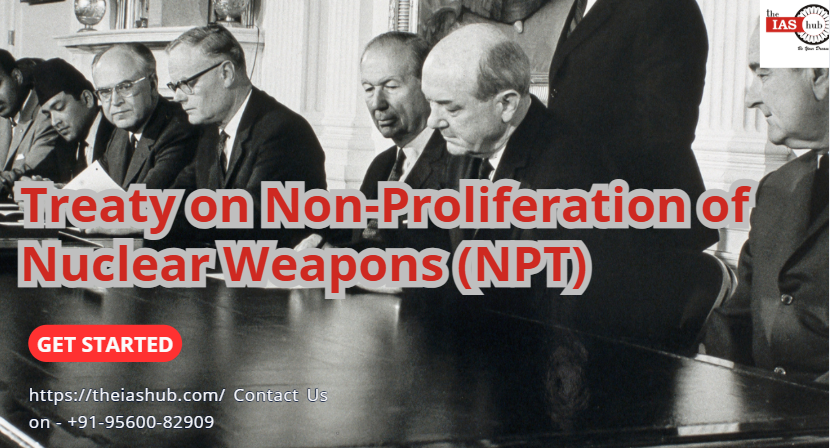
NPT is a landmark international treaty whose objective is to prevent the spread of nuclear weapons and weapons technology, to promote cooperation in the peaceful uses of nuclear energy and to further the goal of achieving nuclear disarmament and general and complete disarmament. The Treaty represents the only binding commitment in a multilateral treaty to the goal of disarmament by the nuclear-weapon States. Opened for signature in 1968, the Treaty entered into force in 1970. On 11 May 1995, the Treaty was extended indefinitely. A total of 191 States have joined the Treaty, including the five nuclear-weapon States. More countries have ratified the NPT than any other arms limitation and disarmament agreement, a testament to the Treaty’s significance.
What is the Treaty on Non-Proliferation of Nuclear Weapons (NPT)?
Treaty on the Non-proliferation of Nuclear Weapons (NPT) is an international legally binding agreement that seeks to halt the spread of nuclear weapons throughout the world.NPT categorizes nations as into Nuclear Weapons States (NWS) or Non-Nuclear Weapons States (NNWS). It calls on both NWS and NNWS to commit to three basic principles:
- Peaceful use of nuclear energy, and
- Arms control and disarmament.
NPT Full Form
NPT Full Form is Treaty on Non-Proliferation of Nuclear Weapons Signed in 1968 and entered into force in 1970, the international treaty is aimed at preventing the spread of nuclear weapons and technology, and promoting cooperation in the peaceful uses of nuclear energy, and future goal is complete disarmament.Brief overview of NPT given below:
| Aspect |
Details |
| Treaty Name |
Nuclear Non-Proliferation Treaty (NPT) |
| Date of Adoption |
July 1, 1968 |
| Entry into Force |
Not in force |
| Aim |
Prevent nuclear weapon spread, promote disarmament, ensure peaceful nuclear use |
| Member Countries |
190 parties (as of 2025) |
| Nuclear-Weapon States |
United States, Russia, United Kingdom, France, China |
| Non-Signatories |
India, Pakistan, Israel, South Sudan |
| Withdraw |
North Korea (2003) |
| Key Articles |
I: No transfer of nukes; II: No acquisition by NNWS; VI: Disarmament |
| Review Conferences |
Every 5 years (next in 2025) |
| Monitoring Body |
International Atomic Energy Agency (IAEA |
Treaty on Non-Proliferation of Nuclear Weapons (NPT)Key Provisions
Treaty on the Non-Proliferation of Nuclear Weapons (NPT), established in 1968, stands as a cornerstone of global efforts to prevent the spread of nuclear arms and promote disarmament. Designed to foster international security, key provisions of NPT given below:
- Article I of the treaty mandates that Nuclear Weapon States (NWS) refrain from transferring nuclear arms or related technology to Non-Nuclear Weapon States (NNWS)
-
- While Article II likewise stipulates that Non-Nuclear Weapon States (NNWS) avoid obtaining such capabilities.
- Under Article III, Nuclear Weapon States NWS must comply with the International Atomic Energy Agency to verify that nuclear activities within their borders are solely for peaceful purposes.
- Article IV guarantees signatories the right to pursue nuclear technology for non-military uses and promotes collaboration among global community members.
- The sole provision in the Non-Proliferation Treaty (NPT) explicitly obligating Nuclear Weapon States( NWS) to pursue disarmament is Article VI.
- Article X permits signatories to withdraw from the treaty, requiring a three-month notification prior to exit.
Objective of Treaty on Non-Proliferation of Nuclear Weapons (NPT)
Objectives of the Non-Proliferation Treaty (NPT)
- To advance the aim of preventing the spread of nuclear weapons and to foster trust among member countries, the Treaty sets up a monitoring system managed by the International Atomic Energy Agency (IAEA).
- These monitoring measures, involving IAEA inspections, ensure that countries adhere to the Treaty’s rules.
- The Treaty encourages collaboration in peaceful nuclear technology and ensures fair access to this technology for all member states, while safeguards stop the misuse of nuclear materials for weapons.
- Under the Treaty’s terms, especially Article VIII, a review of its implementation is planned every five years, a commitment reconfirmed by member states at the 1995 NPT Review and Extension Conference.
Implications of Treaty on Non-Proliferation of Nuclear Weapons (NPT)
Treaty on Non-Proliferation of nuclear weapon has for reaching implementations for global peace and stability
- Non-nuclear-weapon states will not be to developing or obtaining nuclear arms
- Nuclear-weapon states pledge to work toward reducing and ultimately eliminating their nuclear arsenals.
- All states are granted the right to utilize nuclear technology for non-military purposes, subject to oversight and protective measures.
Treaty on Non-Proliferation of Nuclear Weapons Countries
Treaty on the Non-Proliferation of Nuclear Weapons (NPT) has 191 signatory countries as of the latest updates. This includes 186 non-nuclear-weapon states (NNWS) and 5 nuclear-weapon states (NWS): the United States, Russia, China, France, and the United Kingdom.
Here is Key Details Of the countries who signed the agreement :
- Nuclear-Weapon States (NWS): The treaty recognizes five countries as nuclear-weapon states, defined as those that manufactured and detonated a nuclear weapon before January 1, 1967: United States, Russia (successor to the Soviet Union), China, France, and the United Kingdom. China and France acceded in 1992.
- Non-Nuclear-Weapon States (NNWS): 186 countries have committed to not acquiring nuclear weapons and to accepting International Atomic Energy Agency (IAEA) safeguards to verify compliance.
- Non-Signatories: Four UN member states have never signed the NPT: India, Israel, Pakistan, and South Sudan.
- Withdrawal: North Korea acceded to the NPT in 1985 but withdrew in 2003, making it the only country to have withdrawn after ratification. Its withdrawal’s legality is debated, as some argue it did not fully comply with the treaty’s withdrawal requirements.
State Responsibilities Under the Treaty on Non-proliferation Nuclear Weapons (NPT)
According to Treaty on Non-Proliferation of Nuclear Weapons, signatory countries has certain responsibility as given below:
- Nuclear-armed countries must not share nuclear weapons with anyone or help, support, or urge non-nuclear-armed countries to create or obtain them.
- Non-nuclear-armed countries must not accept nuclear weapons from any source, nor should they produce or acquire them.
- Non-nuclear-armed countries must allow the International Atomic Energy Agency (IAEA) to monitor all nuclear materials within their borders or under their authority.
Role of International Atomic Energy Agency (IAEA) Under NPT
International Atomic Energy Agency (IAEA) was set up under a treaty on non-proliferation of nuclear weapons 1968 its aim is to implement safeguard, Verification of Compliance Technical Assistance,Monitoring and Reporting Facilitating Cooperation.
International Atomic Energy Agency serves as the global primary intergovernmental platform for scientific and technical collaboration in nuclear matters. It promotes the safe, protected, and peaceful application of nuclear science and technology, supporting global peace, security, and the United Nations’ Sustainable Development .
Is India is Part of Treaty on Non-Proliferation of Nuclear Weapons (NPT)
India is not a party to the Treaty on the Non-Proliferation of Nuclear Weapons (NPT). It has not signed or ratified the treaty, primarily because it views the NPT as discriminatory, as it distinguishes between nuclear-weapon states (those that tested nuclear weapons before 1967) and non-nuclear-weapon states, limiting the latter’s ability to develop nuclear weapons. India conducted its first nuclear test in 1974 and maintains a nuclear arsenal, positioning itself as a nuclear-armed state outside the NPT framework. Despite this, India engages with the International Atomic Energy Agency (IAEA) and has a safeguards agreement for specific civilian nuclear facilities, particularly under the 2008 India-U.S. Civil Nuclear Agreement.
Why Did India Not Sign the Treaty on Non-Proliferation of Nuclear Weapons (NPT) ?
India didn’t not join treaty on non-proliferation of nuclear weapon because of its national security and various other reason as given below:
- According to the Indian Government’s perspective, the treaty in its present form is unjust, as it effectively grants the five World War II victor nations the privilege to maintain nuclear arsenals while relegating non-nuclear nations to a subordinate position, subject to the preferences of those with nuclear capabilities.
- Essentially, the treaty creates a global divide between nuclear “haves” and “have-nots.”
- India has consistently advocated for either complete denuclearization by the five nuclear powers or equal rights for all nations to Possess nuclear weapons.
- The primary catalyst for India’s nuclear tests was the heightened aggression from its nuclear-armed neighbor, China.
- In response to what Pakistan perceives as “India’s overt hostility,” this escalation by India spurred Pakistan to conduct its own nuclear tests as a countermeasure.
Limitations of the Treaty on Non-Proliferation of Nuclear Weapon(NPT)
- The primary shortcomings of the Non-Proliferation Treaty (NPT) lie in its failure to hold the five nuclear-armed nations accountable at the time of its signing.
- Secondly, the treaty’s enforcement raises significant concerns. Despite the threat of economic sanctions and other severe repercussions, North Korea conducted its first nuclear test in 2006, and Iran now appears to be following a similar path.
- Treaty also contains notable vulnerabilities that other nations could exploit to develop their own nuclear weapons programs. Nevertheless, the world is arguably safer due to the NPT’s existence. Predictions once suggested that around 25 nations might acquire nuclear weapons, but the treaty’s presence has limited this number to nine.
- While the NPT is not the sole factor in this reduction, its safeguards contribute to fostering an era of stability. Addressing the existing loopholes could further strengthen its ability to ensure lasting peace.
[metaslider id=”5575″]
Post-Cold War Challenges to the Treaty on Non-Proliferation of the Nuclear Weapon(NPT)
After cold world has undergone fundamental changes,there are following challenges after cold War given below:
- Increasing energy needs have prompted more nations to pursue nuclear power, with many seeking energy self-sufficiency to secure a sustainable and reliable domestic energy supply. Clean energy, development, and peaceful coexistence are vital for all countries.
- The international community faces the challenge of balancing nations’ aspirations for energy independence with the need to lessen the invasiveness of IAEA safeguards and minimize proliferation risks.
- Non-nuclear-weapon states (NNWS) support New START and similar efforts but are eager for more tangible progress in reducing the prominence of nuclear weapons in national security strategies, lowering alert levels, enhancing transparency, and other measures.
- More regions, ideally including nuclear-weapon states (NWS), should commit to establishing nuclear-weapon-free zones.
- The Treaty on the Prohibition of Nuclear Weapons represents a positive step toward nuclear disarmament.
Present Challenges to the Treaty on Non-Proliferation of Nuclear Weapons?
Treaty on the Non-Proliferation of Nuclear Weapons (NPT) faces several challenges that threaten its effectiveness in promoting global nuclear non-proliferation and disarmament. Below is a concise present challenges:
- Balancing Energy Independence and Non-Proliferation: Many nations seek nuclear energy to achieve self-sufficient, sustainable energy supplies, but this ambition can conflict with the need for stringent International Atomic Energy Agency (IAEA) oversight to prevent the development of nuclear weapons. Reducing the intrusiveness of safeguards while ensuring no proliferation occurs remains a complex issue.
- Slow Progress on Disarmament: Non-nuclear-weapon states (NNWS) express frustration over the limited concrete actions by nuclear-weapon states (NWS) to reduce the role of nuclear weapons in their security policies, lower alert levels, increase transparency, or pursue meaningful disarmament, despite commitments under Article VI of the NPT.
- Geopolitical Tensions and Non-Compliance: Some states have violated or withdrawn from NPT obligations, pursuing nuclear programs covertly or openly, which undermines trust in the treaty. Regional conflicts and mistrust among nations further complicate enforcement and compliance.
- Emerging Technologies and Loopholes: Advances in nuclear technology, such as enrichment and reprocessing capabilities, create potential pathways for proliferation if not adequately monitored. The dual-use nature of nuclear technology poses challenges for distinguishing peaceful from military applications.
- Limited Scope of Nuclear-Weapon-Free Zones (NWFZs): While NWFZs are seen as a positive step, their establishment is slow, and the inclusion of nuclear-weapon states in such arrangements remains limited, reducing their global impact.
- Tensions Over the Treaty on the Prohibition of Nuclear Weapons (TPNW): Although the TPNW is viewed as progress toward disarmament, its lack of participation from nuclear-weapon states and their allies creates a divide, weakening its influence and integration with the NPT framework.
- Erosion of Trust in Multilateralism: Growing distrust among states, coupled with the perceived inequity between NWS and NNWS obligations, fuels skepticism about the NPT’s fairness and effectiveness, potentially encouraging some states to pursue alternative security measures.
Way Forward for the Treaty on Non-Proliferation of Nuclear Weapons
To strengthen the Treaty on the Non-Proliferation of Nuclear Weapons (NPT) and address its challenges, a clear path forward is needed to advance non-proliferation, disarmament, and the peaceful use of nuclear energy as given below:
- Enhance Safeguards with Flexibility: Develop less intrusive yet robust IAEA monitoring mechanisms, leveraging advanced technologies like remote sensing and AI to verify compliance while respecting states’ sovereignty.
- Accelerate Disarmament Commitments: Nuclear-weapon states (NWS) should take verifiable steps to reduce nuclear arsenals, de-emphasize nuclear weapons in security doctrines, lower alert levels, and increase transparency.
- Strengthen Compliance and Enforcement: Establish clearer consequences for non-compliance through UN Security Council resolutions, while fostering diplomatic engagement to address regional tensions driving proliferation risks.
- Expand Nuclear-Weapon-Free Zones (NWFZs): Promote the creation and recognition of additional NWFZs, particularly in regions involving NWS, through incentives like economic cooperation or security assurances. Strengthen existing zones by ensuring NWS respect their protocols.
- Bridge the TPNW-NPT Divide: Facilitate dialogue between TPNW supporters and NWS to align the TPNW’s disarmament goals with the NPT framework. Encourage confidence-building measures.
- Address Emerging Technologies: Develop international norms for regulating dual-use nuclear technologies, including uranium enrichment and reprocessing.
Treaty on Non-Proliferation of Nuclear Weapons FAQs
The NPT is an international treaty aimed at preventing the spread of nuclear weapons, promoting global disarmament, and facilitating the peaceful use of nuclear energy. Signed in 1968 and entering into force in 1970, it is a cornerstone of global security.
The treaty rests on three pillars:
Non-Proliferation: Preventing the spread of nuclear weapons and related technology.
Disarmament: Encouraging nuclear-weapon states (NWS) to reduce and eventually eliminate their nuclear arsenals.
Peaceful Use: Ensuring all states can access nuclear energy for civilian purposes under safeguards.
NWFZs are regional agreements where countries commit not to possess, produce, or host nuclear weapons. Examples include treaties in Latin America (Tlatelolco) and Africa (Pelindaba). Expanding NWFZs, especially with NWS involvement, supports the NPT’s non-proliferation and disarmament goals.
Treaty has 191 member states, including five recognized nuclear-weapon states (NWS): the United States, Russia, China, France, and the United Kingdom. Non-nuclear-weapon states (NNWS) commit not to develop nuclear weapons. Non-signatories include India, Pakistan, Israel, and North Korea (which withdrew in 2003).
North Korea in 2003 has withdrawn from the treaty on non-proliferation of nuclear weapons 1968,which is cause of concern from global peace and stability.

















 theIAShub | 25 Jun, 2025 | 3425 | 0 |