
















World Refugee Day 2025 will be observed on June 20 to honor the strength of refugees worldwide. Learn about its history, 2025 theme “Solidarity with Refugees,” global context, refugee rights, and India’s position on the 1951 Refugee Convention.
 theIAShub | 14 Jun, 2025 | 1958 | 0 |
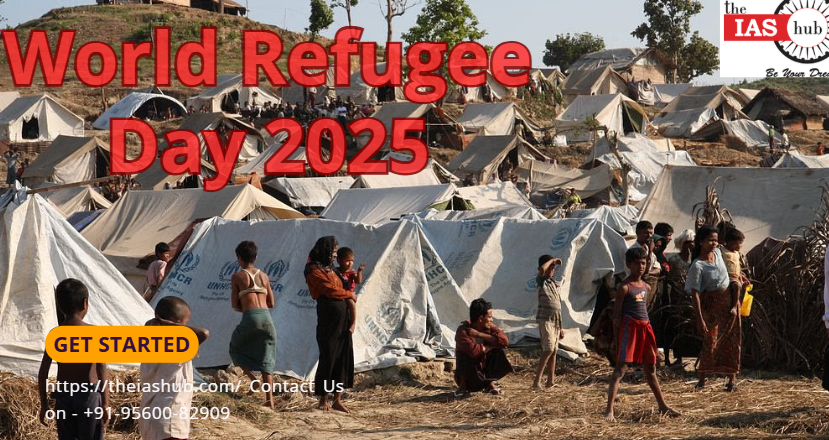


World Refugee Day is observed every year on 20 June to honor the courage and resilience of refugees – people forced to flee their own country and seek safety in another. Its origins lie in the 50th anniversary of the 1951 Refugee Convention; the first World Refugee Day took place on 20 June 2001. This date was chosen by the United Nations General Assembly in late 2000 to raise global awareness and mobilize support for refugees. World Refugee Day highlights refugee rights and honors the strength and courage of people who have been forced to flee their home country. Over the decades, it has become an occasion for events, campaigns and solidarity actions around the world.
Also Read: National and International Days 2025
A refugee is defined by international law as someone who has a well‑founded fear of persecution for reasons such as race, religion, nationality, membership of a particular social group or political opinion, and who is outside their country and unable to seek its protection.
Also Read: List of Important Days in June 2025
World Refugee Day was first celebrated on 20 June 2001, coinciding with the 50th anniversary of the 1951 Refugee Convention. Originally known as Africa Refugee Day, the United Nations General Assembly officially adopted 20 June as World Refugee Day in December 2000 to elevate the observance to a global scale.
| Fact | Detail |
| Date (annual observance) | 20 June |
| First observed | 20 June 2001 (50th anniversary of 1951 Refugee Convention) |
| Initiated by | UN General Assembly, Dec 2000 |
| Purpose | Honor refugees’ strength; highlight rights and needs |
| 2025 Theme | “Solidarity with Refugees” |
Also Read: World Food Safety Day
World Refugee Day 2025 Theme
Each year, UNHCR sets a campaign theme for World Refugee Day. Past themes include “Everyone has the Right to Seek Safety” (2022), “Hope Away From Home” (2023), and “For a world where refugees are welcomed” (2024). These slogans stress global solidarity and universal rights.
For 2025, the official theme is “Solidarity with Refugees”. This message urges people everywhere to stand with refugees, honour their stories, and show that no one is alone in their plight. Organizations worldwide will focus on empathy campaigns, solidarity rallies, and storytelling that highlight refugee experiences.
Also Read: World Environment Day
World Refugee Day is crucial given the current scale of displacement. By mid-2024, there were roughly 108 million forcibly displaced people worldwide, including refugees, internally displaced persons, and asylum seekers—an all-time high. Every minute, an estimated 33 people are displaced by conflict or persecution.
World Refugee Day conveys these facts to the global public. It shines a light on refugee rights, needs, and aspirations, mobilizing political support, funding, and community empathy. Events held on this day include public education initiatives, cultural festivals led by refugees, and storytelling to promote integration.
Also Read: World Day Against Child Labor
[metaslider id=”5575″]
The 1951 Refugee Convention (and its 1967 Protocol) defines who a refugee is and outlines their fundamental rights. These include non-refoulement and access to basic legal and social protections. The 1967 Protocol extended the Convention’s provisions globally by removing geographical and temporal restrictions.
Table 2: Key Refugee Law Instruments and India’s Position
| Instrument | Year | Scope / Definition | India Signed? |
| Refugee Convention (Geneva) | 1951 | Defines refugee status and verbatim protections | No |
| Refugee Protocol | 1967 | Removes time/location limits; universal protection | No |
India has not signed the Convention or its Protocol. This means India lacks a formal legal framework for refugee protection. Instead, refugee matters are handled under immigration law, mainly the Foreigners Act, 1946.
India hosts tens of thousands of refugees and asylum seekers, mainly from Myanmar, Afghanistan, Sri Lanka, and Tibet. As of early 2022, UNHCR registered over 46,000 refugees in India, including about 22,500 Rohingya from Myanmar. India’s refugee communities mostly live in urban centers and maintain informal livelihoods.
Refugee Populations in India (UNHCR-registered)
| Group | Approximate Number |
| Refugees and asylum-seekers (2022) | ~46,000+ |
| Rohingya (from Myanmar) | ~22,500 |
India’s refugee policy has been flexible. It has enabled resettlement for some Sri Lankan Tamils and provided support to Tibetans. Still, India lacks a formal refugee law. Asylum seekers often face legal uncertainty and are vulnerable to detention or deportation.
No, India is not a signatory to the 1951 Refugee Convention or its 1967 Protocol. Therefore, India is not legally bound by those specific refugee protections. Instead, refugee rights in India are shaped by domestic laws, judicial decisions, and policy interpretations. This legal arrangement highlights a significant difference between India and many Western countries that adhere to the Convention. UPSC aspirants should understand this when comparing India’s refugee policy with international norms.
Are you preparing for UPSC 2026? Join IAShub’s UPSC coaching batches to boost your preparation. Enroll now!
World Refugee Day 2025 serves as a vital reminder of the global refugee crisis and the urgent need for collective action. With displacement figures at historic highs, the day draws attention to the rights, dignity, and resilience of millions forced to flee their homes. The 2025 theme, “Solidarity with Refugees,” urges governments, institutions, and communities to support inclusive, humane responses to displacement. This observance highlights the importance of empathy, legal safeguards, and sustained humanitarian support in addressing one of the most pressing human rights challenges of our time.

World Refugee Day was officially recognized by the United Nations in December 2000. It was first observed globally on June 20, 2001, marking the 50th anniversary of the 1951 Refugee Convention. Since then, it has become an annual international observance.
The World Refugee Day 2025 theme is “Solidarity with Refugees.” It emphasizes the importance of protecting refugee rights and supporting their dignity and well-being. The theme calls for global unity and inclusive policies for displaced populations.
No, India is not a signatory to the 1951 Refugee Convention or its 1967 Protocol. However, the country continues to host and protect refugees through domestic laws, policies, and humanitarian assistance. India maintains an open-door policy for various refugee groups.
A refugee is a person forced to leave their home country due to war, violence, persecution, or disasters. They seek safety and legal protection in another country where their basic rights are upheld. International law safeguards their status and security.

Refine your answer writing skills and elevate your UPSC preparation with personalized support and expert feedback.
Fill out the form to get started with the program or any other enquiries !



Are you dreaming of becoming an IAS officer? Then, IAShub can be your best guide. It is one of the Best IAS Coaching in Delhi. Many students who want to clear the UPSC exam join IAShub for learning. The institute gives both online and offline classes. Their teachers are experienced and helpful. They easily explain every topic. Students also get notes, tests, and tips to do well in the exam.
IAShub is in Delhi and is trusted by many UPSC students. It offers coaching for every part of the UPSC exam – Prelims, Mains, and Interview. The classes are simple and easy to understand. The teachers are experts and guide students in the right way. IAShub is also known for its helpful notes, test series, and answer-writing practice. IAShub is the best coaching in Delhi and also gives UPSC Online Classes. This helps students from any place in India to learn. The online classes are live and also recorded. So, students can watch them anytime. These classes cover the full UPSC syllabus.
Here are some important services provided by IAShub:
The UPSC Civil Services Exam has three parts:
This exam is tough, but with the right guidance, it becomes easy to manage. Students must study smart and stay regular.
IAShub supports students from the beginning to the end. It gives the right books, tests, and notes. The classes are easy to follow, and the teachers are always ready to help. Students get personal doubt sessions too. The test series and answer checking help students learn where they need to do better. Also, free study materials save time and money.
IAShub also guides students during the final stage – the interview. Experts take mock interviews and give useful tips. This full support makes IAShub one of the best IAS coaching in Delhi.

Join 50,000+ UPSC Aspirants! 🚀
Get Free UPSC/IAS Study Materials, Daily Current Affairs, Editorial Summaries & Exam Updates.
Join Telegram Channel