
















Explore Lakshadweep's history, culture, polity, wildlife, and economy. Learn about its coral islands, marine life, festivals, ports, and ecological uniqueness. Discover key facts about India’s smallest and most vibrant Union Territory.
 theIAShub | 03 Jun, 2025 | 10954 | 0 |

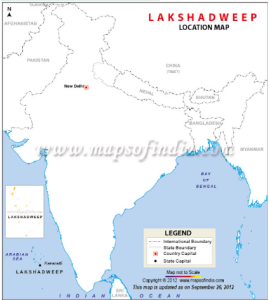
Courtesy: Maps of India
Lakshadweep, a group of islands in the Arabian Sea, holds significant importance as India’s smallest Union Territory. Known for its pristine beaches, coral reefs, and unique culture, the islands combine natural beauty with a distinct way of life. Spanning just 32 square kilometers, it is India’s smallest administrative division. As per the 2011 Census, Lakshadweep has a population of around 64,473. Kavaratti, the administrative capital, serves as the main hub for governance and culture.
Also Read: Operation Sindoor
Lakshadweep has a rich maritime history, with early influences from Arab traders and later European colonial powers. The islands were historically ruled by local chieftains and later came under the control of the Arakkal Kingdom of Kannur. The British incorporated Lakshadweep into British India, and post-independence, it became a Union Territory in 1956 under the States Reorganisation Act.
Also Read: Andhra Pradesh
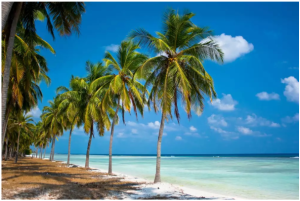
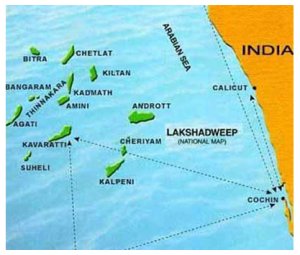
Lakshadweep is an archipelago of 36 islands, located off the southwestern coast of India in the Arabian Sea. The islands are known for their coral atolls, lagoons, and white sandy beaches. The climate is tropical, with warm temperatures year-round and moderate monsoon rains.
| Category | Details |
| Geographical Features | – Coral atolls & lagoons (dominant landform) – Rich marine biodiversity – No major rivers, only small freshwater lenses |
| Climate Type | Tropical Monsoon (warm & humid) |
| Seasons | – Summer (Mar–May): Warm & humid – Monsoon (Jun–Sep): Moderate rainfall – Post-Monsoon (Oct–Dec): Calm weather – Winter (Jan–Feb): Mild & pleasant |
Also Read: Arunachal Pradesh
As per the 2011 Census, Lakshadweep had a population of 64,473. The population density is high, at around 2,013 persons per square kilometer. The sex ratio is 946 females per 1,000 males.
Literacy Rate: The Union Territory recorded a literacy rate of 91.85%, with male literacy at 95.56% and female literacy at 87.95%.
Languages Spoken:
Each Union Territory has its own symbols. Following are the symbols of Lakshadweep:
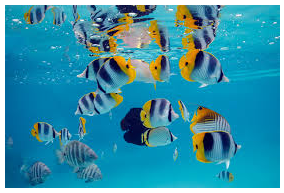
| Symbol | Name |
| State Animal | Butterfly Fish |
| State Bird | Sooty Tern |
| State Tree | Breadfruit Tree |
| State Flower | Neelakurinji |
These symbols reflect Lakshadweep’s ecological diversity and cultural heritage.
Also Read: Chattisgarh
[metaslider id=”5575″]
Lakshadweep is governed as a Union Territory under the direct administration of the Central Government.
| Category | Details |
| UT Formation | Established on November 1, 1956 |
| Administrator | Shri Praful Khoda Patel (Since 2021) |
| Judiciary | Falls under Kerala High Court jurisdiction |
| Legislature Type | No legislative assembly; governed by an Administrator |
| Lok Sabha Representation | 1 Member |
| Districts | 1 (as of 2024) |
| Local Governance Units | Divided into islands and panchayats |
Also Read: Assam
Lakshadweep’s culture reflects a unique blend of maritime traditions, Islamic influences, and indigenous customs shaped by its island geography and historical trade links.
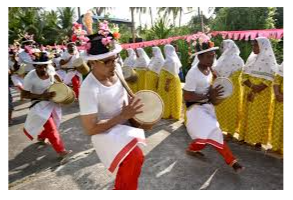
| Category | Details |
| Classical Dance | Lakshadweep does not have a classical dance form of its own but shares cultural similarities with Kerala, including influences of Mohiniyattam and Kolkali (a traditional stick dance). |
| Folk Performances | – Lava Dance: A traditional dance performed during festivals. – Kolkali: Group dance with rhythmic stick beats, similar to Kerala’s tradition. – Parichakali: A martial arts-inspired dance performed with shields and swords. |
| Music & Songs | – Oppana: Also performed in Lakshadweep, especially during weddings. – Mappila Paattu: Folk songs with Arabic-Malayalam fusion. – Jeseri Songs: Traditional songs in the local dialect. |
| Festivals | – Eid-ul-Fitr & Eid-ul-Adha: Major Islamic festivals celebrated with feasts and prayers. – Milad-un-Nabi: Birth anniversary of Prophet Muhammad. – Independence Day & Republic Day: Celebrated with cultural programs. |
| Arts & Crafts | – Coir Craft: Handmade products from coconut fiber. – Shell & Coral Jewelry: Traditional handicrafts. – Tuna Bone Carving: Unique art form using fish bones. |
| Architecture | – Mosques: Whitewashed coral stone mosques with intricate woodwork. – Traditional Houses: Made of coral and limestone with thatched roofs. |
| Cuisine | – Seafood Dominant: Dishes like Mas Podichathu (spicy tuna fry). – Coconut-based Dishes: Such as Kadalakka (coconut sweets). – Influence of Arab Cuisine: Dishes like Biriyani and Pathiri (rice flatbread). |
Also Read: Bihar
Lakshadweep is known for its rich marine biodiversity, coral reefs, and protected marine ecosystems.
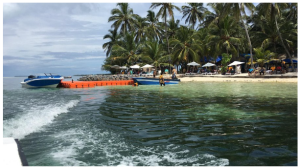
| Category | Details |
| Marine Protected Areas | Pitti Bird Sanctuary (Pitti Island) – Known for: Seabird nesting site (Sooty Terns, Brown Noddies) – Area: 0.01 sq. km (small coral islet) – No human habitation, strictly protected |
| Largest Marine Ecosystem | Lakshadweep Coral Reefs – Covers ~4200 sq. km (one of India’s largest reef systems) – Home to: 105+ coral species, 600+ fish species, sea turtles – Protected under Lakshadweep Marine Regulation (1982) |
| Smallest Protected Area | Pitti Island (Bird Sanctuary) – Area: Just 0.01 sq. km (smallest in India) – Key features: Critical seabird breeding ground |
| Notable Conservation Zones | – Agatti Island Reef: Famous for snorkeling & diving – Kadmat Island: Marine conservation zone – Bangaram Atoll: Pristine coral ecosystem |
| Ramsar Sites | None currently designated (but coral lagoons qualify as critical wetlands) |
| UNESCO Recognition | No World Heritage Sites, but reefs are part of India’s marine biodiversity hotspots |
| Key Wildlife | – Sea Turtles: Green turtles, Hawksbill turtles – Marine Mammals: Dolphins, occasional whale sightings – Endemic Birds: Sooty Tern, Brown Noddy |
Lakshadweep’s economy is primarily driven by fishing, coconut cultivation, and tourism, with limited industrial activity due to its fragile ecosystem.
| Sector | Key Details |
| Primary Sector | – Fishing: Tuna fishing dominates (85% of livelihood) – Coconut Farming: Coir production, coconut exports – Limited Agriculture: Due to saline soil |
| Secondary Sector | – Coir & Handicrafts: Small-scale industry – Fish Processing: Limited canning & drying units |
| Tertiary Sector | – Tourism: Controlled eco-tourism (permits required) – Government Services: Major employer |
| Key Challenges | – Fragile ecology restricts industrialization – High dependency on mainland imports – Limited infrastructure |
| Major Exports | – Dried Tuna (exported to Sri Lanka, Japan) – Coconut Products (coir, oil) |
| Transport & Connectivity | – Air: Agatti Airport (only airstrip) – Ship: Regular passenger/cargo ships from Kochi |
[metaslider id=”5575″]
| Port Name | Type | Location | Key Features |
| Kavaratti Port | Minor Port | Kavaratti Island | – Main administrative and cargo handling port – Connects to mainland via ships |
| Agatti Port | Minor Port | Agatti Island | – Only island with an airstrip – Handles passenger and limited cargo movement |
| Minicoy Port | Minor Port | Minicoy Island | – Southernmost port – Supports fishing and inter-island transport |
| Androth Port | Minor Port | Androth Island | – Trade and fishing activities – Connects to Kochi via ships |
| Kadmat Port | Minor Port | Kadmat Island | – Supports tourism and fishing – Known for coral reef proximity |
Lakshadweep has no significant mineral resources due to its coral atoll formation. The primary natural resources are:
| Resource | Location | Details |
| Coral Sand | All Islands | – Used locally in construction |
| Seawater Minerals | Coastal Areas | – Salt production in limited quantities |
| Coconut Byproducts | All Islands | – Coir, coconut oil, and shell crafts |
Are you preparing for UPSC 2025? Join IAShub’s UPSC coaching batches to boost your preparation. Enroll now!
Lakshadweep, with its exceptional social development indicators, unique geography, and progressive policies, offers a distinct model of human development.

Fishing (tuna), coconut cultivation, and controlled tourism. No large-scale industries due to ecological sensitivity.
Ships from Kochi (mainland) and inter-island boats. Agatti has the sole airstrip.
Marine species (turtles, reef sharks) and seabirds (Sooty Tern). No terrestrial wildlife.
Pitti Bird Sanctuary and coral reefs under strict conservation laws.

Refine your answer writing skills and elevate your UPSC preparation with personalized support and expert feedback.
Fill out the form to get started with the program or any other enquiries !



Are you dreaming of becoming an IAS officer? Then, IAShub can be your best guide. It is one of the Best IAS Coaching in Delhi. Many students who want to clear the UPSC exam join IAShub for learning. The institute gives both online and offline classes. Their teachers are experienced and helpful. They easily explain every topic. Students also get notes, tests, and tips to do well in the exam.
IAShub is in Delhi and is trusted by many UPSC students. It offers coaching for every part of the UPSC exam – Prelims, Mains, and Interview. The classes are simple and easy to understand. The teachers are experts and guide students in the right way. IAShub is also known for its helpful notes, test series, and answer-writing practice. IAShub is the best coaching in Delhi and also gives UPSC Online Classes. This helps students from any place in India to learn. The online classes are live and also recorded. So, students can watch them anytime. These classes cover the full UPSC syllabus.
Here are some important services provided by IAShub:
The UPSC Civil Services Exam has three parts:
This exam is tough, but with the right guidance, it becomes easy to manage. Students must study smart and stay regular.
IAShub supports students from the beginning to the end. It gives the right books, tests, and notes. The classes are easy to follow, and the teachers are always ready to help. Students get personal doubt sessions too. The test series and answer checking help students learn where they need to do better. Also, free study materials save time and money.
IAShub also guides students during the final stage – the interview. Experts take mock interviews and give useful tips. This full support makes IAShub one of the best IAS coaching in Delhi.
Join 50,000+ UPSC Aspirants! 🚀
Get Free UPSC/IAS Study Materials, Daily Current Affairs, Editorial Summaries & Exam Updates.
Join Telegram Channel