
















Explore Modern History Questions In UPSC Prelims 2025 with detailed trend analysis topic-wise breakdown and PYQs. Understand recurring themes like freedom movement reformers and British policies to boost your GS Paper I preparation effectively.
 theIAShub | 02 Jun, 2025 | 21676 | 0 |

Q1. Consider the following statements about Raja Ram Mohan Roy:
Which of the statements given above is/are correct?
(a) I only
(b) II only
(c) Both I and II
(d) Neither I nor II
And: (c) Both I and II
Q2. Consider the following subjects with regard to the Non-Cooperation Programme:
III. Retention of titles and honours without using them in public
How many of the above were parts of the Non-Cooperation Programme?
(a) Only one
(b) Only two
(c) Only three
(d) All the four
And: (c) Only three
[metaslider id=”5575″]
Q3. The first Gandharva Mahavidyalaya, a music training school, was set up in 1901 by Vishnu Digambar Paluskar in:
(a) Delhi
(b) Gwalior
(c) Ujjain
(d) Lahore
And: (b) Gwalior
Q4. Consider the following statements in respect of the Non-Cooperation Movement:
Which of the statements given above is/are correct?
(a) I only
(b) II only
(c) Both I and II
(d) Neither I nor II
And: (c) Both I and II
Q5. “Sedition has become my religion” was the famous statement given by Gandhiji at the time of:
(a) the Champaran Satyagraha
(b) publicly violating Salt Law at Dandi
(c) attending the Second Round Table Conference in London
(d) the launch of the Quit India Movement
And: (d) the launch of the Quit India Movement
Q6. Who provided legal defence to the people arrested in the aftermath of the Chauri Chaura incident?
(a) C. R. Das
(b) Madan Mohan Malaviya and Krishna Kant
(c) Dr. Saifuddin Kitchlew and Khwaja Hasan Nizami
(d) M. A. Jinnah
Ans: (b) Madan Mohan Malaviya and Krishna Kant
Q7. Subsequent to which one of the following events did Gandhiji decide to include the upliftment of ‘Harijans’ in his political and social programme?
(a) The Poona Pact
(b) The Gandhi-Irwin Agreement (Delhi Pact)
(c) Arrest of Congress leadership at the time of the Quit India Movement
(d) Promulgation of the Government of India Act, 1935
Ans: (a) The Poona Pact
Q8. Who among the following was the founder of the ‘Self-Respect Movement’?
(a) Periyar E. V. Ramaswamy Naicker
(b) Dr. B. R. Ambedkar
(c) Bhaskarrao Jadhav
(d) Dinkarrao Javalkar
Ans: (a) Periyar E. V. Ramaswamy Naicker
This year’s Modern History section was considered easier compared to previous years, described by experts as “the easiest in the last five years.” However, UPSC still tested candidates’ attention to detail and understanding of both major events and lesser-known facts.
The questions were mostly straightforward but required solid preparation on the Independence Movement and notable reformers. Unusual questions like the Portuguese-origin fruits added a bit of variety, ensuring candidates had to stay alert and well-rounded in their preparation.
Overall, the Modern History questions gave aspirants a warm break in an otherwise challenging Prelims paper. But as always with UPSC, “easy” means don’t take anything for granted!
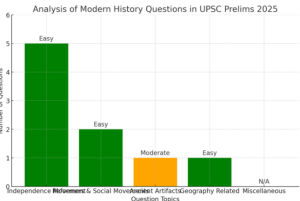
Understanding topic-wise distribution can help target high-yield areas. Here’s a breakdown of the commonly repeated themes:
| Topic | Expected Questions |
| Indian National Movement | 2–3 |
| Advent of Europeans | 1–2 |
| Socio-Religious Reform Movements | 1–2 |
| British Economic Policies | 1–2 |
| Acts & Constitutional Developments | 1–2 |
| Personalities & Contributions | 1–2 |
| Tribal & Peasant Movements | 1–2 |
Focusing preparation on these topics increases your chances of scoring well in Modern History Questions in UPSC Prelims.
Also Read: UPSC Prelims Previous Years Papers
Here’s an analysis of the number of Modern History Questions in UPSC Prelims over the past six years:
| Year | No. of Questions |
| 2024 | 4 |
| 2023 | 3 |
| 2022 | 4 |
| 2021 | 9 |
| 2020 | 8 |
| 2019 | 5 |
| 2018 | 14 |
The declining trend indicates a shift in focus, but recurring themes suggest that preparation should remain targeted and smart.
In the last few years, the number of Modern History Questions in UPSC Prelims has gone up and down. Some years have many questions from this topic, and some years have only a few. But even when there are fewer questions, they are still important and can help increase your marks.
Usually, 3 to 7 questions are asked from modern history every year. These questions often focus on:
Most questions are factual and need proper memorization, but some test your understanding of causes and effects. Practicing old papers and understanding trends helps you guess what may come next.
Despite fewer questions in 2024 compared to previous years, the Modern History section in the UPSC Prelims maintained its signature conceptual depth. The questions were framed in such a way that a surface-level reading would not suffice aspirants needed to have both factual knowledge and the ability to apply it.
Here are the actual questions asked from Modern History in the UPSC Prelims 2024, along with explanations:
Question 1:
With reference to the Government of India Act, 1935, consider the following statements:
Which of the statements given above is/are correct?
(a) 1 and 2 only
(b) 1 and 3 only
(c) 2 and 3 only
(d) 1, 2 and 3
Correct Answer: (b) 1 and 3 only
Explanation:
With reference to revenue collection and administration under Lord Cornwallis, consider the following statements:
Which of the statements given above is/are correct?
(a) 1 only
(b) 2 only
(c) 1 and 3 only
(d) 1, 2 and 3
Correct Answer: (d) 1, 2 and 3
Explanation:
Question 3:
Which one of the following movements contributed to the emergence of the ‘Untouchability’ (Offences) Act, 1955?
(a) Vaikom Satyagraha
(b) Bardoli Satyagraha
(c) Kheda Satyagraha
(d) Quit India Movement
Correct Answer: (a) Vaikom Satyagraha
Explanation:
[metaslider id=”5575″]
Question 4:
Who among the following was associated with the founding of the Indian National Army (INA)?
(a) Rasbehari Bose
(b) Mahatma Gandhi
(c) Motilal Nehru
(d) Vallabhbhai Patel
Correct Answer: (a) Rasbehari Bose
Explanation:
These questions reflect the UPSC’s continued emphasis on blending factual knowledge with conceptual understanding. Candidates are expected to go beyond rote memorization and understand the historical significance and context of major events, laws, and personalities.
UPSC Prelims Modern History Questions 2024 in Hindi
यूपीएससी प्रारंभिक परीक्षा में आधुनिक इतिहास के प्रश्नों की प्रकृति विश्लेषणात्मक और तथ्यात्मक दोनों होती है। 2024 की परीक्षा में पूछे गए कुछ उदाहरण नीचे दिए गए हैं:
प्रश्न 1. भारत सरकार अधिनियम, 1935 के संदर्भ में निम्नलिखित कथनों पर विचार कीजिए:
उपरोक्त में से कौन-सा/से कथन सही है/हैं?
(अ) केवल 1 और 2
(ब) केवल 1 और 3
(स) केवल 2 और 3
(द) 1, 2 और 3
सही उत्तर: (ब) केवल 1 और 3
व्याख्या: अधिनियम ने अखिल भारतीय संघ और प्रांतीय स्वायत्तता का प्रस्ताव दिया, लेकिन रियासतों की भागीदारी स्वैच्छिक थी और उन्होंने इसमें भाग नहीं लिया, जिससे संघ नहीं बन सका। इसलिए कथन 2 गलत है।
प्रश्न 2. लॉर्ड कॉर्नवालिस के अधीन राजस्व संग्रहण और प्रशासन के संदर्भ में निम्नलिखित कथनों पर विचार कीजिए:
उपरोक्त में से कौन-सा/से कथन सही है/हैं?
(अ) केवल 1
(ब) केवल 2
(स) केवल 1 और 3
(द) 1, 2 और 3
सही उत्तर: (द) 1, 2 और 3
व्याख्या: 1793 में बंगाल में लागू की गई इस प्रणाली ने ज़मींदारों को भूमि का स्वामित्व दिया और उनसे स्थायी राजस्व संग्रह की अपेक्षा की। इससे बहुत से ज़मींदार शहरों में बस गए और ग्रामीण क्षेत्रों में अनुपस्थित हो गए।
प्रश्न 3. निम्नलिखित में से कौन-सा आंदोलन ‘अस्पृश्यता (अपराध) अधिनियम, 1955’ के प्रारंभ में सहायक रहा?
(अ) वैकोम सत्याग्रह
(ब) बारडोली सत्याग्रह
(स) खेड़ा सत्याग्रह
(द) भारत छोड़ो आंदोलन
सही उत्तर: (अ) वैकोम सत्याग्रह
व्याख्या: वैकोम सत्याग्रह (1924–25) एक ऐतिहासिक आंदोलन था जो निचली जातियों को मंदिरों तक पहुँच का अधिकार दिलाने के लिए केरल में लड़ा गया था। इसने भारत में सामाजिक न्याय की दिशा में बड़ी भूमिका निभाई।
प्रश्न 4. निम्नलिखित में से कौन भारतीय राष्ट्रीय सेना (INA) की स्थापना से संबंधित थे?
(अ) रासबिहारी बोस
(ब) महात्मा गांधी
(स) मोतीलाल नेहरू
(द) वल्लभभाई पटेल
सही उत्तर: (अ) रासबिहारी बोस
व्याख्या: रासबिहारी बोस ने जापान में भारतीय क्रांतिकारियों के साथ मिलकर आईएनए की नींव रखी और बाद में सुभाष चंद्र बोस को नेतृत्व के लिए आमंत्रित किया। उन्होंने संगठन की नींव और दिशा तय की।
| Theme | Examples |
| Gandhian Movements | Champaran, Non-Cooperation, Dandi March |
| Acts & Reforms | Govt. of India Act 1935, Pitt’s India Act, Charter Acts |
| Revolutionaries & Reformers | Raja Ram Mohan Roy, Bhagat Singh, Subhas Bose |
| British Economic Impact | Deindustrialization, Land Revenue Systems |
| Congress Sessions & Policies | Surat Split, Lucknow Pact |
| Tribal/Peasant Uprisings | Santhal Revolt, Indigo Movement |
Focusing on these can help predict the Modern History Questions in UPSC Prelims.
Modern History Questions in UPSC Prelims 2025 have consistently remained a critical component of GS Paper I. While the number of questions may fluctuate, this section continues to test both factual recall and deeper understanding of India’s colonial past. From the advent of European powers and socio-religious reform movements to the Indian National Movement and post-independence developments, a wide array of topics is covered.
Aspirants must recognize that Modern History Questions in UPSC Prelims 2025 are not just about memorizing dates but also about understanding the causes, consequences, and significance of historical events. A thorough study of NCERTs, standard reference books like Spectrum, and analysis of previous year papers is essential.
This article offers a topic-wise breakdown and curated practice questions to strengthen your preparation. By focusing on patterns and analytical reasoning, candidates can develop an effective strategy to tackle Modern History Questions in UPSC Prelims with confidence.
Also Read: UPSC Prelims Admit Card 2025
Modern History Questions in UPSC Prelims focus on the period from the mid-18th century, including the arrival of European powers, the rise of British rule, socio-religious reform movements, and the Indian freedom struggle. These questions are drawn from static sources and test understanding across themes such as British policies, constitutional developments, revolutionary movements, and key personalities.
Also Read: UPSC Prelims Exam Analysis 2025
Even though Modern History Questions in UPSC Prelims have seen a reduction (from 14 questions in 2018 to just 3 in 2023), the importance of the topic remains unchanged. Questions are often conceptual and linked to recurring themes, demanding conceptual clarity and memorization.
Also Read: UPSC Civil Services Preliminary Examination 2025
The UPSC Prelims 2025 is scheduled to be held on 25th May 2025, and Modern History remains a crucial part of the GS Paper I. While the number of questions from this section may vary each year, its importance in the exam has been consistent. These questions assess your understanding of India’s historical journey, especially the freedom movement and British colonial rule.
Also Read: UPSC Topic Wise Prelims Analysis
Topics such as the 1857 Revolt, formation and role of the Indian National Congress, and key British-era legislations are frequently asked. To excel, it’s important to grasp core concepts and memorize essential facts. Mere reading won’t suffice—you should regularly practice previous year questions and refer to standard resources like NCERTs and Spectrum.
Also Read: Prelims Question Paper 2025
With focused preparation, scoring well in this section is achievable. In this article, we will explore the question trends, highlight important topics, and share effective tips to tackle Modern History Questions in the UPSC Prelims 2025 with confidence.
Modern History questions in UPSC Prelims 2025
In the UPSC Prelims 2025, there were 8 questions from Modern Indian History. This topic dominated the History section, focusing mainly on the Independence Struggle. Many questions centered around key events and personalities like Mahatma Gandhi and the Non-Cooperation Movement.
While Modern History Questions in UPSC Prelims 2025 have seen a dip in numbers, they remain highly scoring if prepared strategically. Recognizing themes, understanding past trends, and adopting a focused approach with quality resources like Spectrum and PYQs will ensure success. The key is smart preparation and regular revision.
So, whether the exam throws 3 or 13 questions your way, your goal remains the same: be ready. Because Modern History Questions in UPSC Prelims 2025 may be few but never irrelevant.

A Brief History of Modern India by Spectrum (Rajiv Ahir) is the most recommended book, along with selective NCERTs.
Both are important. UPSC often frames questions that test conceptual understanding with a factual base.
Exact questions are rare, but similar themes and topics often recur, making PYQ analysis very useful.
Important topics include the Revolt of 1857, socio-religious reform movements, INC sessions, Gandhian movements, and British administrative acts.

Refine your answer writing skills and elevate your UPSC preparation with personalized support and expert feedback.
Fill out the form to get started with the program or any other enquiries !



Are you dreaming of becoming an IAS officer? Then, IAShub can be your best guide. It is one of the Best IAS Coaching in Delhi. Many students who want to clear the UPSC exam join IAShub for learning. The institute gives both online and offline classes. Their teachers are experienced and helpful. They easily explain every topic. Students also get notes, tests, and tips to do well in the exam.
IAShub is in Delhi and is trusted by many UPSC students. It offers coaching for every part of the UPSC exam – Prelims, Mains, and Interview. The classes are simple and easy to understand. The teachers are experts and guide students in the right way. IAShub is also known for its helpful notes, test series, and answer-writing practice. IAShub is the best coaching in Delhi and also gives UPSC Online Classes. This helps students from any place in India to learn. The online classes are live and also recorded. So, students can watch them anytime. These classes cover the full UPSC syllabus.
Here are some important services provided by IAShub:
The UPSC Civil Services Exam has three parts:
This exam is tough, but with the right guidance, it becomes easy to manage. Students must study smart and stay regular.
IAShub supports students from the beginning to the end. It gives the right books, tests, and notes. The classes are easy to follow, and the teachers are always ready to help. Students get personal doubt sessions too. The test series and answer checking help students learn where they need to do better. Also, free study materials save time and money.
IAShub also guides students during the final stage – the interview. Experts take mock interviews and give useful tips. This full support makes IAShub one of the best IAS coaching in Delhi.

Join 50,000+ UPSC Aspirants! 🚀
Get Free UPSC/IAS Study Materials, Daily Current Affairs, Editorial Summaries & Exam Updates.
Join Telegram Channel