
















Explore Ladakh’s history, polity, culture, rivers, national parks, and economic profile. Learn about its geography, biodiversity, festivals, and development projects in this detailed guide on India’s high-altitude Union Territory.
 theIAShub | 31 May, 2025 | 16016 | 0 |
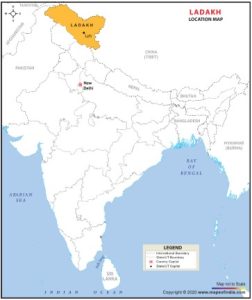

Courtesy: Map of India
Ladakh, located in the northernmost region of India, is celebrated for its stark and majestic landscapes, high-altitude deserts, and deeply rooted Buddhist culture. The region is known for its monasteries, adventure tourism, and strategic location. Spanning approximately 59,146 square kilometers (Union Territory status as of 2019), Ladakh holds a critical place in India’s geopolitical and environmental framework. According to the 2011 Census, Ladakh had a population of around 274,000. Leh and Kargil are the two administrative districts, with Leh serving as the joint capital of the Union Territory.
Also Read: Operation Sindoor
The history of Ladakh reflects Tibetan Buddhist traditions, ancient trade routes, and strategic importance. It was historically part of the broader Tibetan cultural sphere, ruled by dynasties such as the Namgyal dynasty. In the 19th century, it was annexed into the Dogra-ruled princely state of Jammu and Kashmir under Gulab Singh.
Post-independence, Ladakh was part of the state of Jammu and Kashmir. Following the abrogation of Article 370 on August 5, 2019, Ladakh was carved out as a separate Union Territory without a legislative assembly.
Also Read: Andhra Pradesh
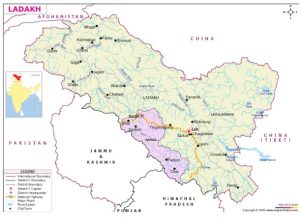
Ladakh shares international borders with China (Tibet Autonomous Region) and Pakistan, and domestic boundaries with Himachal Pradesh and Jammu and Kashmir.
| Category | Details |
| Key Geographic Features | • Karakoram Range and Zanskar Range • Indus River Valley and Nubra Valley • Cold deserts, high-altitude lakes, and snow-capped peaks |
| Highest Peak | Saltoro Kangri • Elevation: 7,742 m (25,400 ft) • Location: Saltoro Ridge (Siachen region) • Significance: One of the highest peaks in Indian-controlled territory |
| Smallest Recognized Peak | No officially designated smallest peak; low-lying valleys such as Zanskar and Sham feature relatively lower elevations (~2,500–3,000 m) |
| Important Mountain Passes | 1. Khardung La (~5,359 m) – Gateway to Nubra Valley; major tourist route 2. Chang La (~5,360 m) – Access to Pangong Lake 3. Fotu La – Highest point on Srinagar-Leh highway 4. Zoji La – Connects Ladakh with Kashmir Valley 5. Rezang La – Strategically significant; site of 1962 battle |
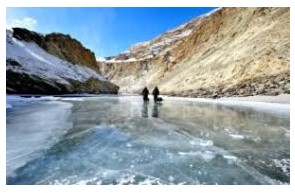
| Major Rivers | • Indus River – Main river flowing across Ladakh from Tibet • Zanskar River – Tributary of the Indus; famous for the frozen Chadar Trek • Shyok River – Tributary of the Indus; flows through Nubra Valley • Suru River – Tributary of the Indus; flows through Kargil |
| Climate | • Leh: Cold desert (long harsh winters, dry summers) • Kargil: Alpine (cold winters with snow, moderate summers) • High-altitude Passes: Severe cold, year-round snow presence Precipitation is scant, with most moisture coming in the form of snowfall. |
Also Read: Arunachal Pradesh
Ladakh is bordered by:
| Type of Border | Neighbour |
| Domestic Border | Himachal Pradesh |
| Domestic Border | Jammu and Kashmir |
| International Border | Pakistan (Gilgit-Baltistan) |
| International Border | China (Aksai Chin, Tibet Autonomous Region) |
Ladakh is strategically vital due to its high-altitude terrain and proximity to disputed international borders.
Also Read: Chattisgarh
[metaslider id=”5575″]
As per the 2011 Census, Ladakh had a population of approximately 274,000. The population density is around 4.6 persons per square kilometer, one of the lowest in India. The sex ratio stands at 1,042 females per 1,000 males.
Literacy Rate: The literacy rate is 77.2%, with male literacy at 86.6% and female literacy at 67.4%.
Languages Spoken:
Also Read: Assam
Following are the state symbols for Ladakh:
| Symbol | Name |
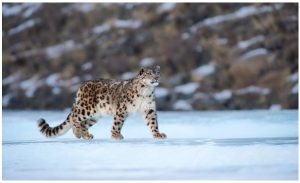
| State Animal | Snow Leopard |
| State Bird | Black-necked Crane |
| State Tree | Juniper |
| State Flower | Notified as Siachen Glacier Saxifraga (local alpine species) |
These symbols highlight Ladakh’s ecological fragility and distinct high-altitude biodiversity.
Also Read: Bihar
Ladakh, designated a Union Territory on October 31, 2019, does not have a legislature of its own. It is directly governed by the central government through a Lieutenant Governor. The Union Territory operates under the Indian Constitution, with representation in both houses of Parliament.
| Category | Details |
| Political Status | • Union Territory since October 31, 2019 (J&K Reorganisation Act, 2019) • No legislature; administered directly by the Centre |
| Current Leadership | Lieutenant Governor: Brig. (Dr.) B. D. Mishra (Retd.) (since February 2023) • Former Governor of Arunachal Pradesh • Focus areas: Border security, sustainable development, tribal welfare |
| Judiciary | High Court: Jammu and Kashmir & Ladakh High Court (shared jurisdiction) Chief Justice: Hon’ble Justice N. Kotiswar Singh (since February 2023) • Priorities: Judicial outreach, infrastructure development |
| Parliamentary Representation | • Lok Sabha (Lower House): 1 elected MP (Ladakh constituency) • Rajya Sabha (Upper House): No representation as of now |
| Legislative Structure | • No legislative assembly • Districts: 2 (Leh and Kargil) • Subdivisions: Includes tehsils, blocks, and villages for decentralized administration |
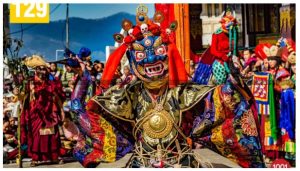
Ladakh’s culture is shaped by its Tibetan Buddhist heritage, tribal traditions, and mountain ecology. It is home to ethnic groups like Ladakhi Buddhists, Balti Muslims, and Dards, each contributing to a vibrant array of music, dance, crafts, and festivals. The region’s cultural identity is deeply spiritual, artistic, and closely tied to nature.
| Category | Details |
| Classical Dance | • No officially recognized classical dance among India’s eight forms • Popular Folk Dances: – Cham Dance (monastic masked dance) – Shondol (royal dance by women in festivals) – Mentok Stanmo (flower dance performed by girls) • Themes: Spiritual stories, harvest, local legends |
| Theatre Art | • Ladakhi Folk Theatre: Oral storytelling with costumes and chants • Performances during Buddhist festivals and village gatherings • Emerging urban theatre in Leh on social themes |
| Folk Music | • Types: Ladakhi ballads, religious chants, wedding songs • Instruments: Damnyan (lute), piwang (fiddle), dungchen (long trumpet), drums • Notable Form: Buddhist monastic chants and folk narratives |
| Classical Music | • Centered on sacred Tibetan Buddhist music • Uses cymbals, horns, and chanting for spiritual rituals • Performed in monasteries and religious events |
| Performance Traditions | • Associated with festivals like Losar, Hemis, and harvest celebrations • Venues: Monasteries, village courtyards, community stages |
| Major Festivals | • Buddhist: Hemis Festival, Losar (New Year), Dosmoche • Muslim: Eid-ul-Fitr, Eid-ul-Adha, Nauroz (Kargil) • Tribal/Cultural: Sindhu Darshan, Ladakh Festival |
| Arts & Crafts | • Thangka Painting: Sacred scrolls of Buddhist deities • Wood Carving: Religious motifs in doors and windows • Metalwork: Copper and silver Buddhist icons • Woolen Products: Hand-spun carpets, garments from yak and sheep wool |
| Architecture | • Monasteries: Hemis, Thiksey, Diskit (Tibetan architectural style) • Fortresses: Leh Palace, Basgo Fort • Religious Sites: Stupas, prayer wheels, rock engravings |
| Wildlife & Nature | • National Parks/Sanctuaries: Hemis National Park (snow leopards), Changthang Wildlife Sanctuary • Ecosystems: Cold desert, alpine meadows, high-altitude lakes like Pangong and Tso Moriri |
Following is the list of National Parks and wildlife sanctuaries of Ladakh:
| Category | Details |
| National Parks | 1. Hemis National Park (4,400 km², Leh) – Largest in India – Key Species: Snow leopard, Tibetan wolf, Himalayan ibex, bharal (blue sheep) |
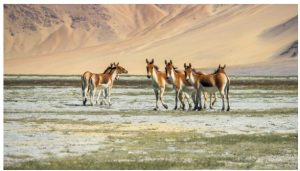
| Wildlife Sanctuaries | • Changthang Wildlife Sanctuary (Ladakh) – Cold desert ecosystem – Key species: Tibetan wild ass (kiang), black-necked crane, Tibetan gazelle |
| Ramsar Sites | 1. Tso Moriri Lake (Ladakh) – High-altitude wetland, nesting site for migratory birds 2. Tso Kar Wetland Complex (Ladakh) – Brackish and freshwater lakes, critical for black-necked cranes and biodiversity |
| UNESCO Tentative Sites | • Buddhist Monasteries of Ladakh (Thiksey, Hemis, Alchi) • Tso Moriri Lake (proposed as Natural Heritage) |
| Tiger Reserve | Not Applicable – Note: Focus on snow leopard conservation through Project Snow Leopard |
| Urban Biodiversity | • Leh Town: Urban greening projects, community gardens, birdwatching initiatives • Eco-tourism promoted through local cooperatives in villages near Pangong and Nubra |
Ladakh’s economy is primarily driven by tourism, defense-related employment, agriculture, and renewable energy. The administration is now emphasizing sustainable development, solar energy, and eco-tourism as pillars of long-term growth.
| Category | Details |
| Key Sectors | • Tourism: Adventure (trekking, rafting), spiritual (monasteries), nature (Pangong, Nubra) • Agriculture/Pastoralism: Barley, buckwheat, sea buckthorn, yak herding • Handicrafts: Woolen products, thangka painting, metalwork • Renewable Energy: Solar farms, hydropower micro-projects (target: carbon neutrality) • Public Sector: Significant employment in defense, BRO, and central services |
| Major Projects | • Zojila Tunnel: Strategic all-weather connectivity to Srinagar • Kushok Bakula Rimpochee Airport (expansion for tourism) • Ladakh Green Energy Initiative: Large-scale solar parks in Hanle and Zanskar • Organic Ladakh Mission: 100% organic farming goal • Ladakh Startup Policy (2022): Focus on agro-tech, tourism-tech, and local manufacturing |
| Economic Overview (2023–24) | • GSDP: Not separately calculated, but steady growth through central grants and tourism • Sectoral Snapshot: – Agriculture & Pastoralism: 20% – Industry (mainly handicrafts, energy): 25% – Services (tourism, govt jobs): 55% |
| Major Economic Centers | • Leh: Administrative hub, tourism, solar energy • Kargil: Agriculture, handicrafts, cross-border heritage tourism • Nubra Valley: Agro-tourism, apricot farming • Changthang Region: Pashmina wool, yak herding |
| Top Contributing Areas | 1. Leh Town (tourism, government services) 2. Kargil (agriculture, local industries) 3. Nyoma/Changthang (pashmina, energy) 4. Nubra (horticulture, sustainable tourism) |
Following are the mineral resources found in the UT of Ladakh
| Mineral Type | Locations |
| Borax | Changthang Plateau |
| Sulphur | Panamik hot springs, Nubra |
| Granite/Building Stone | Leh, Zanskar |
| Precious Stones (trace presence) | Karakoram ranges (unexplored) |
[metaslider id=”5575″]
Following are the government schemes for the welfare of citizens:
| Scheme | Objective | Key Features |
| Ladakh Vision 2050 | Long-term sustainable development | Focus on clean energy, cultural preservation, infrastructure |
| Pashmina Promotion Programme | Wool sector upliftment | Support to Changpa nomads, wool processing units |
| RE Policy 2022 | Renewable energy self-sufficiency | 10 GW solar energy target, green hydrogen pilots |
| Subsidized Airfare Scheme | Connectivity for remote residents | Discounted air travel during winter blockade |
| Mission Organic Development | Organic agriculture | Soil testing, certification, training for farmers |
| Tourism Incentive Scheme | Boost tourism infra | Homestay subsidies, eco-tourism training, heritage conservation |
Are you preparing for UPSC 2025? Join IAShub’s UPSC coaching batches to boost your preparation. Enroll now!
With its alpine landscape, cultural tapestry, and geopolitical importance, Ladakh plays a key role in India’s strategic and development landscape. From snow-clad peaks to saffron valleys and Buddhist monasteries to tech-driven youth missions, the region is undergoing rapid transformation under Union governance.

The Indus River is the principal river, flowing through Leh, along with tributaries like Zanskar and Shyok.
Due to its location, Ladakh is of high strategic significance, hosting the Siachen Glacier and major border posts with China and Pakistan.
Tourism in Ladakh is promoted through eco-tourism, spiritual tourism (monasteries), and adventure sports like trekking, rafting, and biking.
Tourism, solar energy, handicrafts, wool production (especially pashmina), and government employment are the major economic drivers.

Refine your answer writing skills and elevate your UPSC preparation with personalized support and expert feedback.
Fill out the form to get started with the program or any other enquiries !



Are you dreaming of becoming an IAS officer? Then, IAShub can be your best guide. It is one of the Best IAS Coaching in Delhi. Many students who want to clear the UPSC exam join IAShub for learning. The institute gives both online and offline classes. Their teachers are experienced and helpful. They easily explain every topic. Students also get notes, tests, and tips to do well in the exam.
IAShub is in Delhi and is trusted by many UPSC students. It offers coaching for every part of the UPSC exam – Prelims, Mains, and Interview. The classes are simple and easy to understand. The teachers are experts and guide students in the right way. IAShub is also known for its helpful notes, test series, and answer-writing practice. IAShub is the best coaching in Delhi and also gives UPSC Online Classes. This helps students from any place in India to learn. The online classes are live and also recorded. So, students can watch them anytime. These classes cover the full UPSC syllabus.
Here are some important services provided by IAShub:
The UPSC Civil Services Exam has three parts:
This exam is tough, but with the right guidance, it becomes easy to manage. Students must study smart and stay regular.
IAShub supports students from the beginning to the end. It gives the right books, tests, and notes. The classes are easy to follow, and the teachers are always ready to help. Students get personal doubt sessions too. The test series and answer checking help students learn where they need to do better. Also, free study materials save time and money.
IAShub also guides students during the final stage – the interview. Experts take mock interviews and give useful tips. This full support makes IAShub one of the best IAS coaching in Delhi.
Join 50,000+ UPSC Aspirants! 🚀
Get Free UPSC/IAS Study Materials, Daily Current Affairs, Editorial Summaries & Exam Updates.
Join Telegram Channel