Know about UPSC Mains Exam Pattern 2025, including subject-wise marking scheme, paper structure, and UPSC Mains exam pattern with marks. Understand the comprehensive UPSC Main exam marking strategy and access the UPSC exam pattern PDF for quick reference
 theIAShub | 27 Jun, 2025 | 16562 | 0 |
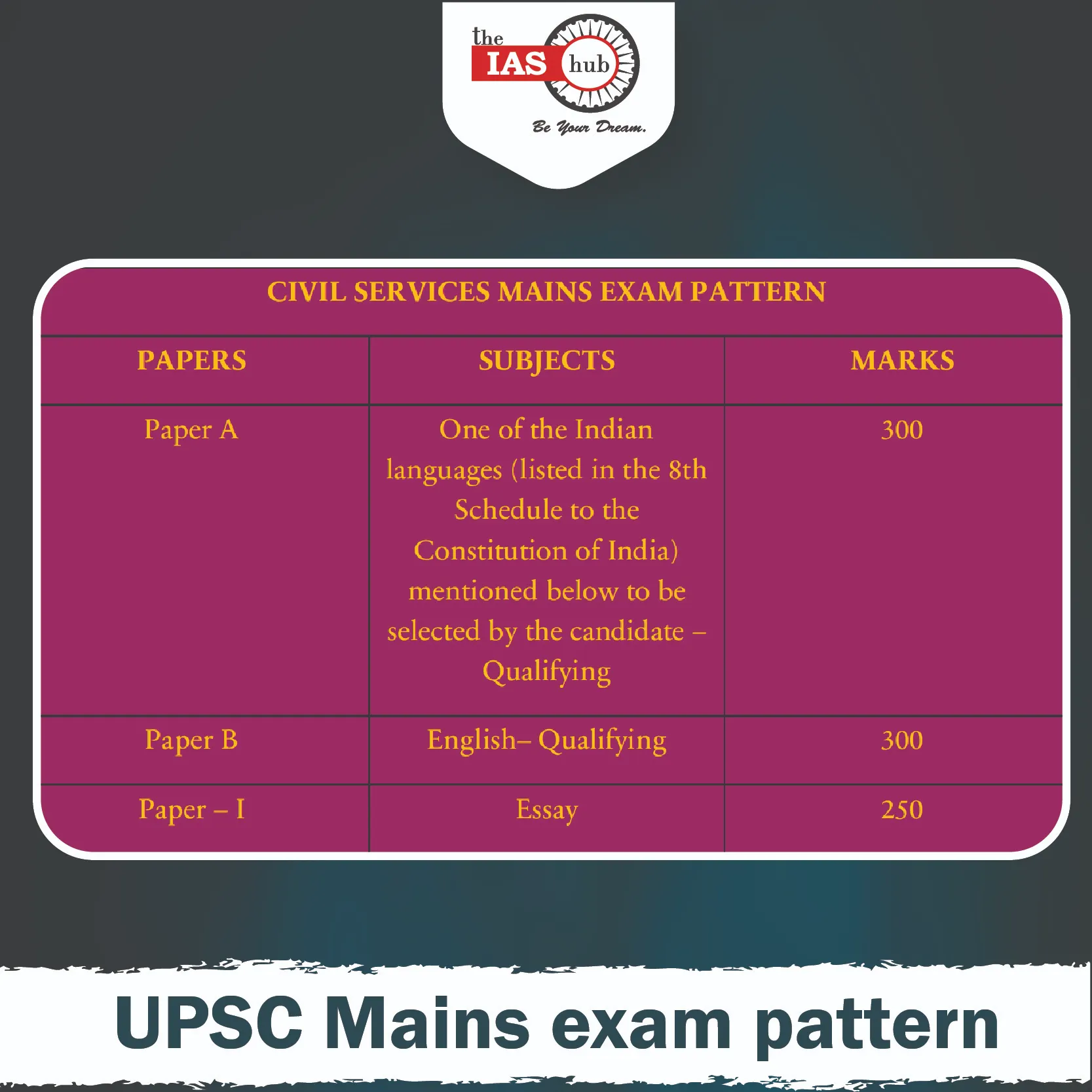

The UPSC Mains Examination is the second stage of the Civil Services Examination (CSE) and follows a structured exam pattern. It is a crucial phase conducted over 5-7 days and consists of nine descriptive papers. According to the UPSC Mains exam pattern, these papers include two qualifying language papers and seven papers that contribute to the final merit.
Only candidates who meet the cut-off in General Studies Paper I and secure at least 33% in General Studies Paper II in the Prelims are eligible to appear for the Mains examination. The UPSC Mains 2025 exam is scheduled for August 22, 2025.
The UPSC Mains Examination is the second phase of the Civil Services Examination, evaluating candidates’ knowledge, analytical abilities, and writing skills. It comprises nine descriptive papers: two qualifying papers and seven that contribute to the final merit. These papers encompass essays, general studies, and an optional subject, assessing a candidate’s grasp of governance, ethics, and socio-economic matters. Success in the Mains leads to the Personality Test, making it a pivotal step toward a career in civil services.
The Mains exam is a written, descriptive test comprising nine papers, of which two are qualifying in nature and seven contribute to the final merit. Covering a wide range of subjects, the exam includes essays, general studies, and optional subjects, allowing candidates to showcase their expertise in specific areas. It aims to evaluate a candidate’s understanding of governance, ethics, and socio-economic issues along with their capacity to tackle complex problems.
The UPSC Mains Exam Pattern 2025 serves as the foundation for aspirants preparing for India’s highly competitive Civil Services Examination. With nine descriptive papers—two qualifying and seven counted for merit—this stage evaluates a candidate’s analytical ability, subject knowledge, ethical reasoning, and written communication skills. Understanding the detailed structure, subject-wise marking scheme, and strategic importance of optional papers is crucial to cracking the exam. This guide provides a complete breakdown of the paper format and marking criteria and includes helpful tools like a UPSC exam pattern chart and a downloadable PDF for smarter preparation.
The Mains examination consists of nine descriptive papers, including two qualifying language papers and seven papers that determine the final merit. The details are as follows:
| Category | Details | Marks |
| 1. Qualifying Papers: These papers are of matriculation or equivalent standard and are qualifying in nature. Marks do not count for ranking. | ||
| Paper-A | One Indian Language (from the Eighth Schedule of the Constitution) | 300 marks |
| Paper-B | English | 300 marks |
| Notes | – Candidates must score at least 25% in each of these papers to qualify.
– Candidates from Arunachal Pradesh, Manipur, Meghalaya, Mizoram, Nagaland, and Sikkim are exempt from Paper-A. |
|
| 2. Papers Counted for Merit Ranking: The following papers contribute to the total score for merit ranking: | ||
| Paper-I | Essay | 250 marks |
| Paper-II | General Studies-I (Indian Heritage and Culture, History, Geography of the World and Society) | 250 marks |
| Paper-III | General Studies-II (Governance, Constitution, Polity, Social Justice, and International Relations) | 250 marks |
| Paper-IV | General Studies-III (Technology, Economic Development, Biodiversity, Environment, Security, and Disaster Management) | 250 marks |
| Paper-V | General Studies-IV (Ethics, Integrity, and Aptitude) | 250 marks |
| Paper-VI | Optional Subject – Paper 1 | 250 marks |
| Paper-VII | Optional Subject – Paper 2 | 250 marks |
| Sub-total (Written Test) | 1750 marks | |
| 3. Personality Test | 275 marks | |
| Grand Total | (Written Test + Personality Test) | 2025 marks |
Candidates must select one optional subject for Papers VI and VII from the following:
Literature of any one of the following languages: Assamese, Bengali, Bodo, Dogri, Gujarati, Hindi, Kannada, Kashmiri, Konkani, Maithili, Malayalam, Manipuri, Marathi, Nepali, Oriya, Punjabi, Sanskrit, Santhali, Sindhi, Tamil, Telugu, Urdu, and English.
Notes: The question papers will be of conventional (essay) type, each lasting three hours.
Syllabus details are provided in Part B of Section III.
Misuse of the language rule (e.g., unauthorized mediums) will result in deductions or non-evaluation of scripts.
| Paper | Subject | Marks | Nature |
| A | Indian Language (selected) | 300 | Qualifying |
| B | English | 300 | Qualifying |
| I | Essay | 250 | Counted for merit |
| II | General Studies I (History, Geography, etc.) | 250 | Counted for merit |
| III | General Studies II (Polity, Governance, etc.) | 250 | Counted for merit |
| IV | General Studies III (Economy, Science, etc.) | 250 | Counted for merit |
| V | General Studies IV (Ethics) | 250 | Counted for merit |
| VI | Optional Subject Paper I | 250 | Counted for merit |
| VII | Optional Subject Paper II | 250 | Counted for merit |
Total (Written Papers Counted for Merit) = 1750 Marks
UPSC Mains Exam 2025 Key Aspects
|
Candidates choose optional papers (Paper VI & VII), both from the same subject, and appear in one of the qualifying language papers.
Here’s a detailed table featuring the UPSC Mains 2025 optional subjects and qualifying language papers based on official UPSC sources:
| Category | Subjects Covered |
| Language (Qualifying) | Assamese, Bengali, Bodo, Dogri, English, Gujarati, Hindi, Kannada, Kashmiri, Konkani, Maithili, Malayalam, Manipuri, Marathi, Nepali, Odia, Punjabi, Sanskrit, Santhali, Sindhi, Tamil, Telugu, and Urdu. |
| Optional Subjects | Agriculture; Animal Husbandry & Veterinary Science; Anthropology; Botany; Chemistry; Civil Engineering; Commerce & Accountancy; Economics; Electrical Engineering; Geography; Geology; History; Law; Literature (any one language); Management; Mathematics; Mechanical Engineering; Medical Science; Philosophy; Physics; Political Science & International Relations; Psychology; Public Administration; Sociology; Statistics; Zoology |
The UPSC Mains Exam consists of 9 descriptive papers, including 2 qualifying (English and Indian Language), 4 General Studies, 1 Essay, and 2 Optional Subject papers.
Marks from 7 papers (1750) and the interview (275) are counted for the final merit out of 2025.
[metaslider id=”5575″]
| Category | Paper | Subject | Marks | Type |
| Qualifying | Paper A | Indian Language (any from the 8th Schedule) | 300 | Qualifying |
| Paper B | English | 300 | Qualifying | |
| Merit Ranking | Paper I | Essay | 250 | Descriptive |
| Paper II | General Studies I—Indian Heritage & Culture, History, Geography of the World & Society | 250 | Descriptive | |
| Paper III | General Studies II—Governance, Constitution, Polity, Social Justice, International Relations | 250 | Descriptive | |
| Paper IV | General Studies III—Technology, Economic Development, Biodiversity, Environment, Security, Disaster Management | 250 | Descriptive | |
| Paper V | General Studies IV—Ethics, Integrity, and Aptitude | 250 | Descriptive | |
| Paper VI | Optional Subject—Paper I | 250 | Descriptive | |
| Paper VII | Optional Subject—Paper II | 250 | Descriptive | |
| Interview | – | Personality Test (Interview) | 275 | Viva Voce |
Checkout the UPSC Mains Syllabus here!

The UPSC Mains exam consists of 9 descriptive papers. Two are qualifying, and seven assess General Studies, Essay, and Optional subjects. Each paper is 3 hours long.
The 7/5/3 rule suggests spending 7 minutes per question, writing 5 points related to the keyword, and elaborating on each point in 3 dimensions (examples, explanations, facts).
Subjects like Political Science, History, Public Administration, and Geography are popular choices for IAS due to their relevance in both Prelims and Mains exams. Choosing a subject based on interest and background is key.

Refine your answer writing skills and elevate your UPSC preparation with personalized support and expert feedback.
Fill out the form to get started with the program or any other enquiries !





Are you dreaming of becoming an IAS officer? Then, IAShub can be your best guide. It is one of the Best IAS Coaching in Delhi. Many students who want to clear the UPSC exam join IAShub for learning. The institute gives both online and offline classes. Their teachers are experienced and helpful. They easily explain every topic. Students also get notes, tests, and tips to do well in the exam.
IAShub is in Delhi and is trusted by many UPSC students. It offers coaching for every part of the UPSC exam – Prelims, Mains, and Interview. The classes are simple and easy to understand. The teachers are experts and guide students in the right way. IAShub is also known for its helpful notes, test series, and answer-writing practice. IAShub is the best coaching in Delhi and also gives UPSC Online Classes. This helps students from any place in India to learn. The online classes are live and also recorded. So, students can watch them anytime. These classes cover the full UPSC syllabus.
Here are some important services provided by IAShub:
The UPSC Civil Services Exam has three parts:
This exam is tough, but with the right guidance, it becomes easy to manage. Students must study smart and stay regular.
IAShub supports students from the beginning to the end. It gives the right books, tests, and notes. The classes are easy to follow, and the teachers are always ready to help. Students get personal doubt sessions too. The test series and answer checking help students learn where they need to do better. Also, free study materials save time and money.
IAShub also guides students during the final stage – the interview. Experts take mock interviews and give useful tips. This full support makes IAShub one of the best IAS coaching in Delhi.