How to Prepare History for UPSC 2025: Best Books & Strategy

Looking for the best way on how to prepare history for UPSC? This guide covers books, syllabus, and strategies to master UPSC History. Learn how to prepare history for UPSC with expert tips and resources.

THEIASHUB

How to prepare history for UPSC is a crucial question for aspirants, as History is one of the most important and scoring subjects in the UPSC Civil Services Examination. It is divided into Ancient, Medieval, and Modern History, along with Art & Culture. A strong foundation in History helps in answering both Prelims and Mains GS Paper 1 questions effectively.

In this article, we will explore how to prepare history for UPSC, covering essential topics, recommended books, study techniques, and preparation strategies for both General Studies (GS) and History Optional papers.

UPSC History 2025

History in UPSC Prelims and Mains GS Paper 1 consists of:

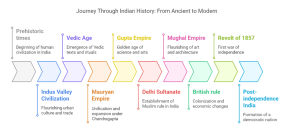
  • Ancient History: Prehistoric times, Indus Valley Civilization, Vedic Age, Mauryan & Gupta Empires, Buddhism, and Jainism.
  • Medieval History: Delhi Sultanate, Mughal Empire, Vijayanagar Empire, Bhakti & Sufi Movements.
  • Modern History: British rule, Revolt of 1857, Indian National Movement, and post-independence India.

History is interlinked with other subjects like Polity, Culture, and Current Affairs, making it essential for a well-rounded UPSC preparation.
How to Start Studying History?

A step-by-step approach is necessary to cover the vast syllabus efficiently:
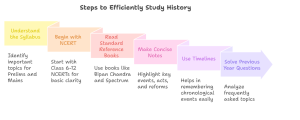
  1. Understand the syllabus: Identify important topics for Prelims and Mains.
  2. Begin with NCERT: Start with Class 6-12 NCERTs for basic clarity.
  3. Read standard reference books: Such as Bipan Chandra, Spectrum, and R.S. Sharma.
  4. Make concise notes: Highlight key events, acts, and reforms.
  5. Use timelines: Helps in remembering chronological events easily.
  6. Solve previous year questions (PYQs): Analyze frequently asked topics.
  7. Link History with Current Affairs: Read newspapers and government reports.
  8. Practice answer writing: Develop structured responses with proper facts and analysis.

How to Study and Prepare History

Aspirants should follow a structured strategy for History preparation. Below are key steps:
1. Understand the Different Parts of History

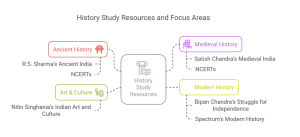
  • Ancient History: Read R.S. Sharma’s Ancient India and NCERTs.
  • Medieval History: Use Satish Chandra’s Medieval India and NCERTs.
  • Modern History: Study Bipan Chandra’s Struggle for Independence and Spectrum’s Modern History.
  • Art & Culture: Refer to Nitin Singhania’s Indian Art and Culture.

2. Make Topic-Wise Notes

  • Summarize key events, acts, and policies.
  • Use timelines and flowcharts for better retention.

3. Practice MCQs and Answer Writing

  • Solve previous year papers.
  • Take mock tests and analyze performance.
  • Write structured answers with relevant historical facts.

How to Study Ancient History for UPSC Prelims

Ancient History is a high-weightage topic in Prelims. Below is a table with key topics:

Topic Focus Areas
Indus Valley Civilization Town planning, agriculture, trade, decline theories
Vedic Period Society, economy, Rig Veda, Later Vedic period
Mauryan Empire Administration, economy, Ashoka’s policies
Gupta Empire Golden Age, literature, science, decline
Buddhism & Jainism Teachings, sects, spread in India

Study Sources:

  • NCERT Class 6-12
  • R.S. Sharma’s Ancient India
  • Tamil Nadu Board History books
  • IGNOU Notes for History

History Books for UPSC 

Aspirants should study NCERTs first, followed by advanced books. Below is a list of must-read books for UPSC History:

For Prelims and GS Paper 1:

  • NCERT Books (Class 6-12) – Covers basics of Indian History.
  • Ancient India by R.S. Sharma – Covers Indus Valley Civilization, Vedic period, and early kingdoms.
  • Medieval India by Satish Chandra – Covers Delhi Sultanate, Mughals, and regional kingdoms.
  • Modern India by Bipan Chandra – Focuses on British rule and Indian freedom struggle.
  • A Brief History of Modern India (Spectrum) – Useful for quick revision and factual clarity.
  • Indian Art and Culture by Nitin Singhania – Covers cultural aspects and is essential for Prelims.

For History Optional:

  • India’s Ancient Past by R.S. Sharma – In-depth coverage of Ancient History.
  • History of Medieval India by Satish Chandra – Essential for Medieval History Optional.
  • Plassey to Partition by Sekhar Bandyopadhyay – Covers Modern Indian History.
  • World History by Arjun Dev – Required for UPSC Mains Paper II.

How to Prepare for History Optional 2025?

1. Understand the Paper Structure

  • Paper 1: Covers Ancient & Medieval Indian History.
  • Paper 2: Covers Modern Indian History & World History.

2. Use Standard Books

  • Ancient & Medieval India: R.S. Sharma & Satish Chandra
  • Modern India: Bipan Chandra & Spectrum
  • World History: Norman Lowe & Arjun Dev

3. Develop Answer Writing Skills

  • Use maps, flowcharts, and structured answers.
  • Write concise and analytical responses.
  • Solve previous year papers for practice.

4. Keep Up with Current Affairs

  • Follow The Hindu, Indian Express, and government websites like amritmahotsav.nic.in.
  • Relate historical events to current issues.

Also Read: History Optional 2025 Syllabus

Conclusion

How to prepare history for UPSC requires a structured study plan, strong conceptual clarity, and regular practice. Start with NCERTs, move on to standard books, and integrate timelines and answer writing into your study routine. Regular PYQ practice, current affairs linkage, and smart revision will help aspirants excel in both Prelims and Mains. With the right strategy and dedication, mastering History for UPSC is achievable!

Are you preparing for UPSC 2025? Join IAShub’s UPSC coaching batches to boost your preparation. Enroll now!

How to prepare history for upsc FAQs

Spectrum’s A Brief History of Modern India and Bipan Chandra’s India’s Struggle for Independence are the best books.

Follow NCERTs, standard books, make notes, and practice PYQs. Regular revisions and online resources like IASHub help in self-study.

History is a good optional due to its static syllabus, availability of study material, and scoring potential.

Use timelines, mnemonics, and revision techniques to retain historical events and dates effectively.

UPSC QEP 2026 Batch 5 - English
Buy now View Details

Submit Your Details to Learn More


NEEV GS + CSAT Foundation 2026/27
Buy now View Details


Join theIAShub’s Mains Answer Writing Program

Refine your answer writing skills and elevate your UPSC preparation with personalized support and expert feedback.

Fill out the form to get started with the program or any other enquiries !

Let's Connect with Counselor

Best IAS Coaching In Delhi, UPSC Online & Offline Classes by IAShub

Are you dreaming of becoming an IAS officer? Then, IAShub can be your best guide. It is one of the Best IAS Coaching in Delhi. Many students who want to clear the UPSC exam join IAShub for learning. The institute gives both online and offline classes. Their teachers are experienced and helpful. They easily explain every topic. Students also get notes, tests, and tips to do well in the exam.

UPSC Online Classes by IAShub

IAShub is in Delhi and is trusted by many UPSC students. It offers coaching for every part of the UPSC exam – Prelims, Mains, and Interview. The classes are simple and easy to understand. The teachers are experts and guide students in the right way. IAShub is also known for its helpful notes, test series, and answer-writing practice. IAShub is the best coaching in Delhi and also gives UPSC Online Classes. This helps students from any place in India to learn. The online classes are live and also recorded. So, students can watch them anytime. These classes cover the full UPSC syllabus.

Key Offerings Provided by IAShub

Here are some important services provided by IAShub:

  • UPSC Prelims: IAShub teaches for Prelims with a focus on basics. It also gives daily current affairs and monthly magazines.
  • Classroom Courses: IAShub has classroom learning for students in Delhi. The environment is good and peaceful for study.
  • Live Classes: Students who live far can join live UPSC online classes. These classes are just like real classes.
  • QEP for Mains: The Quality Enrichment Program (QEP) is special for Mains preparation. It helps students write better and faster.
  • Answer Writing: Regular answer writing practice is given. Teachers also check answers and give tips to improve.
  • Free Resource: IAShub gives free notes by toppers and helpful Main Booster material.
  • Test Series: Test series are available for every subject. These help students know their weak points and improve.
  • Interview Guidance Session: IAShub also gives interview practice sessions with experts. These help students feel confident.

UPSC Exam Overview

The UPSC Civil Services Exam has three parts:

  • Prelims: It has two papers: General Studies and CSAT.
  • Mains: It has nine papers, including essays and optional subjects.
  • Interview: It tests the personality and confidence of the student.

This exam is tough, but with the right guidance, it becomes easy to manage. Students must study smart and stay regular.

How IAShub Helps in the UPSC Journey

IAShub supports students from the beginning to the end. It gives the right books, tests, and notes. The classes are easy to follow, and the teachers are always ready to help. Students get personal doubt sessions too. The test series and answer checking help students learn where they need to do better. Also, free study materials save time and money.
IAShub also guides students during the final stage – the interview. Experts take mock interviews and give useful tips. This full support makes IAShub one of the best IAS coaching in Delhi.

Best IAS Coaching In Delhi FAQs

Yes, IAShub offers live and recorded online classes. Students can attend from any part of India.

Classes are available in both English and Hindi, so students can choose the language they are comfortable with.

The classroom centre is located in Delhi. Students can visit and join offline batches there.

IAShub gives interview guidance sessions to help students prepare for the final round of UPSC.
Footer Image