
















Explore the Anglo-Sikh Wars, battles between the British East India Company & the Sikh Empire, leading to the annexation of Punjab and the rise of British rule.
 theIAShub | 13 Mar, 2025 | 7096 | 0 |

Anglo-Sikh Wars were a series of conflicts fought between the British East India Company and the Sikh Empire, which existed in the northwestern region of the Indian subcontinent during the early 19th century. These wars played a significant role in the expansion of British rule in India. The Anglo-Sikh Wars are crucial in understanding the eventual downfall of the Sikh Empire and the establishment of British colonial dominance in Punjab.
Here we will cover detailed analysis of the Anglo-Sikh Wars, examining their causes, key events, and consequences.
The Anglo-Sikh Wars can be divided into two major conflicts:
Each of these wars played a pivotal role in shaping the fate of the Sikh Empire, leading to its ultimate annexation by the British East India Company. Let’s take a closer look at each of these wars.
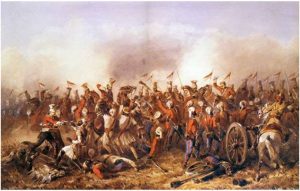
The First Anglo-Sikh War was fought between the British East India Company and the Sikh Empire from 1845 to 1846. The primary cause of this conflict was the increasing tensions between the British and the Sikh Empire after the death of Maharaja Ranjit Singh in 1839. His death left a power vacuum, and the subsequent internal turmoil within the Sikh Empire made it easier for the British to exert pressure on the region.
The First Anglo-Sikh War was fought between the British East India Company and the forces of the Sikh Empire. The British were led by Sir Hugh Gough, while the Sikh forces were commanded by their generals, such as Sardar Tej Singh and Sardar Gulab Singh.
The war started when the British attempted to assert control over the Sikh territories, which were rich in resources and strategically important for the British Empire. The initial battles were fought near the Sutlej River, where the Sikh forces attempted to defend their territory. Despite initial successes, the Sikh forces were eventually defeated due to superior British military tactics and resources.
The war ended with the signing of the Treaty of Lahore in 1846. According to this treaty, the Sikh Empire was forced to cede significant portions of its territory to the British and pay a heavy indemnity. Additionally, the British installed a puppet ruler, Maharaja Gulab Singh, who was granted control of Jammu and Kashmir in return for a large payment to the British.
The Second Anglo-Sikh War was a direct consequence of the instability that followed the First Anglo-Sikh War. Following the Treaty of Lahore, the Sikh Empire had been reduced in size, and internal dissensions further weakened its authority. The Sikh military, which was once a formidable force, was now in disarray. However, the desire to reclaim lost territory and independence led to renewed resistance against British rule.
The Second Anglo-Sikh War was fought between the British East India Company and the Sikh Empire, led by Sher Singh Attariwala, the son of the former Sikh general, and other leaders like Chattar Singh Attariwala. The British were led by Sir Hugh Gough once again, supported by a number of British officers who had gained experience during the first war.
The Second Anglo-Sikh War saw a number of intense battles, including the Battle of Gujrat in 1849, where the British decisively defeated the Sikh forces. Although the Sikh Empire had initially put up a strong resistance, it was unable to recover its previous power. The war culminated in the annexation of Punjab into British India.
The war ended with the Treaty of Amritsar in 1849, which officially annexed Punjab into the British East India Company’s territories. The British East India Company took full control of Punjab, and the Sikh military was disbanded. The British also took punitive measures against the leaders who had rebelled, with many being exiled or imprisoned. The result of the Second Anglo-Sikh War marked the complete disintegration of the Sikh Empire.
[metaslider id=”5575″]
Anglo-Sikh Wars led to significant consequences, such as the annexation of Punjab, the disbandment of the Sikh Army, and profound cultural and political shifts.
Are you preparing for UPSC 2025? Join IAShub’s UPSC coaching batches to boost your preparation. Enroll now!
The First Anglo-Sikh War (1845-1846) was fought between the British East India Company and the Sikh Empire due to rising tensions after the death of Maharaja Ranjit Singh, leading to British intervention.
The First Anglo-Sikh War was fought between the British East India Company, led by Sir Hugh Gough, and the Sikh Empire, commanded by generals like Sardar Tej Singh and Sardar Gulab Singh.
Second Anglo-Sikh War (1848-1849) was fought between the British East India Company and the weakened Sikh Empire, resulting in the annexation of Punjab into British India after a series of battles.
Treaty of Amritsar (1849) marked the end of the Second Anglo-Sikh War, leading to the annexation of Punjab into British India and the disbandment of the Sikh military.

Refine your answer writing skills and elevate your UPSC preparation with personalized support and expert feedback.
Fill out the form to get started with the program or any other enquiries !



Are you dreaming of becoming an IAS officer? Then, IAShub can be your best guide. It is one of the Best IAS Coaching in Delhi. Many students who want to clear the UPSC exam join IAShub for learning. The institute gives both online and offline classes. Their teachers are experienced and helpful. They easily explain every topic. Students also get notes, tests, and tips to do well in the exam.
IAShub is in Delhi and is trusted by many UPSC students. It offers coaching for every part of the UPSC exam – Prelims, Mains, and Interview. The classes are simple and easy to understand. The teachers are experts and guide students in the right way. IAShub is also known for its helpful notes, test series, and answer-writing practice. IAShub is the best coaching in Delhi and also gives UPSC Online Classes. This helps students from any place in India to learn. The online classes are live and also recorded. So, students can watch them anytime. These classes cover the full UPSC syllabus.
Here are some important services provided by IAShub:
The UPSC Civil Services Exam has three parts:
This exam is tough, but with the right guidance, it becomes easy to manage. Students must study smart and stay regular.
IAShub supports students from the beginning to the end. It gives the right books, tests, and notes. The classes are easy to follow, and the teachers are always ready to help. Students get personal doubt sessions too. The test series and answer checking help students learn where they need to do better. Also, free study materials save time and money.
IAShub also guides students during the final stage – the interview. Experts take mock interviews and give useful tips. This full support makes IAShub one of the best IAS coaching in Delhi.

Join 50,000+ UPSC Aspirants! 🚀
Get Free UPSC/IAS Study Materials, Daily Current Affairs, Editorial Summaries & Exam Updates.
Join Telegram Channel