15 August vs 26 January, Learn the key difference between Independence Day and Republic Day, their history, celebrations, symbolism, and why both hold a special place in India’s journey from freedom to becoming a constitutional republic.
 theIAShub | 13 Aug, 2025 | 6708 | 0 |
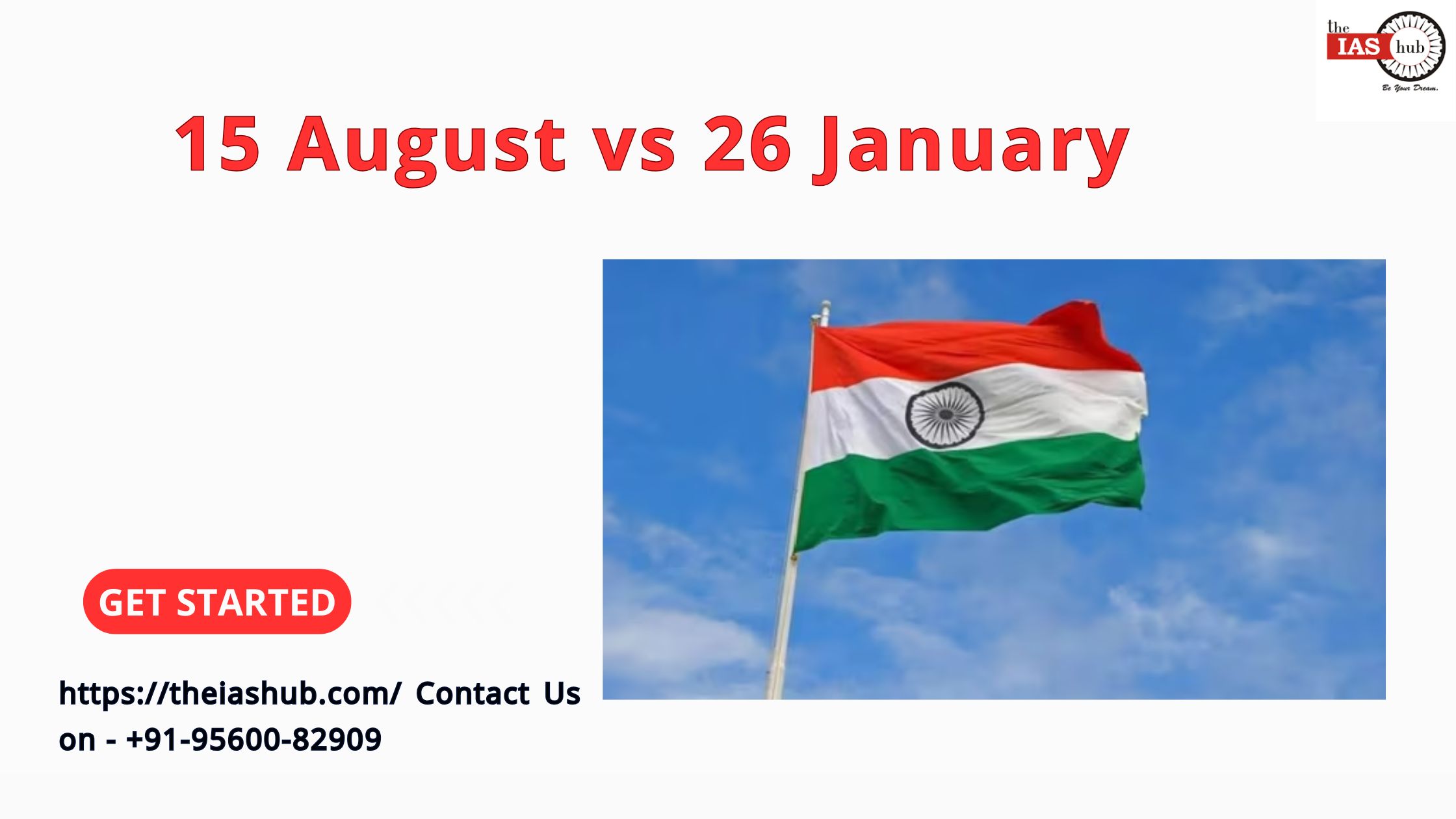

India commemorates two vital milestones in its journey to nationhood: 15 August vs 26 January. While both days evoke strong national pride, they represent very different chapters in India’s history. Let’s explore the difference between 15 August vs 26 January, diving into the significance of Independence Day vs Republic Day.
On Independence Day, Prime Minister hoists the national flag at the Red Fort in Delhi. Flag is pulled up to the top of the pole and then unfurled, symbolising the nation freedom after years of struggle. In contrast, on Republic Day (26 January), the President of India hoists the flag at Kartavya Path (formerly Rajpath). Here, the flag is tied at the top and unfurled, representing the formal establishment of India’s constitutional governance.
Also Read: Independence Day 2025
|
Date |
Occasion | Year Started |
Significance |
| 15 August | Independence Day | 1947 | Marks India’s freedom from British rule |
| 26 January | Republic Day | 1950 | Marks adoption of the Indian Constitution |
Here are the historical significances related to Independence Day vs Republic Day:
|
Aspect |
15 August (Independence Day) |
26 January (Republic Day) |
| Event Trigger | End of British colonial rule | Enforcement of the Constitution |
| Declared By | Lord Mountbatten & Indian leaders | Constituent Assembly of India |
| Reason for Date | Transfer of power from Britain on 15 August 1947 | 26 January chosen to honour the 1930 Declaration of Purna Swaraj |
Here are the key differences between Independence Day and Republic Day:
|
Aspect |
15 August (Independence Day) |
26 January (Republic Day) |
| Meaning | Mark’s end of British rule (1947) | Constitutes India as a republic under its Constitution (1950) |
| Who Hoists Flag | Prime Minister at Red Fort | President at Kartavya Path (formerly Rajpath) |
| Main Celebrations | Flag hoisting, cultural programs, singing | Grand military and cultural parade, tableaux, and foreign guests |
| Tone of Event | Festive and patriotic | Formal and emblematic of constitutional pride |
| Key Symbolism | Freedom and independence | Democratic governance and rule of law |
Here is the information related to different Celebrations and ceremonies:
|
Feature |
15 August |
26 January |
| Main Event | PM’s speech and flag hoisting | Republic Day Parade |
| Parade | Limited to local events | Grand national parade with military display |
| Cultural Programs | Patriotic songs, kite flying, and school performances | Tableaux, folk dances, and award ceremonies |
| Public Participation | Highly decentralised | Mostly centralised in Delhi with state-level parades |
Key aspects of the 15 August and 26 January are:

Here are the details related to the Symbolism Awards and International aspects for Republic Day and Independence Day:
|
Aspect |
15 August (Independence Day) |
26 January (Republic Day) |
| Symbolic Meaning | Freedom from British rule; sovereignty of the nation | Democracy, constitutional governance, and unity |
| Core Message | “We are free” – celebrates sacrifices and the birth of the nation | “We govern ourselves” – showcases India’s democratic framework |
| National Focus | Remembering the struggle for independence | Celebrating the enforcement of the Constitution |
| Awards & Honours | Rarely associated with national awards | Gallantry awards like Param Vir Chakra, Ashok Chakra, and civilian Padma Awards are presented |
| International Participation | No foreign dignitary invited | Foreign Head of State or Government invited as Chief Guest |
| Global Message | Projects the story of India’s freedom struggle to the world | Demonstrates India’s cultural richness and military strength globally |
Although often conflated, 15 August vs 26 January reflect distinctly different landmarks in India’s democratic evolution. Independence Day symbolizes the end of external rule, while Republic Day marks the affirmation of India’s sovereign identity under its Constitution.

On 15 August, the Prime Minister hoists the flag at the Red Fort in Delhi. On 26 January, the President of India hoists the flag at Kartavya Path during the Republic Day Parade.
26 January was chosen to honour the date in 1930 when the Indian National Congress declared Purna Swaraj (Complete Independence) during the Lahore Session.
Independence Day celebrations include the PM’s speech, flag hoisting, cultural programs, and kite flying. Republic Day is marked by a grand parade, military displays, cultural tableaux, and the presence of a foreign chief guest.
Republic Day sees the announcement and presentation of prestigious honours like the Padma Awards (Padma Shri, Padma Bhushan, Padma Vibhushan) and gallantry awards such as the Param Vir Chakra and Ashok Chakra.

Refine your answer writing skills and elevate your UPSC preparation with personalized support and expert feedback.
Fill out the form to get started with the program or any other enquiries !
Are you dreaming of becoming an IAS officer? Then, IAShub can be your best guide. It is one of the Best IAS Coaching in Delhi. Many students who want to clear the UPSC exam join IAShub for learning. The institute gives both online and offline classes. Their teachers are experienced and helpful. They easily explain every topic. Students also get notes, tests, and tips to do well in the exam.
IAShub is in Delhi and is trusted by many UPSC students. It offers coaching for every part of the UPSC exam – Prelims, Mains, and Interview. The classes are simple and easy to understand. The teachers are experts and guide students in the right way. IAShub is also known for its helpful notes, test series, and answer-writing practice. IAShub is the best coaching in Delhi and also gives UPSC Online Classes. This helps students from any place in India to learn. The online classes are live and also recorded. So, students can watch them anytime. These classes cover the full UPSC syllabus.
Here are some important services provided by IAShub:
The UPSC Civil Services Exam has three parts:
This exam is tough, but with the right guidance, it becomes easy to manage. Students must study smart and stay regular.
IAShub supports students from the beginning to the end. It gives the right books, tests, and notes. The classes are easy to follow, and the teachers are always ready to help. Students get personal doubt sessions too. The test series and answer checking help students learn where they need to do better. Also, free study materials save time and money.
IAShub also guides students during the final stage – the interview. Experts take mock interviews and give useful tips. This full support makes IAShub one of the best IAS coaching in Delhi.