


Discover the inspiring role of women in Indian freedom struggle, from Rani Lakshmi Bai to Sarojini Naidu, and their contributions to India’s independence.
 theIASHub | 24 Sep, 2025 | 4060

The story of India’s independence is incomplete without acknowledging the courage and determination of women in Indian freedom struggle. From Rani Lakshmi Bai to Sarojini Naidu, Annie Besant to Kasturba Gandhi, countless women stood shoulder to shoulder with men, sacrificing comfort, family, and even their lives for the larger cause of independence. Their role was not limited to support; they led movements, addressed public gatherings, challenged the colonial government, and even took up arms. The participation of women in Indian freedom struggle not only strengthened the national movement but also laid the foundation for gender equality in modern India.
India has a long history of brave women who resisted oppression and injustice. Even before Gandhi’s mass movements, leaders like Rani Lakshmi Bai and Begum Hazrat Mahal emerged as symbols of courage. Their sacrifices inspired later generations of women in Indian freedom struggle to take active roles in political, social, and revolutionary activities.
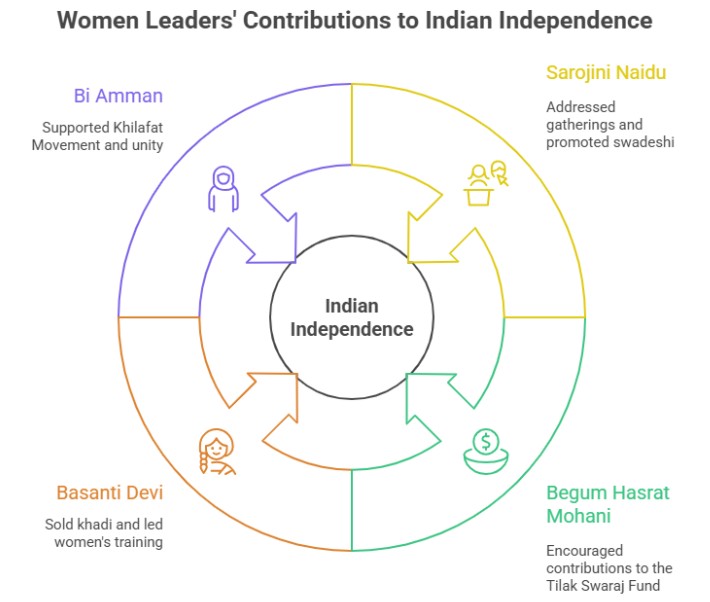
When the Non-Cooperation Movement began in 1920 under Gandhi’s leadership, the role of women in Indian freedom struggle was initially limited to boycotts and swadeshi. They were encouraged to boycott foreign goods and promote Indian-made products.
Despite the limited scope, many women emerged as powerful voices. Sarojini Naidu, Begum Hasrat Mohani, Basanti Devi, and Sarala Devi Chaudhurani addressed large gatherings, encouraging women to contribute to the Tilak Swaraj Fund and embrace swadeshi.
The formation of Rashtriya Stree Sangh was a milestone, connecting women with the national cause. Its members promoted khadi in Bombay and organized strikes during the Prince of Wales’ visit in 1921. These initiatives showed how women in Indian freedom struggle were beginning to move from the private to the public sphere.
The Civil Disobedience Movement saw an expansion of women’s roles. Women in Bombay, under Sarojini Naidu’s leadership, protested the Simon Commission, demanding complete Swaraj and inclusion of women in political processes.
Gandhi legitimized the political involvement of women, encouraging them to take part in picketing, boycotts, and demonstrations. The participation of women in Indian freedom struggle now became more organized and visible.
Several organizations played a pivotal role in mobilizing women:
Kasturba Gandhi, wife of Mahatma Gandhi, actively promoted khadi and endured several imprisonments. Her leadership symbolized the grassroots participation of women in Indian freedom struggle, inspiring women from villages and towns alike.
The Quit India Movement of 1942 saw women emerge as fearless leaders. Usha Mehta founded the Voice of Freedom underground radio network to broadcast updates on protests and British atrocities, keeping the spirit of resistance alive.
In Bengal, women joined the Mahila Atmaraksha Samiti, which organized self-defence training for women. These committees highlighted the growing assertiveness of women in Indian freedom struggle.
Unlike earlier movements where roles were segregated, the Quit India Movement witnessed women and men fighting side by side. Women no longer needed separate platforms; they led processions, organized strikes, and directly confronted colonial authorities.
Subhas Chandra Bose created history by establishing the Rani of Jhansi Regiment under the Indian National Army (INA). Women soldiers like Captain Lakshmi Sehgal and Colonel Latika Ghosh took part in military marches and warfare training, proving that women in Indian freedom struggle could also be warriors on the battlefield.
Not all women confined themselves to Gandhian movements. Many joined revolutionary organizations and undertook militant action.
These women challenged stereotypes, proving that women could be as daring and determined as their male counterparts.
The contribution of women in Indian freedom struggle was not only political but also social and cultural. They broke centuries-old traditions, entered public life, and asserted their right to fight for justice. Their participation ensured that the freedom movement was inclusive and democratic.
By the time India gained independence in 1947, the role of women had transformed society’s perception of gender. They paved the way for post-independence reforms such as women’s suffrage, legal equality, and greater access to education and employment.
The story of women in Indian freedom struggle is one of resilience, sacrifice, and leadership. From the Non-Cooperation Movement to the Quit India Movement, from peaceful protests to armed revolution, women proved themselves as equal partners in the fight for freedom. Leaders like Sarojini Naidu, Annie Besant, Kasturba Gandhi, Usha Mehta, and countless unsung heroines showed that the independence of India was achieved through the combined efforts of both men and women.
Their courage continues to inspire generations, reminding us that the fight for justice and equality never ends.


Refine your answer writing skills and elevate your UPSC preparation with personalized support and expert feedback.
Fill out the form to get started with the program or any other enquiries !

Are you dreaming of becoming an IAS officer? Then, IAShub can be your best guide. It is one of the Best IAS Coaching in Delhi. Many students who want to clear the UPSC exam join IAShub for learning. The institute gives both online and offline classes. Their teachers are experienced and helpful. They easily explain every topic. Students also get notes, tests, and tips to do well in the exam.
IAShub is in Delhi and is trusted by many UPSC students. It offers coaching for every part of the UPSC exam – Prelims, Mains, and Interview. The classes are simple and easy to understand. The teachers are experts and guide students in the right way. IAShub is also known for its helpful notes, test series, and answer-writing practice. IAShub is the best coaching in Delhi and also gives UPSC Online Classes. This helps students from any place in India to learn. The online classes are live and also recorded. So, students can watch them anytime. These classes cover the full UPSC syllabus.
Here are some important services provided by IAShub:
The UPSC Civil Services Exam has three parts:
This exam is tough, but with the right guidance, it becomes easy to manage. Students must study smart and stay regular.
IAShub supports students from the beginning to the end. It gives the right books, tests, and notes. The classes are easy to follow, and the teachers are always ready to help. Students get personal doubt sessions too. The test series and answer checking help students learn where they need to do better. Also, free study materials save time and money.
IAShub also guides students during the final stage – the interview. Experts take mock interviews and give useful tips. This full support makes IAShub one of the best IAS coaching in Delhi.
Join 39,000+ UPSC Aspirants! 🚀
Get Free UPSC/State PSC Study Materials, Daily Current Affairs Question & Exam Updates.
Join Telegram Channel
