


Explore the legacy of Vinoba Bhave in Independence India as a spiritual reformer. Learn how his Bhoodan, Gramdan, and Sarvodaya movements championed non-violent land reform, rural upliftment, moral education, and self-sufficient village life.
 theIASHub | 28 Jun, 2025 | 1721

Vinoba Bhave in Independence India is remembered as a symbol of spiritual activism and Gandhian reform. Known as the spiritual successor of Mahatma Gandhi, Bhave was not a freedom fighter in the conventional sense, yet his post-independence work had a profound impact on Indian society. Through movements like Bhoodan, Gramdan, and Sarvodaya, Vinoba Bhave focused on non-violent land reforms, rural upliftment, and moral education, reshaping the ideals of free India.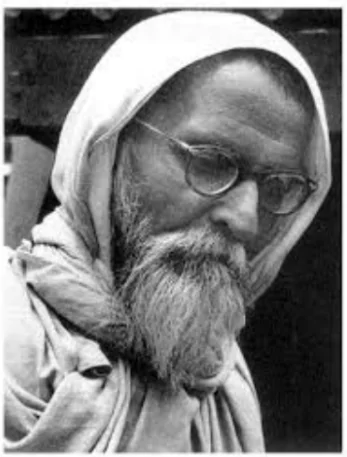
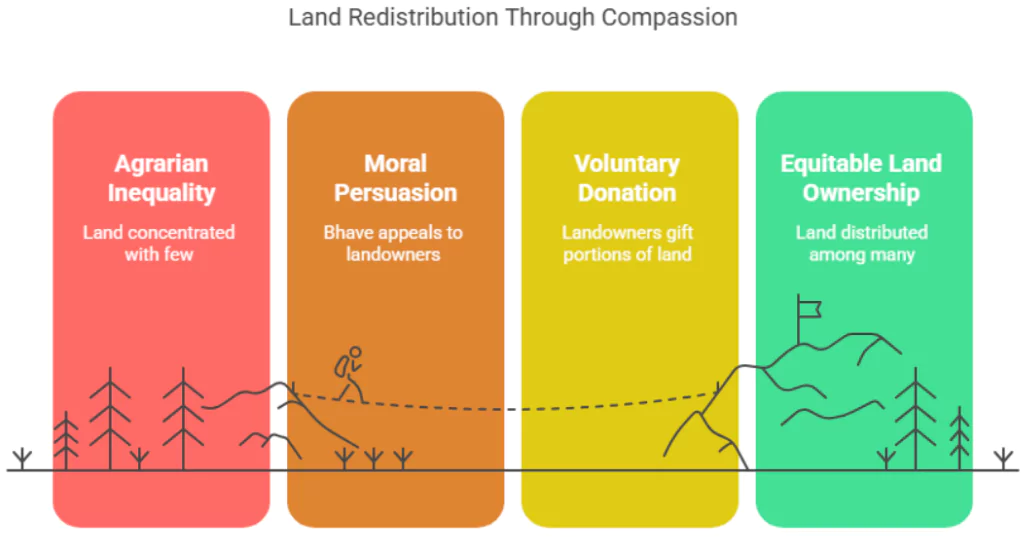
One of the most significant contributions of Vinoba Bhave in Independence India was the Bhoodan Movement, initiated in 1951 in Pochampally, Telangana. This movement reflected Gandhian ideals of non-violence, voluntary service, and equity.
Bhoodan translates to “land gift.” Bhave urged wealthy landowners to voluntarily donate a portion of their land to the landless. He traveled on foot from village to village, persuading landowners not through coercion, but through moral appeal.
This movement was a hallmark of the influence of Vinoba Bhave in Independence India, as it attempted to solve agrarian inequality through compassion and ethics.
Following the success of Bhoodan, Vinoba Bhave in Independence India launched the Gramdan Movement, an even more ambitious plan where entire villages donated their land for communal ownership and management.
The Gramdan Movement promoted:
Bhave believed that through collective responsibility, villages could become self-reliant units of economy and morality, reducing dependence on state mechanisms and external markets.
Another major initiative that defines Vinoba Bhave in Independence India is the Sarvodaya Movement, meaning “universal uplift” or “progress for all.”
Inspired by Gandhi’s principles, Sarvodaya aimed at creating a non-violent, classless, and exploitation-free society. Bhave envisioned a society where:
The Sarvodaya Movement remains one of the central elements when studying Vinoba Bhave in Independence India, representing his deep commitment to ethical socialism and human dignity.
A crucial part of Vinoba Bhave in Independence India was his continuous advocacy for non-violence and peace. He introduced the concept of Shanti Sena, or “peace army,” which was a volunteer force trained in resolving social conflicts peacefully.
Bhave believed that true independence was not just political freedom, but freedom from hatred, fear, and violence.
Another essential aspect of Vinoba Bhave in Independence India was his commitment to educational transformation. He promoted Nai Talim, or "Basic Education," an idea originally propounded by Gandhi and further developed by Bhave.
This holistic model emphasized that schools must be tied to the economic and cultural life of villages, reflecting Bhave’s belief in rooted, practical learning.
Vinoba Bhave in Independence India was not only a social reformer but also a respected spiritual figure. He blended Vedantic philosophy with Gandhian activism, making his messages both ethical and transformative.
His books and talks emphasized inner purity, humility, and devotion, making him a moral compass for post-independent India.
A vital theme throughout the life of Vinoba Bhave in Independence India was his vision for village-level economic self-reliance. He believed that every village should produce its basic needs—food, clothing, shelter, and education—locally, reducing dependence on imports and external markets.
His economic ideas aligned closely with Gandhi’s vision of self-sufficient rural India and remain relevant even today in the context of sustainability and local governance.
The legacy of Vinoba Bhave in Independence India is one of silent yet powerful transformation. Unlike political leaders who sought power, Bhave pursued peace, equity, and inner change. His Bhoodan, Gramdan, and Sarvodaya movements were landmark attempts at creating a just and harmonious society.
He proved that revolution does not always need violence, and reforms can stem from the soul. His emphasis on non-violence, moral education, and village empowerment remains a blueprint for grassroots transformation even in the 21st century.


Refine your answer writing skills and elevate your UPSC preparation with personalized support and expert feedback.
Fill out the form to get started with the program or any other enquiries !

Are you dreaming of becoming an IAS officer? Then, IAShub can be your best guide. It is one of the Best IAS Coaching in Delhi. Many students who want to clear the UPSC exam join IAShub for learning. The institute gives both online and offline classes. Their teachers are experienced and helpful. They easily explain every topic. Students also get notes, tests, and tips to do well in the exam.
IAShub is in Delhi and is trusted by many UPSC students. It offers coaching for every part of the UPSC exam – Prelims, Mains, and Interview. The classes are simple and easy to understand. The teachers are experts and guide students in the right way. IAShub is also known for its helpful notes, test series, and answer-writing practice. IAShub is the best coaching in Delhi and also gives UPSC Online Classes. This helps students from any place in India to learn. The online classes are live and also recorded. So, students can watch them anytime. These classes cover the full UPSC syllabus.
Here are some important services provided by IAShub:
The UPSC Civil Services Exam has three parts:
This exam is tough, but with the right guidance, it becomes easy to manage. Students must study smart and stay regular.
IAShub supports students from the beginning to the end. It gives the right books, tests, and notes. The classes are easy to follow, and the teachers are always ready to help. Students get personal doubt sessions too. The test series and answer checking help students learn where they need to do better. Also, free study materials save time and money.
IAShub also guides students during the final stage – the interview. Experts take mock interviews and give useful tips. This full support makes IAShub one of the best IAS coaching in Delhi.
Join 39,000+ UPSC Aspirants! 🚀
Get Free UPSC/State PSC Study Materials, Daily Current Affairs Question & Exam Updates.
Join Telegram Channel
