


Discover the 1000-word journey of the Unification of Italy – key events, leaders like Mazzini, Cavour, Garibaldi, and the impact on modern Europe.
 theIASHub | 13 Jun, 2025 | 139

The Unification of Italy in the 19th century was a turning point in European history that transformed a fragmented peninsula into a unified nation-state. This monumental process was driven by the power of nationalism, revolutionary leadership, and diplomatic strategies. The Unification of Italy was not a single event but a series of interconnected political, military, and diplomatic efforts that finally led to the formation of the Kingdom of Italy in 1871.
“Italy is my country, Rome is my city, and humanity is my religion.” – Giuseppe Mazzini
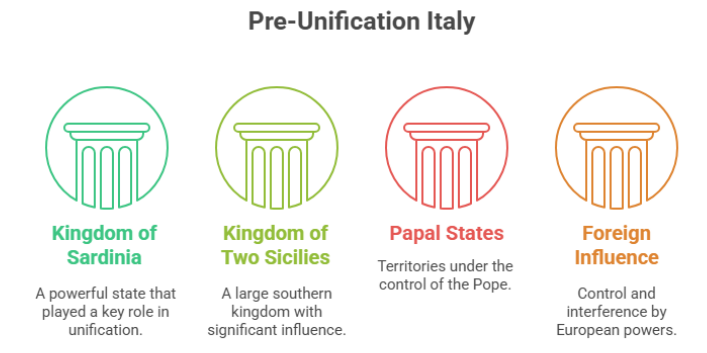
Before the Unification of Italy, the Italian peninsula was divided into multiple independent states and territories. These included the Kingdom of Sardinia, the Kingdom of the Two Sicilies, the Papal States, and various duchies and republics. Many of these regions were under foreign rule or influence from Austria, France, and Spain, which greatly obstructed any collective national movement.
The influence of powerful foreign empires was deeply entrenched in Italian affairs. Austria controlled Lombardy and Venetia, France supported the Papal States, and Spain had historical dominance over the southern parts of Italy. This interference made the Unification of Italy a difficult and prolonged struggle.
The ideals of liberty, equality, and fraternity spread during the French Revolution, deeply impacting Italian intellectuals. Napoleon’s campaigns exposed the Italian states to concepts of unified governance and national identity, indirectly sowing the seeds for the Unification of Italy.
Giuseppe Mazzini, a passionate nationalist, played a significant role in awakening Italian national consciousness. In 1831, he founded Young Italy, a secret society advocating for a democratic and unified Italian republic. Though his revolutionary attempts failed, Mazzini inspired future leaders and laid the ideological foundation for the Unification of Italy.
The 1848 revolts were a series of widespread uprisings across Europe, including Italy. These revolts were driven by demands for national independence, constitutional governance, and liberal reforms. Although the revolts were suppressed, they intensified the desire for the Unification of Italy.
While the revolts failed to dislodge Austrian dominance or achieve unification, they marked a shift in political consciousness. They highlighted the need for strategic leadership and unity in the pursuit of a single Italian nation.
Count Camillo di Cavour, Prime Minister of the Kingdom of Sardinia, emerged as the political architect of the Unification of Italy. He adopted a pragmatic approach known as realpolitik, focusing on strategic alliances and modernization rather than idealism.
Cavour secured a military alliance with Napoleon III of France. Together, they launched a war against Austria, defeating them and liberating northern Italian territories. These regions were then united under the Sardinian monarchy.
Giuseppe Garibaldi, a military hero, led the expedition of the Red Shirts to liberate the Kingdom of the Two Sicilies. In 1860, he successfully overthrew the Bourbon rule and handed over the territories to the King of Sardinia, accelerating the Unification of Italy.
Italy allied with Prussia in the Austro-Prussian War of 1866. After Austria’s defeat, Venetia was ceded to Italy, furthering the cause of the Unification of Italy.
The withdrawal of French troops during the Franco-Prussian War allowed Italian forces to capture Rome. With Rome declared the capital in 1871, the Unification of Italy was finally complete.
The Unification of Italy established a constitutional monarchy under King Victor Emmanuel II, replacing fragmented and foreign-dominated states with a single Italian government.
Northern Italy, especially, saw rapid industrial growth. Railways, telegraphs, and modern infrastructure projects connected regions and boosted trade.
National education policies promoted a unified Italian identity, although linguistic and cultural differences persisted, especially between the north and south.
Unified Italy became an active participant in European diplomacy. Italy joined the Triple Alliance with Germany and Austria-Hungary, seeking to assert its position as a modern nation-state.
Despite the success of unification, Italy faced many internal issues. Economic disparities, especially between the industrial north and the agrarian south, created social unrest. Regionalism, poverty, and emigration were persistent challenges.
The Unification of Italy in 1871 was a milestone that transformed the Italian peninsula from a patchwork of states into a united nation. It demonstrated how nationalism, strategic diplomacy, and visionary leadership could overcome deep-rooted fragmentation. Although post-unification Italy faced many hurdles, the movement remains a symbol of national pride and political achievement.
The Unification of Italy laid the foundation for Italy’s role in modern European politics and inspired other nationalist movements across the continent.




Refine your answer writing skills and elevate your UPSC preparation with personalized support and expert feedback.
Fill out the form to get started with the program or any other enquiries !





Are you dreaming of becoming an IAS officer? Then, IAShub can be your best guide. It is one of the Best IAS Coaching in Delhi. Many students who want to clear the UPSC exam join IAShub for learning. The institute gives both online and offline classes. Their teachers are experienced and helpful. They easily explain every topic. Students also get notes, tests, and tips to do well in the exam.
IAShub is in Delhi and is trusted by many UPSC students. It offers coaching for every part of the UPSC exam – Prelims, Mains, and Interview. The classes are simple and easy to understand. The teachers are experts and guide students in the right way. IAShub is also known for its helpful notes, test series, and answer-writing practice. IAShub is the best coaching in Delhi and also gives UPSC Online Classes. This helps students from any place in India to learn. The online classes are live and also recorded. So, students can watch them anytime. These classes cover the full UPSC syllabus.
Here are some important services provided by IAShub:
The UPSC Civil Services Exam has three parts:
This exam is tough, but with the right guidance, it becomes easy to manage. Students must study smart and stay regular.
IAShub supports students from the beginning to the end. It gives the right books, tests, and notes. The classes are easy to follow, and the teachers are always ready to help. Students get personal doubt sessions too. The test series and answer checking help students learn where they need to do better. Also, free study materials save time and money.
IAShub also guides students during the final stage – the interview. Experts take mock interviews and give useful tips. This full support makes IAShub one of the best IAS coaching in Delhi.
 Detailed Solutions & Explanations
Improve Your Answer Writing & Strategy
Detailed Solutions & Explanations
Improve Your Answer Writing & Strategy

