


Explore the Unification of Germany (1871), its causes, key events, and long-term impacts on European politics, nationalism, and balance of power.
 theIASHub | 13 Jun, 2025 | 959

The Unification of Germany in 1871 was one of the most significant milestones in European history. Spearheaded by Otto von Bismarck, the Prussian Chancellor, the unification transformed a fragmented region of over 300 states into a powerful and centralized empire. This monumental achievement reshaped the political, economic, and military landscape of Europe and set the stage for events leading to World War I. The Unification of Germany reflected a mix of military strategy, diplomacy, nationalism, and political pragmatism.
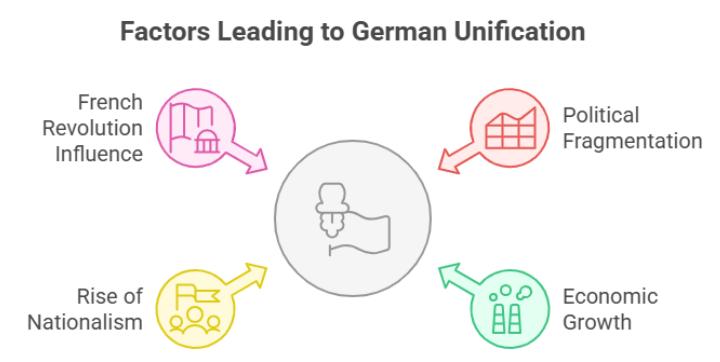
Understanding the Unification of Germany requires a look into the conditions that existed prior to 1871.
Before unification, the German region was divided into more than 300 independent states, remnants of the Holy Roman Empire. After its dissolution, the German Confederation was established in 1815, consisting of 39 states loosely bound under Austrian influence. This fragmentation hindered political unity and cooperation.
By the early 19th century, Prussia and the Rhineland saw significant industrial growth. The formation of the Zollverein (1834), a customs union, helped eliminate internal tariffs and promoted economic integration among the German states, laying a strong foundation for eventual political unity.
The rise of nationalism greatly contributed to the Unification of Germany. Enlightenment and Romantic ideals encouraged a collective German identity. Thinkers like Johann Gottlieb Fichte emphasized cultural unity and self-determination, inspiring youth and intellectuals alike.
The French Revolution and the Napoleonic Wars had a significant ideological and political influence. They introduced ideas of sovereignty, equality, and centralized governance, encouraging German states to reconsider the benefits of unification.
The Unification of Germany was shaped largely by the rivalry between Austria and Prussia, both vying for dominance within the German Confederation. Austria’s conservative policies clashed with Prussia’s reform-oriented and militaristic ambitions.
Prussia’s military modernization played a pivotal role. Well-trained and equipped, the Prussian army led successful wars that would ultimately unify the German states under Prussian control.
Otto von Bismarck, one of history’s greatest statesmen, engineered the Unification of Germany through his policy of "Blood and Iron"—a mix of diplomacy and military force. He believed that speeches and resolutions were not enough; unification required strength and decisive action.
“The task of the leader is to get their people from where they are to where they have not been.” – Otto von Bismarck
Bismarck formed an alliance with Austria to defeat Denmark and annex the duchies of Schleswig and Holstein, expanding Prussian influence in northern Germany.
Bismarck diplomatically isolated Austria before defeating it in the Battle of Königgrätz. Austria was excluded from German affairs, and the German Confederation was dissolved, replaced by the North German Confederation under Prussian leadership.
This war was the final step in the Unification of Germany. Bismarck manipulated the Ems Dispatch to provoke France into declaring war. The Southern German states, initially reluctant, joined Prussia, leading to a swift victory over France. In January 1871, the German Empire was proclaimed in the Hall of Mirrors at Versailles, with the King of Prussia as Kaiser Wilhelm I.
Napoleon's campaigns ended many feudal divisions, reducing the number of German states to 38, paving the way for eventual unity.
The French Revolution inspired German liberals and nationalists to seek democracy, civil rights, and unity.
Formed at the Congress of Vienna, the German Confederation failed to provide strong central leadership and was dominated by Austria, leading to dissatisfaction.
The 1848 revolutions were a significant turning point. People across the German states revolted against monarchies, demanding a unified Germany and democratic reforms.
An attempt to create a unified constitution through the Frankfurt Parliament failed when the Prussian king refused the crown, stating he would not accept it from the people.
The revolutions were suppressed, and monarchs revoked constitutional rights. However, these failures convinced nationalists that only military power and monarchy, not liberalism, would lead to unification.
The Unification of Germany had far-reaching consequences in Europe and globally.
It created a centralized German Empire under Prussian leadership, enhancing political stability and administrative efficiency.
Unified Germany saw rapid industrialization, infrastructure development, and growth in sectors like steel, coal, and railways, making it a leading European economy.
The new German Empire possessed one of the most powerful militaries in Europe, influencing future conflicts and alliances.
For the first time, German-speaking people were united under one flag, fostering a strong national identity, pride, and loyalty to the state.
The Unification of Germany disrupted the traditional balance of power. Germany became a major continental force, challenging France, Austria, and even Britain, contributing to increasing tensions.
Under Bismarck and subsequent leaders, Germany pursued colonial ambitions, formed alliances, and adopted an assertive stance in international affairs, which eventually contributed to World War I.
The Franco-Prussian War, the final step in German unification, saw France suffer a humiliating defeat. This left deep resentment in France, planting the seeds of Franco-German hostility that persisted for decades and resurfaced in both World Wars.
The Unification of Germany was a transformative event that changed the trajectory of Europe. Under Bismarck’s leadership, Germany emerged as a powerful and industrialized nation-state. While it brought political and economic unity to German-speaking regions, it also sowed the seeds for future European conflicts.
Today, the Unification of Germany stands as a symbol of how strategic leadership, military strength, and nationalism can reshape history—though not without consequences. It remains a critical chapter in understanding the origins of modern Europe and the dynamics of power, identity, and diplomacy.


Refine your answer writing skills and elevate your UPSC preparation with personalized support and expert feedback.
Fill out the form to get started with the program or any other enquiries !
Are you dreaming of becoming an IAS officer? Then, IAShub can be your best guide. It is one of the Best IAS Coaching in Delhi. Many students who want to clear the UPSC exam join IAShub for learning. The institute gives both online and offline classes. Their teachers are experienced and helpful. They easily explain every topic. Students also get notes, tests, and tips to do well in the exam.
IAShub is in Delhi and is trusted by many UPSC students. It offers coaching for every part of the UPSC exam – Prelims, Mains, and Interview. The classes are simple and easy to understand. The teachers are experts and guide students in the right way. IAShub is also known for its helpful notes, test series, and answer-writing practice. IAShub is the best coaching in Delhi and also gives UPSC Online Classes. This helps students from any place in India to learn. The online classes are live and also recorded. So, students can watch them anytime. These classes cover the full UPSC syllabus.
Here are some important services provided by IAShub:
The UPSC Civil Services Exam has three parts:
This exam is tough, but with the right guidance, it becomes easy to manage. Students must study smart and stay regular.
IAShub supports students from the beginning to the end. It gives the right books, tests, and notes. The classes are easy to follow, and the teachers are always ready to help. Students get personal doubt sessions too. The test series and answer checking help students learn where they need to do better. Also, free study materials save time and money.
IAShub also guides students during the final stage – the interview. Experts take mock interviews and give useful tips. This full support makes IAShub one of the best IAS coaching in Delhi.
 Detailed Solutions & Explanations
Improve Your Answer Writing & Strategy
Detailed Solutions & Explanations
Improve Your Answer Writing & Strategy

