


Explore different types of regionalism in India—inter-state, intra-state, linguistic, cultural, and political. Know how regional aspirations shape national unity.
 theIASHub | 19 Aug, 2025 | 1105

Types of Regionalism refer to the various ways regional aspirations, identities, and interests are expressed within a country. In a diverse nation like India, regionalism takes multiple forms—some constructive, fostering cooperation, and others demanding separation or autonomy. Understanding the different types of regionalism is crucial to grasp how India balances unity with diversity.
Regionalism arises due to socio-economic disparities, linguistic or cultural identities, geographical isolation, or historical neglect. It can be a powerful force for positive change or a disruptive challenge to national integration, depending on how it's addressed.
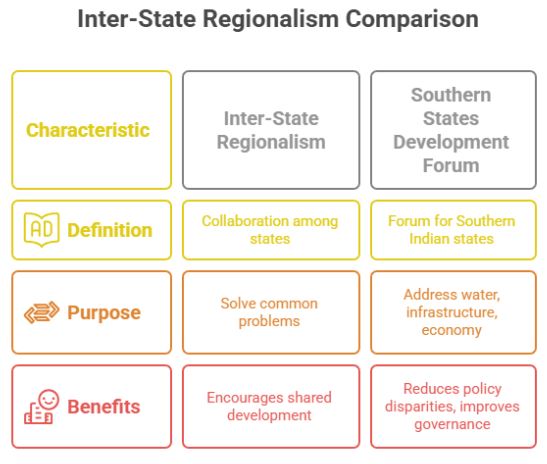
Inter-state regionalism refers to collaboration and coordination among various states of a country to solve common problems. It is one of the more positive types of regionalism, as it encourages states to work together for shared development.
In India, the Southern States Development Forum brings together states like Karnataka, Kerala, Tamil Nadu, Andhra Pradesh, and Telangana to address issues such as water sharing, infrastructure, and economic growth. This form of inter-state regionalism helps reduce policy disparities and improve governance outcomes.
Supra-state regionalism goes beyond individual state boundaries and focuses on broader regional cooperation for strategic or developmental goals. It is an inclusive form of regionalism that enhances unity by fostering joint efforts across multiple regions.
The North Eastern Council is a great example of supra-state regionalism. It aims to develop the North Eastern region as a whole by promoting socio-economic development, infrastructure building, and inter-state coordination. This type of regionalism helps in bridging developmental gaps in geographically isolated areas.
Intra-state regionalism involves movements or demands that arise within a single state. People belonging to a specific region within a state may feel neglected in terms of development, governance, or representation, prompting them to seek separate identity or autonomy.
The formation of Telangana in 2014 is a prime example of intra-state regionalism. The people of Telangana region, within Andhra Pradesh, demanded statehood due to perceived discrimination and lack of development. Their struggle reflects how intra-state regionalism can reshape the political map of a country.
Linguistic regionalism is a type of regionalism that centers around the promotion of a particular language or dialect. In India, language has been a powerful source of regional pride and political mobilization.
The demand for the recognition of Telugu language in Andhra Pradesh is a clear instance of linguistic regionalism. Similar movements led to the creation of linguistic states like Maharashtra (Marathi), Gujarat (Gujarati), and Karnataka (Kannada). This type of regionalism strengthens local identity while contributing to cultural diversity.
Ethnic and cultural regionalism arises when a community seeks to protect and promote its ethnic, religious, or cultural identity within a larger state or national framework. This type of regionalism is often driven by a fear of cultural extinction or loss of traditional practices.
The Gorkhaland movement in West Bengal is a significant case of ethnic and cultural regionalism. The Gorkha community demands a separate state to safeguard its unique cultural heritage, language, and traditions. This form of regionalism highlights the need for cultural recognition and local governance.
Political regionalism is one of the more assertive types of regionalism. It involves demands for political power, separate statehood, or even complete independence. Often, this kind of regionalism emerges when a group feels politically marginalized or excluded.
The demand for Bodoland in Assam is an example of political regionalism, where the Bodo people seek a separate state to protect their rights and ensure political representation. While political regionalism can lead to conflict, it also opens the door for constitutional reforms and decentralization.
Uneven development across states and regions fuels dissatisfaction and becomes a major trigger for intra-state or inter-state regionalism.
Language, traditions, and customs form the backbone of linguistic and cultural regionalism. People feel a strong connection to their roots and resist any threats to their identity.
Some regions feel neglected since independence in terms of infrastructure, employment, and education. This historical injustice sparks movements, particularly seen in North Eastern India.
When communities do not find political representation or autonomy, they turn toward political regionalism to assert their place in governance.
The Indian Constitution provides flexibility for state formation, language recognition, and cultural autonomy under various articles and schedules.
Democratic solutions like creating new states (e.g., Telangana) or councils (e.g., NEC) have been successful in resolving regionalism-based conflicts.
Special packages and schemes are launched for economically backward regions to reduce inter-state disparities and appease regional demands.
Understanding the types of regionalism is essential in managing India's complex socio-political landscape. Whether it’s linguistic, cultural, inter-state, or political regionalism, the key lies in recognizing legitimate demands while upholding national unity. A decentralized governance model that respects regional aspirations without compromising on constitutional integrity is the way forward.


Refine your answer writing skills and elevate your UPSC preparation with personalized support and expert feedback.
Fill out the form to get started with the program or any other enquiries !

Are you dreaming of becoming an IAS officer? Then, IAShub can be your best guide. It is one of the Best IAS Coaching in Delhi. Many students who want to clear the UPSC exam join IAShub for learning. The institute gives both online and offline classes. Their teachers are experienced and helpful. They easily explain every topic. Students also get notes, tests, and tips to do well in the exam.
IAShub is in Delhi and is trusted by many UPSC students. It offers coaching for every part of the UPSC exam – Prelims, Mains, and Interview. The classes are simple and easy to understand. The teachers are experts and guide students in the right way. IAShub is also known for its helpful notes, test series, and answer-writing practice. IAShub is the best coaching in Delhi and also gives UPSC Online Classes. This helps students from any place in India to learn. The online classes are live and also recorded. So, students can watch them anytime. These classes cover the full UPSC syllabus.
Here are some important services provided by IAShub:
The UPSC Civil Services Exam has three parts:
This exam is tough, but with the right guidance, it becomes easy to manage. Students must study smart and stay regular.
IAShub supports students from the beginning to the end. It gives the right books, tests, and notes. The classes are easy to follow, and the teachers are always ready to help. Students get personal doubt sessions too. The test series and answer checking help students learn where they need to do better. Also, free study materials save time and money.
IAShub also guides students during the final stage – the interview. Experts take mock interviews and give useful tips. This full support makes IAShub one of the best IAS coaching in Delhi.
Join 39,000+ UPSC Aspirants! 🚀
Get Free UPSC/State PSC Study Materials, Daily Current Affairs Question & Exam Updates.
Join Telegram Channel
