


Explore the structure, powers, challenges, and key reforms needed to improve tribunals in India and ensure faster, impartial justice delivery.
 theIASHub | 12 May, 2025 | 2212


Tribunals in India are quasi-judicial institutions established to resolve specific disputes outside the traditional court system. Unlike regular courts, Tribunals in India are set up under Acts of Parliament or State Legislatures to deal with particular matters like tax, environment, service disputes, and more.
They are meant to be cost-effective, faster, and expert-driven alternatives for dispute resolution. The 42nd Constitutional Amendment Act, 1976, added Articles 323-A and 323-B to the Constitution, enabling the formation of these tribunals.
Tribunals in India enjoy powers similar to civil courts in specific matters like summoning, examining witnesses, and producing documents. Although they are not bound by the Civil Procedure Code or Evidence Act, they follow Natural Justice principles, allowing more flexibility in dispute resolution.
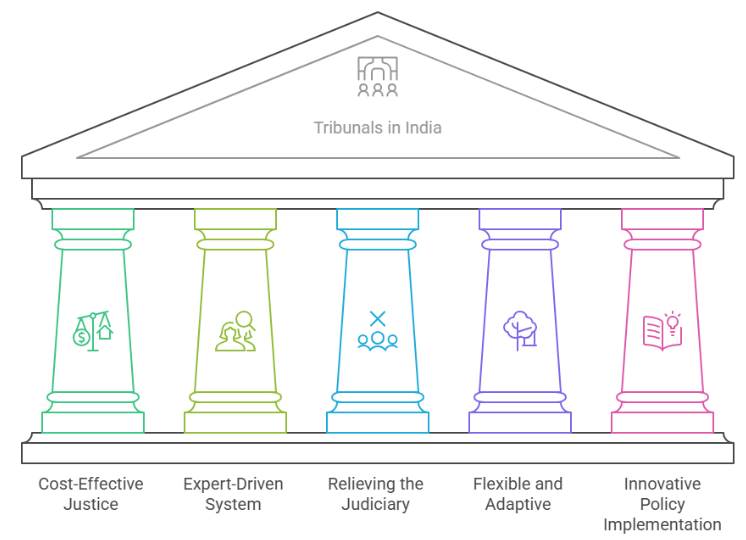
Cost-Effective and Speedy Justice
There is no requirement for court fees, elaborate pleadings, or trials. Tribunals in India enable swift disposal of cases through simplified procedures and oral hearings.
Tribunals are often manned by experts from the relevant fields. For example, Income Tax Appellate Tribunals include finance and legal professionals for informed decision-making.
With over 4.5 crore pending cases in regular courts, tribunals in India help ease the burden, ensuring faster justice for specific cases.
Tribunals in India are not bound by precedents and can modify their decisions based on new developments, aligning with changing social, economic, and legal contexts.
They provide a platform for testing new governance policies by resolving related disputes without clogging traditional courts.
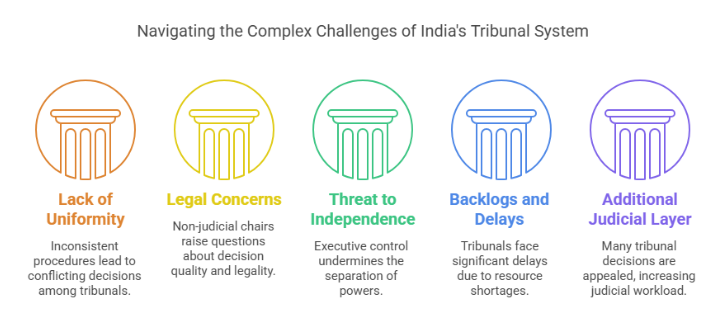
Different tribunals function without standard operating procedures, causing inconsistency and sometimes conflicting decisions in similar matters.
Tribunals are often chaired by non-judicial members lacking legal qualifications, raising questions about the legality and quality of decisions.
Since tribunals in India are controlled and staffed by executive authorities, it undermines the principle of separation of powers.
Despite being created to speed up justice, tribunals in India suffer from large backlogs and delays due to workforce shortages and inadequate infrastructure. As per the 272nd Law Commission Report, the top five central tribunals had a backlog of around 4 lakh cases.
Although tribunals bypass lower courts, many of their decisions are appealed in High Courts or the Supreme Court, increasing judicial workload.
A Selection Committee led by the Chief Justice of India should appoint key members of tribunals. Separate panels must be formed for administrative and technical members.
Ensure timely filling of vacancies to maintain the efficiency of tribunals in India.
Establish a nodal body under the Law Ministry to manage service conditions, appointments, and uniformity in the functioning of all tribunals.
Restore High Courts' review power over tribunal decisions, as suggested by the Chandra Kumar judgment (1997).
Tribunals should be established across the country, ideally where High Courts are located, to provide easy access to justice for all.
Tribunals in India are a crucial component of the judicial ecosystem, offering specialized, quicker, and cost-effective dispute resolution. However, to enhance their efficiency, impartiality, and public trust, reforms in appointment, infrastructure, and judicial oversight are essential.


Refine your answer writing skills and elevate your UPSC preparation with personalized support and expert feedback.
Fill out the form to get started with the program or any other enquiries !

Are you dreaming of becoming an IAS officer? Then, IAShub can be your best guide. It is one of the Best IAS Coaching in Delhi. Many students who want to clear the UPSC exam join IAShub for learning. The institute gives both online and offline classes. Their teachers are experienced and helpful. They easily explain every topic. Students also get notes, tests, and tips to do well in the exam.
IAShub is in Delhi and is trusted by many UPSC students. It offers coaching for every part of the UPSC exam – Prelims, Mains, and Interview. The classes are simple and easy to understand. The teachers are experts and guide students in the right way. IAShub is also known for its helpful notes, test series, and answer-writing practice. IAShub is the best coaching in Delhi and also gives UPSC Online Classes. This helps students from any place in India to learn. The online classes are live and also recorded. So, students can watch them anytime. These classes cover the full UPSC syllabus.
Here are some important services provided by IAShub:
The UPSC Civil Services Exam has three parts:
This exam is tough, but with the right guidance, it becomes easy to manage. Students must study smart and stay regular.
IAShub supports students from the beginning to the end. It gives the right books, tests, and notes. The classes are easy to follow, and the teachers are always ready to help. Students get personal doubt sessions too. The test series and answer checking help students learn where they need to do better. Also, free study materials save time and money.
IAShub also guides students during the final stage – the interview. Experts take mock interviews and give useful tips. This full support makes IAShub one of the best IAS coaching in Delhi.
Join 39,000+ UPSC Aspirants! 🚀
Get Free UPSC/State PSC Study Materials, Daily Current Affairs Question & Exam Updates.
Join Telegram Channel
