Tobacco Epidemic in India: Impact, Challenges, and Policy Response

Explore the Tobacco Epidemic in India—its causes, public health impact, policies, and hidden costs with insights into challenges and the way forward.

THEIASHUB
Get an Instant Call Back from Our Expert Mentors Now!
+91

The Tobacco Epidemic in India is one of the most severe public health threats the country faces today. With nearly 260 million users, India ranks second globally in tobacco consumption. The epidemic has wide-ranging health, environmental, and economic consequences, demanding urgent and sustained action.
Tobacco Epidemic in India: Key Facts and Statistics


The Tobacco Epidemic in India is responsible for approximately 1.35 million deaths annually, making it a leading preventable cause of death. Despite several national and international efforts, tobacco consumption remains deeply entrenched, especially among vulnerable populations.

Global Context of Tobacco Usage

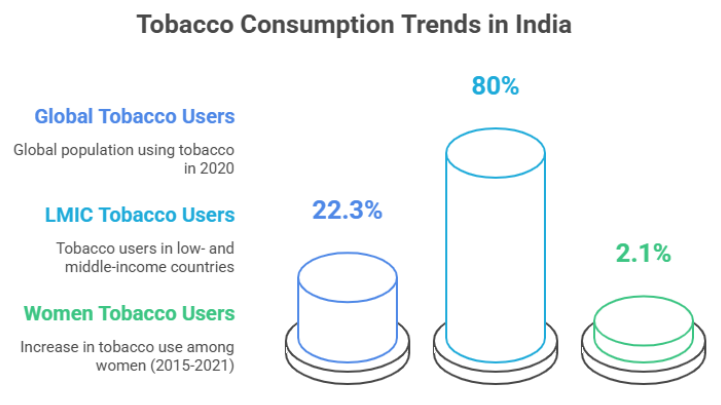
  • In 2020, 22.3% of the global population used tobacco.

  • Nearly 80% of the world’s 1.3 billion tobacco users reside in low- and middle-income countries.

  • India’s vast user base continues to pose a major barrier to global tobacco control goals.

Consumption Trends in India

  • No Major Decline in Usage: According to National Family Health Survey (NFHS) data, there has been no significant reduction in cigarette or bidi use across NTCP and non-NTCP districts. Reasons include poor staffing, low resource allocation, and lack of consistent monitoring.

  • Affordability of Tobacco: Over the past decade, cigarettes, bidis, and smokeless tobacco (SLT) products have become more affordable. The GST regime has made it easier for consumers to access these products due to integrated tax structures.

  • Rising Usage Among Women: Alarmingly, tobacco use among women increased by 2.1% between 2015 and 2021, bucking the overall declining trend.

India’s Fight Against the Tobacco Epidemic

International Commitment

India is a signatory to the WHO Framework Convention on Tobacco Control (FCTC), a global treaty aiming to reduce both demand and supply of tobacco products. It has committed to creating effective national-level strategies to fight the Tobacco Epidemic in India.

World No Tobacco Day, observed on May 31st, plays a crucial role in creating awareness about the dangers of tobacco.

National Legislation and Programs

COTPA 2003

The Cigarettes and Other Tobacco Products Act (COTPA) governs the advertising, sale, packaging, labeling, and distribution of tobacco in India.

National Tobacco Control Program (NTCP) 2007

The NTCP was launched to strengthen the implementation of COTPA and FCTC obligations. Key activities include:

  • Public Awareness Campaigns

  • Smoking Cessation Services: Including quitlines and behavioral counseling

  • Law Enforcement: Through trained officers for compliance and inspections

Prohibition of Electronic Cigarette Act (PECA), 2019

This law bans the production and sale of e-cigarettes across India.

mCessation Program

Launched under the Digital India initiative, this mobile-based program supports individuals trying to quit tobacco.

Tobacco Taxation

A 28% GST rate applies to most tobacco products, excluding raw tobacco leaves.

Hidden Costs of the Tobacco Epidemic in India

While health remains the most discussed aspect, the Tobacco Epidemic in India imposes several other hidden costs:

Environmental Impact

  • Soil Depletion: Tobacco cultivation rapidly exhausts nutrients, requiring more fertilizers.

  • Deforestation: Processing 1 kg of tobacco needs up to 5.4 kg of wood, contributing to deforestation.

  • Waste Generation: Nearly 1.7 lakh tonnes of waste are produced annually due to tobacco use.

Economic Burden

  • Direct and indirect tobacco-related expenses cost over 1% of India’s GDP.

  • Health expenditures on tobacco-related diseases amount to 5.3% of India’s total health expenditure.

Challenges to Controlling the Tobacco Epidemic in India

Despite robust frameworks, the Tobacco Epidemic in India continues due to multiple challenges:

Regulatory Gaps

  • Non-Compliant Products: Products like gutkha and smuggled tobacco often escape regulation.

  • Weak Penalties: Current fines under COTPA are outdated and insufficient (e.g., ₹5,000 for packaging violations).

Surrogate Advertising and Loopholes

  • Companies promote their brands through indirect advertisements, such as promoting elaichi under tobacco brand names.

  • The ICC Men’s Cricket World Cup 2023 featured such surrogate promotions for at least two tobacco brands.

Stalled Legislative Reforms

Amendments to strengthen COTPA proposed in 2015 and 2020 have not been implemented, weakening enforcement capacity.

Industry Influence and Government Conflict of Interest

  • Effective lobbying by the tobacco industry hinders stricter regulations.

  • The Indian government owns a 7.8% stake in ITC Ltd., raising concerns about conflict of interest in its tobacco control policies.

Conclusion: Tackling the Tobacco Epidemic in India

The Tobacco Epidemic in India is more than just a health issue—it's an environmental, social, and economic crisis. Strengthening enforcement, increasing taxation, updating fines, banning surrogate advertising, and addressing government-industry conflicts are essential steps forward.

India’s commitment to international treaties like the FCTC and programs like NTCP and mCessation must be backed with resources, political will, and consistent monitoring to truly curb the Tobacco Epidemic in India.



UPSC QEP 2026 Batch 5 - English
Buy now View Details
Submit Your Details to Learn More
I agree to give my consent to receive updates through SMS/Email & WhatsApp*.

NEEV GS + CSAT Foundation 2026/27
Buy now View Details


Join theIAShub’s Mains Answer Writing Program

Refine your answer writing skills and elevate your UPSC preparation with personalized support and expert feedback.

Fill out the form to get started with the program or any other enquiries !

I agree to give my consent to receive updates through SMS/Email & WhatsApp*.

Best IAS Coaching In Delhi, UPSC Online & Offline Classes by IAShub

Are you dreaming of becoming an IAS officer? Then, IAShub can be your best guide. It is one of the Best IAS Coaching in Delhi. Many students who want to clear the UPSC exam join IAShub for learning. The institute gives both online and offline classes. Their teachers are experienced and helpful. They easily explain every topic. Students also get notes, tests, and tips to do well in the exam.

UPSC Online Classes by IAShub

IAShub is in Delhi and is trusted by many UPSC students. It offers coaching for every part of the UPSC exam – Prelims, Mains, and Interview. The classes are simple and easy to understand. The teachers are experts and guide students in the right way. IAShub is also known for its helpful notes, test series, and answer-writing practice. IAShub is the best coaching in Delhi and also gives UPSC Online Classes. This helps students from any place in India to learn. The online classes are live and also recorded. So, students can watch them anytime. These classes cover the full UPSC syllabus.

Key Offerings Provided by IAShub

Here are some important services provided by IAShub:

  • UPSC Prelims: IAShub teaches for Prelims with a focus on basics. It also gives daily current affairs and monthly magazines.
  • Classroom Courses: IAShub has classroom learning for students in Delhi. The environment is good and peaceful for study.
  • Live Classes: Students who live far can join live UPSC online classes. These classes are just like real classes.
  • QEP for Mains: The Quality Enrichment Program (QEP) is special for Mains preparation. It helps students write better and faster.
  • Answer Writing: Regular answer writing practice is given. Teachers also check answers and give tips to improve.
  • Free Resource: IAShub gives free notes by toppers and helpful Main Booster material.
  • Test Series: Test series are available for every subject. These help students know their weak points and improve.
  • Interview Guidance Session: IAShub also gives interview practice sessions with experts. These help students feel confident.

UPSC Exam Overview

The UPSC Civil Services Exam has three parts:

  • Prelims: It has two papers: General Studies and CSAT.
  • Mains: It has nine papers, including essays and optional subjects.
  • Interview: It tests the personality and confidence of the student.

This exam is tough, but with the right guidance, it becomes easy to manage. Students must study smart and stay regular.

How IAShub Helps in the UPSC Journey

IAShub supports students from the beginning to the end. It gives the right books, tests, and notes. The classes are easy to follow, and the teachers are always ready to help. Students get personal doubt sessions too. The test series and answer checking help students learn where they need to do better. Also, free study materials save time and money.
IAShub also guides students during the final stage – the interview. Experts take mock interviews and give useful tips. This full support makes IAShub one of the best IAS coaching in Delhi.

Best IAS Coaching In Delhi FAQs

Yes, IAShub offers live and recorded online classes. Students can attend from any part of India.

Classes are available in both English and Hindi, so students can choose the language they are comfortable with.

The classroom centre is located in Delhi. Students can visit and join offline batches there.

IAShub gives interview guidance sessions to help students prepare for the final round of UPSC.
