


Explore the Suez Crisis of 1956, its causes, Cold War impact, decline of colonialism, and rise of nationalism in West Asia. Learn how Egypt reshaped global politics.
 theIASHub | 20 Jun, 2025 | 8030

The Suez Crisis of 1956 marked a turning point in post-World War II geopolitics. When Egypt's President Gamal Abdel Nasser nationalized the Suez Canal, a vital global trade route formerly controlled by Britain and France, it set off a major international conflict. The Suez Crisis not only challenged European colonial dominance in the Middle East but also highlighted the shifting global power dynamics during the Cold War era.
This article delves into the causes, events, and consequences of the Suez Crisis, exploring how it redefined colonial relationships, encouraged Egyptian nationalism, and influenced the rise of the Non-Alignment Movement.
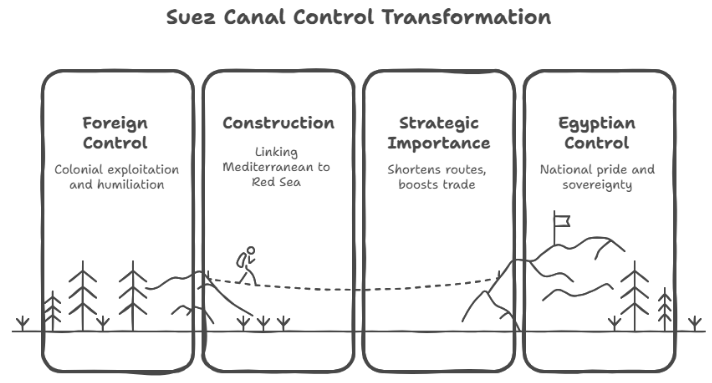
The Suez Canal, constructed in 1869, is a crucial waterway linking the Mediterranean Sea to the Red Sea. It dramatically shortens maritime routes between Europe and Asia, making it one of the world’s most strategic trade corridors.
The Suez Crisis was fueled by a mix of anti-colonial sentiment, Cold War rivalry, and strategic interests. Several factors converged to spark the conflict.
On July 26, 1956, President Gamal Abdel Nasser shocked the world by nationalizing the Suez Canal. He justified his action as a way to fund Egypt's Aswan High Dam project after Western powers withdrew financial support.
This move directly threatened British and French economic interests, provoking an aggressive response.
The mid-20th century witnessed a rise in anti-colonial movements across Asia and Africa. In Egypt, Nasser emerged as a charismatic leader symbolizing Arab nationalism and opposition to Western domination.
For Britain and France, the Suez Canal was essential for:
Its nationalization by Egypt threatened to undermine their influence permanently.
The Suez Crisis unfolded during a critical phase of the Cold War:
In October 1956, Britain, France, and Israel secretly coordinated an attack on Egypt:
The Suez Crisis quickly escalated into a global issue:
This marked the first time Britain and France were diplomatically overpowered by both the U.S. and the USSR—showing the decline of old colonial powers.
The Suez Crisis had far-reaching implications that reshaped global politics and regional dynamics.
The most significant outcome of the Suez Crisis was the rapid decline in British and French influence:
President Nasser emerged as a hero of the Arab world:
The Suez Crisis reinforced the importance of neutrality during the Cold War:
Although not a direct conflict between the U.S. and USSR, the Suez Crisis played a significant role in Cold War geopolitics:
The Suez Crisis was a diplomatic victory for the United Nations:
The Suez Crisis continues to be a vital case study in international relations for several reasons:
The Suez Crisis marked the end of an era where Western powers could use military intervention to protect economic and colonial interests. Military strength alone was no longer sufficient in a bipolar Cold War world.
The success of Egypt’s nationalization efforts without long-term consequences for its sovereignty encouraged liberation movements in Africa, Asia, and the Middle East to demand independence and resist colonial rule.
The power vacuum left by the retreat of Britain and France allowed for greater U.S. and Soviet involvement in Middle Eastern affairs—shaping the region's political future for decades.
The Suez Crisis was more than a regional dispute—it was a global confrontation that altered the balance of power in the Cold War world. By challenging the dominance of Britain and France and asserting its sovereignty, Egypt set a precedent for other nations striving for independence.
This pivotal moment in 1956 marked the decline of European colonialism, the rise of Arab nationalism, and the emergence of the Non-Alignment Movement, making the Suez Crisis a defining event in the history of the 20th century.


Refine your answer writing skills and elevate your UPSC preparation with personalized support and expert feedback.
Fill out the form to get started with the program or any other enquiries !

Are you dreaming of becoming an IAS officer? Then, IAShub can be your best guide. It is one of the Best IAS Coaching in Delhi. Many students who want to clear the UPSC exam join IAShub for learning. The institute gives both online and offline classes. Their teachers are experienced and helpful. They easily explain every topic. Students also get notes, tests, and tips to do well in the exam.
IAShub is in Delhi and is trusted by many UPSC students. It offers coaching for every part of the UPSC exam – Prelims, Mains, and Interview. The classes are simple and easy to understand. The teachers are experts and guide students in the right way. IAShub is also known for its helpful notes, test series, and answer-writing practice. IAShub is the best coaching in Delhi and also gives UPSC Online Classes. This helps students from any place in India to learn. The online classes are live and also recorded. So, students can watch them anytime. These classes cover the full UPSC syllabus.
Here are some important services provided by IAShub:
The UPSC Civil Services Exam has three parts:
This exam is tough, but with the right guidance, it becomes easy to manage. Students must study smart and stay regular.
IAShub supports students from the beginning to the end. It gives the right books, tests, and notes. The classes are easy to follow, and the teachers are always ready to help. Students get personal doubt sessions too. The test series and answer checking help students learn where they need to do better. Also, free study materials save time and money.
IAShub also guides students during the final stage – the interview. Experts take mock interviews and give useful tips. This full support makes IAShub one of the best IAS coaching in Delhi.
Join 39,000+ UPSC Aspirants! 🚀
Get Free UPSC/State PSC Study Materials, Daily Current Affairs Question & Exam Updates.
Join Telegram Channel
