


Discover the crucial role of Social Capital Organizations in India, their types, functions, and impact on development and inclusive growth.
 theIASHub | 15 May, 2025 | 208

Social Capital Organizations are key players in building a strong, inclusive, and collaborative society. These organizations are formed on the foundation of trust, cooperation, and shared goals. They help communities function effectively by promoting mutual respect, civic participation, and collective problem-solving. In India, they have emerged as powerful agents of change, addressing critical social, economic, and environmental challenges.
Social Capital Organizations refer to groups or institutions that promote trust, relationships, and cooperation among people. These organizations act as bridges between individuals and the broader society, helping in the smooth functioning of civil life. They are often non-profit in nature and focus on public welfare, development, and empowerment of communities.
These organizations include NGOs, charitable institutions, cooperatives, SHGs, and other non-profit entities working to create positive social impact.
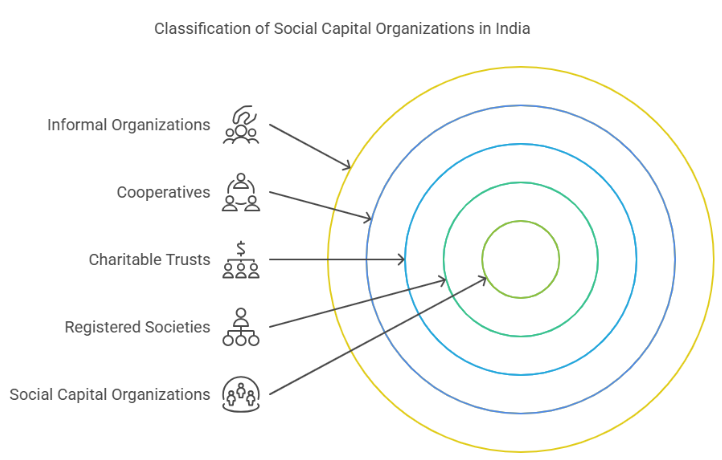
According to the Second Administrative Reforms Commission (2nd ARC), Social Capital Organizations in India can be classified based on their legal status and the nature of their activities:
Formed for specific social, cultural, or scientific purposes under the Societies Registration Act, 1860. A minimum of seven members is required to register a society, and they must annually submit details of the managing committee to the Registrar.
These are entities where a Trustee manages the property or funds of the Trust for the benefit of the public. A Trust Deed outlines its objectives and rules. Trusts are registered with the Charity Commissioner or Registrar of Societies.
Member-owned organizations that function to meet common needs in sectors like credit, agriculture, housing, and consumer goods.
These are unregistered groups that function without a legal structure but contribute significantly to community welfare and development.
These include Self Help Groups (SHGs), microcredit institutions, student-led bodies, and other local stakeholder groups promoted or supported by government initiatives.
These organizations ensure ethical practices and professional standards within specific industries or sectors.
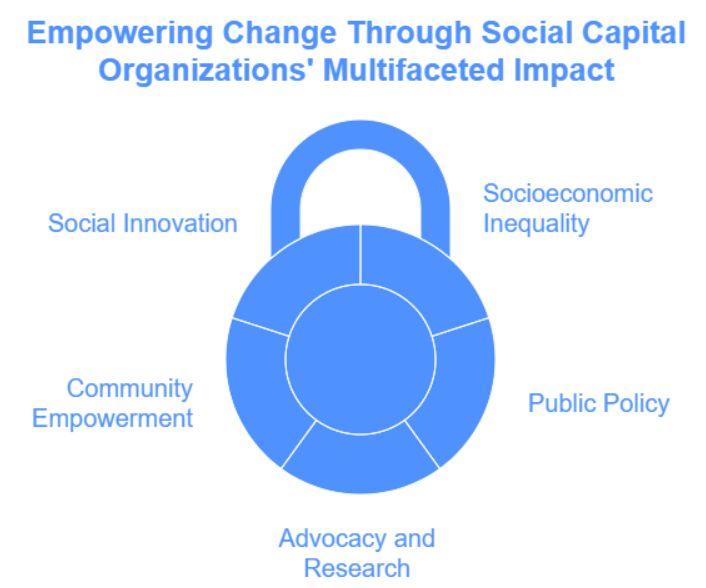
Social Capital Organizations contribute to national development and social well-being in various ways:
They reach underserved areas and provide essential services like healthcare, education, and support for women, children, the elderly, and the disabled.
Example: Pratham and SaveLIFE Foundation are working in education and road safety respectively.
These organizations amplify the voices of marginalized groups and contribute to policy formulation and reform.
Example: Farmer organizations played a crucial role during the anti-farm law protests.
They conduct policy research, run advocacy campaigns, and raise awareness on social and environmental issues.
Example: Birdlife India and Save Narmada Movement.
Social Capital Organizations support grassroots initiatives, leadership development, and sustainable livelihood programs to empower local communities.
They experiment with new solutions for emerging social problems and lead innovative projects.
Example: The India Against Corruption movement brought attention to systemic issues through innovative public engagement.
These organizations rely on grants, donations, CSR funding, and volunteer support for their operations and growth.
In times of natural disasters, pandemics, or humanitarian crises, Social Capital Organizations provide emergency aid, medical support, and help in rehabilitation efforts.
The National Policy defines Voluntary Organizations (VOs) as entities engaged in public service on ethical, cultural, or social grounds. This includes NGOs, SHGs, Societies, and Charitable Trusts that work across sectors and regions. The policy emphasizes the importance of collaboration between the government and voluntary organizations to achieve development goals.
Social Capital Organizations are vital for strengthening democracy and ensuring that development is inclusive. They not only fill gaps in public services but also ensure community participation and accountability in governance. By building trust, fostering cooperation, and encouraging social responsibility, these organizations play a key role in India’s progress.



Refine your answer writing skills and elevate your UPSC preparation with personalized support and expert feedback.
Fill out the form to get started with the program or any other enquiries !





Are you dreaming of becoming an IAS officer? Then, IAShub can be your best guide. It is one of the Best IAS Coaching in Delhi. Many students who want to clear the UPSC exam join IAShub for learning. The institute gives both online and offline classes. Their teachers are experienced and helpful. They easily explain every topic. Students also get notes, tests, and tips to do well in the exam.
IAShub is in Delhi and is trusted by many UPSC students. It offers coaching for every part of the UPSC exam – Prelims, Mains, and Interview. The classes are simple and easy to understand. The teachers are experts and guide students in the right way. IAShub is also known for its helpful notes, test series, and answer-writing practice. IAShub is the best coaching in Delhi and also gives UPSC Online Classes. This helps students from any place in India to learn. The online classes are live and also recorded. So, students can watch them anytime. These classes cover the full UPSC syllabus.
Here are some important services provided by IAShub:
The UPSC Civil Services Exam has three parts:
This exam is tough, but with the right guidance, it becomes easy to manage. Students must study smart and stay regular.
IAShub supports students from the beginning to the end. It gives the right books, tests, and notes. The classes are easy to follow, and the teachers are always ready to help. Students get personal doubt sessions too. The test series and answer checking help students learn where they need to do better. Also, free study materials save time and money.
IAShub also guides students during the final stage – the interview. Experts take mock interviews and give useful tips. This full support makes IAShub one of the best IAS coaching in Delhi.
 Detailed Solutions & Explanations
Improve Your Answer Writing & Strategy
Detailed Solutions & Explanations
Improve Your Answer Writing & Strategy

