Social Audit in India: Evolution, Importance, Transparent and Participatory Governance

Social Audit empowers citizens to evaluate government programs, boosting transparency, accountability, and participatory governance.

THEIASHUB
Get an Instant Call Back from Our Expert Mentors Now!
+91

Social Audit is a democratic process where citizens evaluate the social, economic, ethical, and environmental performance of government schemes and departments. It ensures that governance operates with the consent and understanding of all stakeholders, encouraging transparency, accountability, and citizen participation at the grassroots level.
Evolution of Social Audit in India


Early Developments

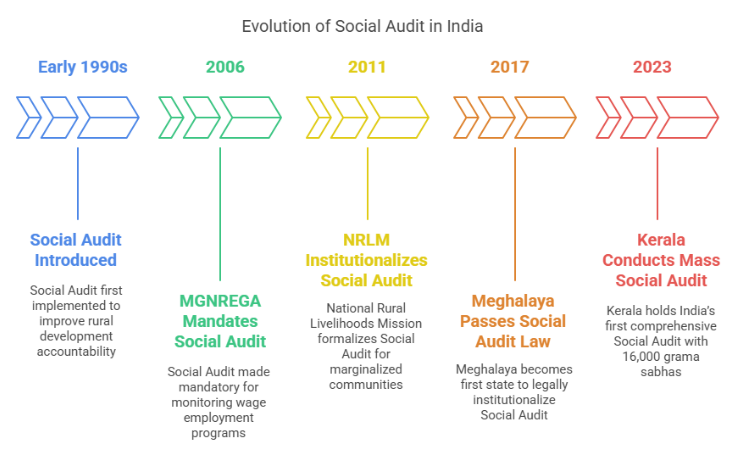
Social Audit was introduced in India in the early 1990s to increase accountability in rural development programs. It gained momentum with the implementation of MGNREGA in 2006, which made Social Audit mandatory for monitoring wage employment programs.

Legal and Technological Progress

  • The National Rural Livelihoods Mission (2011) institutionalized Social Audit to empower marginalized communities.

  • Meghalaya became the first state to pass a law institutionalizing Social Audit.

  • Kerala recently conducted India’s first comprehensive Social Audit by holding 16,000 grama sabhas.

  • Use of technology like mobile apps and digital platforms has further enhanced the process.

  • Civil society organizations like SAFAR in Rajasthan and Bihar have actively promoted public participation in Social Audit.

Importance of Social Audit

Participative Governance and Community Empowerment

Social Audit promotes citizen-led governance through local planning, debates, and community deliberations in gram sabhas. It builds capacity and awareness among people.

Enhancing Transparency and Accountability

By placing financial and operational details in the public domain, Social Audit exposes irregularities such as ghost beneficiaries and fake works (e.g., MGNREGA).

  • Assam conducted a Social Audit post-flood to expose corruption in relief measures.

  • Rajasthan’s SPAA was created to enhance government performance through auditing.

Impact Measurement and Policy Improvement

Social Audit helps evaluate a program’s impact across multiple parameters—economic, environmental, and social—enabling evidence-based decision-making.

Grievance Redressal and Public Feedback

Platforms like Jan Sunwaai by MKSS allow marginalized citizens to voice concerns, creating pressure on officials for corrective action.

Boosting Public Trust and Social Capital

Social Audit fosters collective responsibility and builds trust between citizens and the government, making public service delivery more people-centric.

Strengthening the Social Audit Framework

Legal and Institutional Reforms

  • Enact a comprehensive legal framework to make Social Audit mandatory across all government programs.

  • Establish independent social audit units with autonomy and sufficient authority.

Capacity Building and Technology Integration

  • Train social auditors, officials, and community members through regular workshops and awareness drives.

  • Prepare audit teams for evaluating AI-based governance systems and incorporate AI tools into audit processes for efficiency.

Public Participation and Transparency

  • Encourage active participation from civil society, women, and marginalized groups.

  • Make audit reports publicly available in accessible formats to enhance awareness.

Monitoring and Whistleblower Protection

  • Implement a strong monitoring mechanism to ensure timely audits.

  • Strengthen the Whistle Blowers Protection Act to safeguard those who report fraud or misconduct.

Program Integration and Mass Awareness

  • Integrate Social Audit into all major welfare and rural development schemes.

  • Launch campaigns using local languages, nukkad nataks, and community radio to promote the importance of Social Audit.

Conclusion

Social Audit is a transformative governance tool that shifts power into the hands of the people. When supported with legal backing, technological tools, and community awareness, Social Audit can drive transparency, improve accountability, and make development inclusive and citizen-driven.


UPSC QEP 2026 Batch 5 - English
Buy now View Details
Submit Your Details to Learn More
I agree to give my consent to receive updates through SMS/Email & WhatsApp*.

NEEV GS + CSAT Foundation 2026/27
Buy now View Details


Join theIAShub’s Mains Answer Writing Program

Refine your answer writing skills and elevate your UPSC preparation with personalized support and expert feedback.

Fill out the form to get started with the program or any other enquiries !
I agree to give my consent to receive updates through SMS/Email & WhatsApp*.

Best IAS Coaching In Delhi, UPSC Online & Offline Classes by IAShub

Are you dreaming of becoming an IAS officer? Then, IAShub can be your best guide. It is one of the Best IAS Coaching in Delhi. Many students who want to clear the UPSC exam join IAShub for learning. The institute gives both online and offline classes. Their teachers are experienced and helpful. They easily explain every topic. Students also get notes, tests, and tips to do well in the exam.

UPSC Online Classes by IAShub

IAShub is in Delhi and is trusted by many UPSC students. It offers coaching for every part of the UPSC exam – Prelims, Mains, and Interview. The classes are simple and easy to understand. The teachers are experts and guide students in the right way. IAShub is also known for its helpful notes, test series, and answer-writing practice. IAShub is the best coaching in Delhi and also gives UPSC Online Classes. This helps students from any place in India to learn. The online classes are live and also recorded. So, students can watch them anytime. These classes cover the full UPSC syllabus.

Key Offerings Provided by IAShub

Here are some important services provided by IAShub:

  • UPSC Prelims: IAShub teaches for Prelims with a focus on basics. It also gives daily current affairs and monthly magazines.
  • Classroom Courses: IAShub has classroom learning for students in Delhi. The environment is good and peaceful for study.
  • Live Classes: Students who live far can join live UPSC online classes. These classes are just like real classes.
  • QEP for Mains: The Quality Enrichment Program (QEP) is special for Mains preparation. It helps students write better and faster.
  • Answer Writing: Regular answer writing practice is given. Teachers also check answers and give tips to improve.
  • Free Resource: IAShub gives free notes by toppers and helpful Main Booster material.
  • Test Series: Test series are available for every subject. These help students know their weak points and improve.
  • Interview Guidance Session: IAShub also gives interview practice sessions with experts. These help students feel confident.

UPSC Exam Overview

The UPSC Civil Services Exam has three parts:

  • Prelims: It has two papers: General Studies and CSAT.
  • Mains: It has nine papers, including essays and optional subjects.
  • Interview: It tests the personality and confidence of the student.

This exam is tough, but with the right guidance, it becomes easy to manage. Students must study smart and stay regular.

How IAShub Helps in the UPSC Journey

IAShub supports students from the beginning to the end. It gives the right books, tests, and notes. The classes are easy to follow, and the teachers are always ready to help. Students get personal doubt sessions too. The test series and answer checking help students learn where they need to do better. Also, free study materials save time and money.
IAShub also guides students during the final stage – the interview. Experts take mock interviews and give useful tips. This full support makes IAShub one of the best IAS coaching in Delhi.

Best IAS Coaching In Delhi FAQs

Yes, IAShub offers live and recorded online classes. Students can attend from any part of India.

Classes are available in both English and Hindi, so students can choose the language they are comfortable with.

The classroom centre is located in Delhi. Students can visit and join offline batches there.

IAShub gives interview guidance sessions to help students prepare for the final round of UPSC.