


Explore the doctrine of separation of powers in India, its constitutional provisions, overlapping roles, and judicial interpretations for a balanced governance system.
 theIASHub | 09 May, 2025 | 150
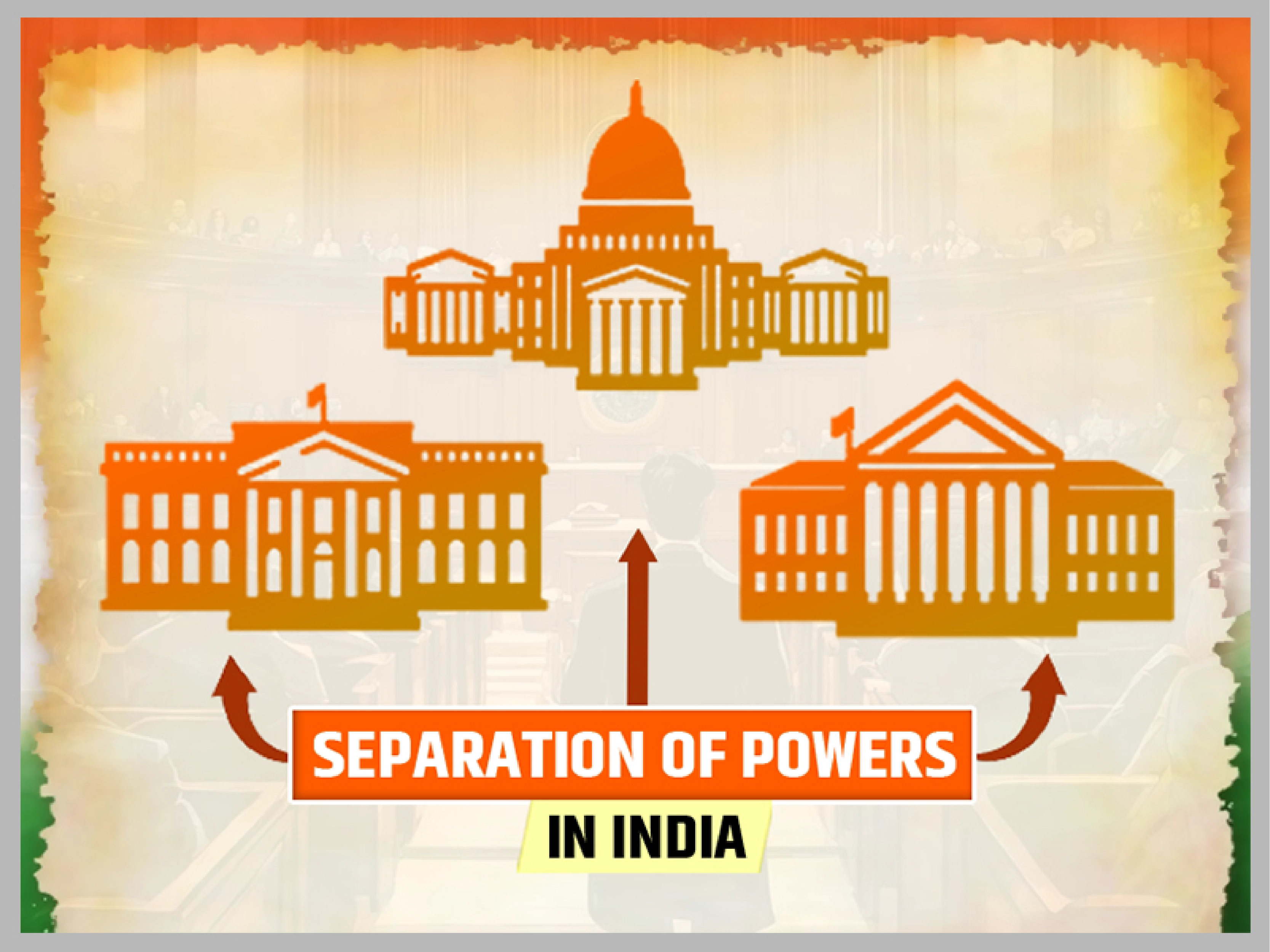

The doctrine of separation of powers is a fundamental principle that aims to ensure a balanced distribution of authority among the three main branches of government: the Executive, the Legislature, and the Judiciary. In India, this doctrine is not rigidly applied as in the United States, but it forms the backbone of governance, preventing the concentration of power and promoting accountability.
This article delves into the meaning, models, and practical application of separation of powers in India, highlighting the overlapping roles among various government organs.
The separation of powers principle asserts that the three branches of government—Executive, Legislature, and Judiciary—should function independently to maintain a system of checks and balances. This prevents any single branch from wielding excessive authority, ensuring that power remains distributed and accountable.
Although the Indian Constitution does not explicitly mention the doctrine, its essence is embedded within various provisions, ensuring a functional separation to maintain the democratic structure.
Different countries implement the separation of powers doctrine in varying degrees.
In India, the three branches of government—Legislature, Executive, and Judiciary—perform separate functions but are not completely independent of one another. Several constitutional provisions and judicial precedents highlight this overlap.
The Legislature is responsible for making laws and overseeing the Executive. However, it also exercises certain judicial and executive functions.
The Executive, led by the President at the Union level and the Governors at the State level, executes laws and policies. However, it also influences the Legislature and Judiciary.
The Judiciary, primarily through the Supreme Court and High Courts, interprets laws and ensures their constitutional validity. However, it also has a role in governance.
This landmark case examined the extent of separation of powers in India. The Supreme Court ruled that while the Indian Constitution follows a broad separation of powers, it does not strictly adhere to the American model. The judgment reinforced the Judiciary’s power to review laws but acknowledged the functional overlap among branches.
In this case, the Supreme Court established the "Basic Structure Doctrine," stating that Parliament cannot alter the fundamental features of the Constitution, including the principle of separation of powers.
The Supreme Court ruled that even laws placed under the Ninth Schedule (immune from judicial review) could be scrutinized if they violate fundamental rights, further reinforcing judicial oversight over the Legislature.
By dividing responsibilities among the three branches, the doctrine prevents any one branch from becoming too powerful, thereby ensuring a fair and democratic system.
Each branch is accountable to the other, ensuring that governance remains transparent and free from arbitrary decision-making.
The Judiciary’s power of judicial review ensures that both the Executive and the Legislature operate within constitutional limits.
The functional overlap among the three branches allows for a system of checks and balances, ensuring efficient governance while preventing misuse of authority.
The doctrine of separation of powers in India is a guiding principle rather than a rigid rule. While the Executive, Legislature, and Judiciary have distinct functions, their overlapping roles allow for a dynamic and balanced system of governance. The Judiciary acts as the guardian of the Constitution, ensuring that the Legislature and Executive function within constitutional boundaries.
Although the Indian model does not follow strict separation like the U.S., it successfully maintains a balance between governance efficiency and constitutional integrity. The ongoing evolution of this principle through judicial interpretations ensures that India's democratic framework remains robust and accountable.

Refine your answer writing skills and elevate your UPSC preparation with personalized support and expert feedback.
Fill out the form to get started with the program or any other enquiries !
Are you dreaming of becoming an IAS officer? Then, IAShub can be your best guide. It is one of the Best IAS Coaching in Delhi. Many students who want to clear the UPSC exam join IAShub for learning. The institute gives both online and offline classes. Their teachers are experienced and helpful. They easily explain every topic. Students also get notes, tests, and tips to do well in the exam.
IAShub is in Delhi and is trusted by many UPSC students. It offers coaching for every part of the UPSC exam – Prelims, Mains, and Interview. The classes are simple and easy to understand. The teachers are experts and guide students in the right way. IAShub is also known for its helpful notes, test series, and answer-writing practice. IAShub is the best coaching in Delhi and also gives UPSC Online Classes. This helps students from any place in India to learn. The online classes are live and also recorded. So, students can watch them anytime. These classes cover the full UPSC syllabus.
Here are some important services provided by IAShub:
The UPSC Civil Services Exam has three parts:
This exam is tough, but with the right guidance, it becomes easy to manage. Students must study smart and stay regular.
IAShub supports students from the beginning to the end. It gives the right books, tests, and notes. The classes are easy to follow, and the teachers are always ready to help. Students get personal doubt sessions too. The test series and answer checking help students learn where they need to do better. Also, free study materials save time and money.
IAShub also guides students during the final stage – the interview. Experts take mock interviews and give useful tips. This full support makes IAShub one of the best IAS coaching in Delhi.
 Detailed Solutions & Explanations
Improve Your Answer Writing & Strategy
Detailed Solutions & Explanations
Improve Your Answer Writing & Strategy

