


Explore the key milestones of scientific developments in India across space, nuclear, defense, and technical education that shaped India’s technological future.
 theIASHub | 20 Aug, 2025 | 3453

Since gaining independence in 1947, scientific developments in India have accelerated at a remarkable pace. From establishing premier institutions like IITs to achieving interplanetary space missions, India has transformed into a self-reliant and scientifically advanced nation. The journey of scientific developments in India is a story of vision, commitment, and innovation across multiple domains such as space research, nuclear energy, defense technology, and technical education.
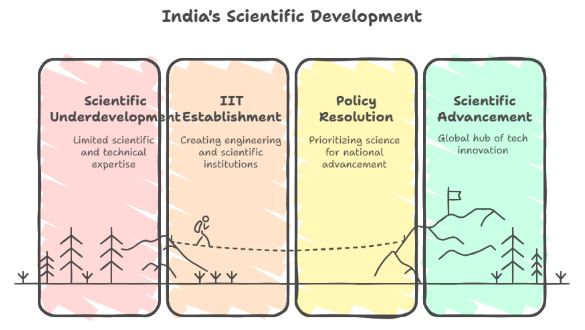
The backbone of scientific developments in India began with the establishment of world-class technical institutions. The first Indian Institute of Technology (IIT) was founded in Kharagpur in 1951, followed by IIT Bombay, Madras, Kanpur, and Delhi. These institutes have since become global centers of engineering and scientific excellence. The IITs have produced engineers, scientists, and researchers who are leading figures in global tech and innovation sectors.
A major turning point in the trajectory of scientific developments in India came with the adoption of the Scientific Policy Resolution in 1958. This resolution recognized science and technology as essential tools for national development. It promoted pure, applied, and educational scientific research, thus laying the policy foundation for future scientific institutions and projects.
India’s foray into space began with the establishment of INCOSPAR (Indian National Committee for Space Research) in 1962 under the Department of Atomic Energy. This marked the initial phase of space-related scientific developments in India. It later evolved into ISRO (Indian Space Research Organisation) in 1969, which became the face of India's space ambitions.
In 1980, ISRO successfully launched Rohini, India’s first satellite placed in orbit by an Indian-made launch vehicle (SLV-3). This marked the beginning of India's journey as a self-reliant space power. One of the most notable scientific developments in India came in 2014, when India’s Mars Orbiter Mission (Mangalyaan) reached Mars on its first attempt—an achievement no other nation had managed.
The Indian Space Policy 2023, approved by the Cabinet Committee on Security, was publicly released to involve the private sector and enhance cooperation. It aimed at fostering a more open, collaborative space ecosystem to further drive scientific developments in India.
India’s nuclear journey began with the development of Apsara, the country’s first nuclear reactor, in 1956. The three-stage nuclear power programme, introduced in the 1950s, emphasized self-reliance in nuclear energy using thorium reserves. As part of the ongoing scientific developments in India, the country now operates 23 nuclear power reactors.
India is also part of the ITER (International Thermonuclear Experimental Reactor) project and has developed its own Tokamak programs, underscoring its commitment to sustainable and clean energy solutions.
India became a nuclear weapons state following its first nuclear test in 1974 (Smiling Buddha) and subsequent tests in 1998 (Pokhran-II). These milestones were critical to establishing India's strategic autonomy and defense capabilities, representing landmark moments in the scientific developments in India.
The Defence Research and Development Organisation (DRDO) was established by merging various military technical establishments. Since then, it has become the cornerstone of India's defense innovation.
DRDO has significantly contributed to scientific developments in India by developing:
These initiatives have not only enhanced national security but also demonstrated India's capability to develop cutting-edge technologies independently.
Alongside institutional and technological advances, scientific developments in India have expanded into various sectors including:
Institutions like CSIR (Council of Scientific and Industrial Research) and IISc (Indian Institute of Science) have played pivotal roles in these domains.
India’s scientific capabilities are now globally recognized. Indian scientists contribute significantly to global research, and India collaborates with countries like the US, France, Japan, and Russia in areas such as space, nuclear energy, biotechnology, and climate science.
With the launch of programs like Atmanirbhar Bharat, India is pushing for self-reliance in science and technology. Encouraging domestic innovation, supporting start-ups, and increasing investments in R&D are key components of this vision.
The National Education Policy 2020 also emphasizes STEM education and encourages critical thinking and innovation at all educational levels, which will further fuel scientific developments in India.
From launching satellites and nuclear reactors to developing indigenous defense systems and world-class institutes, the story of scientific developments in India is nothing short of inspiring. The country continues to push the boundaries of innovation, setting new standards in space research, defense technology, and energy production. As India steps into the future, it stands tall among the world’s scientific superpowers with a strong foundation built over decades of dedication, planning, and visionary leadership.


Refine your answer writing skills and elevate your UPSC preparation with personalized support and expert feedback.
Fill out the form to get started with the program or any other enquiries !

Are you dreaming of becoming an IAS officer? Then, IAShub can be your best guide. It is one of the Best IAS Coaching in Delhi. Many students who want to clear the UPSC exam join IAShub for learning. The institute gives both online and offline classes. Their teachers are experienced and helpful. They easily explain every topic. Students also get notes, tests, and tips to do well in the exam.
IAShub is in Delhi and is trusted by many UPSC students. It offers coaching for every part of the UPSC exam – Prelims, Mains, and Interview. The classes are simple and easy to understand. The teachers are experts and guide students in the right way. IAShub is also known for its helpful notes, test series, and answer-writing practice. IAShub is the best coaching in Delhi and also gives UPSC Online Classes. This helps students from any place in India to learn. The online classes are live and also recorded. So, students can watch them anytime. These classes cover the full UPSC syllabus.
Here are some important services provided by IAShub:
The UPSC Civil Services Exam has three parts:
This exam is tough, but with the right guidance, it becomes easy to manage. Students must study smart and stay regular.
IAShub supports students from the beginning to the end. It gives the right books, tests, and notes. The classes are easy to follow, and the teachers are always ready to help. Students get personal doubt sessions too. The test series and answer checking help students learn where they need to do better. Also, free study materials save time and money.
IAShub also guides students during the final stage – the interview. Experts take mock interviews and give useful tips. This full support makes IAShub one of the best IAS coaching in Delhi.
Join 39,000+ UPSC Aspirants! 🚀
Get Free UPSC/State PSC Study Materials, Daily Current Affairs Question & Exam Updates.
Join Telegram Channel
