Round Table Conferences and Communal Award Poona Pact 1930–1932

Explore key outcomes of the Round Table Conferences (1930–32), the Communal Award, and the Poona Pact between Gandhi and Ambedkar on minority representation in India.

THEIASHUB
Get an Instant Call Back from Our Expert Mentors Now!
+91

Nevertheless, the Round Table Conferences played a role in shaping the political discourse and highlighting the diverse interests and challenges in India's struggle for self-rule.
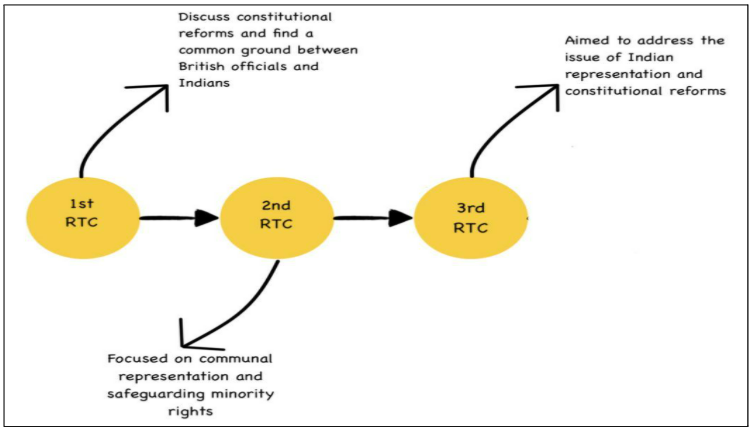


Three Round Table Conferences and Their Legacy

FACTORS

1st RTC (1930-1931)

2nd RTC (1931)

3rd RTC (1932)

Dates

November 12, 1930 - January 19, 1931

September 7, 1931 - December 1, 1931

November 17, 1932 - December 24, 1932

Key Participants

  • Ramsay MacDonald (British Prime Minister)
  • B.R. Ambedkar
  • Tej Bahadur Sapru
  • Aga Khan III
  • Srinivasa Sastri
  • Sarojini Naidu
  • Various Princes and Representatives from Indian States
  • Mahatma Gandhi
  • B.R. Ambedkar
  • Madan Mohan Malaviya
  • Sarojini Naidu
  • Sir Mohammad Iqbal
  • Aga Khan III
  • Ramsay MacDonald (British Prime Minister)
  • B.R. Ambedkar
  • Tej Bahadur Sapru
  • Sir Mohammad Iqbal
  • Various Representatives from Indian States

Main Discussions

  • The structure of government in British India
  • Representation of the provinces
  • The role of native princes in governance
  • Minority representation and rights
  • Representation in the central legislature
  • Minority rights and representation
  • The Federal Structure
  • Gandhi-Irwin Pact & its implications
  • Awarding a separate electorate to the 'Depressed Classes' (Scheduled Castes)
  • Representation of minority communities
  • Drafting of a new constitution for India.

Key Outcomes

  • It was decided that India should have a federal structure with autonomy for provinces.
  • Agreement on the need for communal representation.
  • Disagreements, mainly between Congress and other parties, led to no significant outcomes.
  • The British government began to lose faith in the Congress as the sole representative of Indian interests.
  • Communal Award declared.
  • B.R. Ambedkar and Mahatma Gandhi reached the Poona Pact, which revised the Communal Award by increasing representation for Depressed Classes.

Communal Award and Compromise of Poona Pact 1932

Communal Award of 1932

  • Provincial legislature seats were set to be doubled.
  • Separate electorates for minorities were maintained.
  • Muslims received additional representation in areas where they were a minority.
  • In all provinces except NWFP, 3% of seats were reserved for women.
  • Depressed classes, Dalits, and untouchables were officially recognized as minorities.
  • Specific allocations were made for labor, landlords, traders, and industrialists.
  • Various groups, including Muslims, Europeans, Sikhs, Indian Christians, Anglo-Indians, Depressed Classes, and Marathas, received separate electorates.
  • Depressed classes were allocated seats through elections from constituencies where only they could vote, but they could also vote in general elections.
  • Special electorates were established for sectors like labor, commerce, industry, mining, plantations, and landowners.
  • In Punjab, Sikhs, who comprised 13.2% of the population, were allocated 32 out of 175 seats.

Responses to Communal Award and Poona Pact of 1932

Responses

  •  Muslim leaders welcomed it as it ensured separate representation for Muslims, while many Hindu leaders criticized it for perpetuating caste divisions. 
  • The award was seen as a threat to Hindu unity and the political aspirations of the depressed classes.
  • Mahatma Gandhi strongly opposed the Communal Award and undertook a fast unto death in protest.

Poona Pact

  • The Poona Pact was an agreement reached between Mahatma Gandhi and Dr. B.R. Ambedkar in September 1932.
  • Aimed to address the issue of separate electorates for the depressed classes as proposed by the Communal Award during the Round Table Conferences.
  • The agreement proposed a reservation of seats for the depressed classes within the general electorate instead of separate electorates.
  • Gandhi and Ambedkar reached a compromise to ensure the political representation of the depressed classes while preserving the unity of Hindus.


UPSC QEP 2026 Batch 5 - English
Buy now View Details
Submit Your Details to Learn More
I agree to give my consent to receive updates through SMS/Email & WhatsApp*.

NEEV GS + CSAT Foundation 2026/27
Buy now View Details


Join theIAShub’s Mains Answer Writing Program

Refine your answer writing skills and elevate your UPSC preparation with personalized support and expert feedback.

Fill out the form to get started with the program or any other enquiries !
I agree to give my consent to receive updates through SMS/Email & WhatsApp*.

Best IAS Coaching In Delhi, UPSC Online & Offline Classes by IAShub

Are you dreaming of becoming an IAS officer? Then, IAShub can be your best guide. It is one of the Best IAS Coaching in Delhi. Many students who want to clear the UPSC exam join IAShub for learning. The institute gives both online and offline classes. Their teachers are experienced and helpful. They easily explain every topic. Students also get notes, tests, and tips to do well in the exam.

UPSC Online Classes by IAShub

IAShub is in Delhi and is trusted by many UPSC students. It offers coaching for every part of the UPSC exam – Prelims, Mains, and Interview. The classes are simple and easy to understand. The teachers are experts and guide students in the right way. IAShub is also known for its helpful notes, test series, and answer-writing practice. IAShub is the best coaching in Delhi and also gives UPSC Online Classes. This helps students from any place in India to learn. The online classes are live and also recorded. So, students can watch them anytime. These classes cover the full UPSC syllabus.

Key Offerings Provided by IAShub

Here are some important services provided by IAShub:

  • UPSC Prelims: IAShub teaches for Prelims with a focus on basics. It also gives daily current affairs and monthly magazines.
  • Classroom Courses: IAShub has classroom learning for students in Delhi. The environment is good and peaceful for study.
  • Live Classes: Students who live far can join live UPSC online classes. These classes are just like real classes.
  • QEP for Mains: The Quality Enrichment Program (QEP) is special for Mains preparation. It helps students write better and faster.
  • Answer Writing: Regular answer writing practice is given. Teachers also check answers and give tips to improve.
  • Free Resource: IAShub gives free notes by toppers and helpful Main Booster material.
  • Test Series: Test series are available for every subject. These help students know their weak points and improve.
  • Interview Guidance Session: IAShub also gives interview practice sessions with experts. These help students feel confident.

UPSC Exam Overview

The UPSC Civil Services Exam has three parts:

  • Prelims: It has two papers: General Studies and CSAT.
  • Mains: It has nine papers, including essays and optional subjects.
  • Interview: It tests the personality and confidence of the student.

This exam is tough, but with the right guidance, it becomes easy to manage. Students must study smart and stay regular.

How IAShub Helps in the UPSC Journey

IAShub supports students from the beginning to the end. It gives the right books, tests, and notes. The classes are easy to follow, and the teachers are always ready to help. Students get personal doubt sessions too. The test series and answer checking help students learn where they need to do better. Also, free study materials save time and money.
IAShub also guides students during the final stage – the interview. Experts take mock interviews and give useful tips. This full support makes IAShub one of the best IAS coaching in Delhi.

Best IAS Coaching In Delhi FAQs

Yes, IAShub offers live and recorded online classes. Students can attend from any part of India.

Classes are available in both English and Hindi, so students can choose the language they are comfortable with.

The classroom centre is located in Delhi. Students can visit and join offline batches there.

IAShub gives interview guidance sessions to help students prepare for the final round of UPSC.


