


Explore the Right to Health in India—its constitutional roots, necessity, challenges, and how it can shape an equitable healthcare future for all.
 theIASHub | 05 Jun, 2025 | 4141

The Right to Health in India is a topic of growing importance in both legal and public policy discourse. Though not explicitly mentioned in the Constitution, judicial interpretations and policy frameworks have progressively evolved to include it under the ambit of the Right to Life. As India battles health inequities, disease burdens, and infrastructure gaps, recognising the Right to Health in India as a fundamental right has become more relevant than ever. This article explores its constitutional basis, significance, need, arguments for and against, and the way forward.
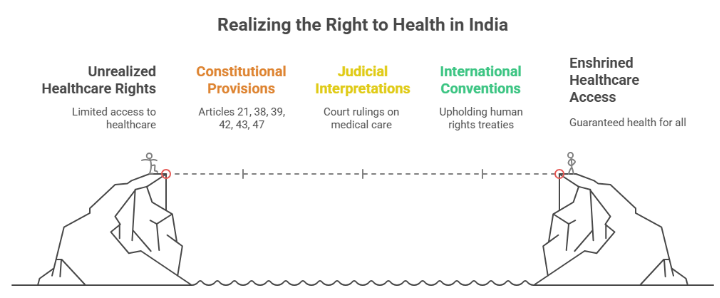
The Right to Health in India is essential to ensuring human dignity. India, being a signatory to the Universal Declaration of Human Rights (1948), has committed to ensuring adequate standards of living including healthcare, food, and housing for its citizens.
Although Article 15 prohibits discrimination, access to quality healthcare remains a privilege for a few. Years of underinvestment in public health systems have worsened the inequality.
Recognising the Right to Health in India can help dismantle structures that perpetuate disparities in access to education, employment, and upward mobility, especially for marginalised communities.
As societies progress, so must their rights. Healthcare is no longer a luxury but a necessity and should be guaranteed for all as a fundamental right.
While schemes like Ayushman Bharat have wide reach, they are primarily service-delivery models. A rights-based framework, on the other hand, ensures enforceability, accountability, and equity.
The primary healthcare system in India suffers from poor infrastructure and lack of trust. Enforcing the Right to Health in India can act as a catalyst to strengthen it.
Private healthcare providers fear the ambiguity around who will bear the cost of emergency and free treatments. This has been a primary point of opposition.
Critics argue that the Right to Health in India may result in the state shifting its responsibilities to the already overburdened private sector without adequate compensation.
India faces a dual burden of communicable and non-communicable diseases. According to Frontiers in Public Health, 33% of the population still suffers from infectious diseases. Coupled with low public health spending, this results in inadequate services and infrastructure.
Women face significant disparities in healthcare access and treatment. Recognising the Right to Health in India can play a transformative role in bridging this gender gap.
Some critics point out the absence of detailed implementation guidelines, but health rights activists argue that such details will be framed through Rules once the law is passed.
There are persistent complaints from private healthcare providers about reimbursement delays and unviable package rates under public health schemes.
Recognising the Right to Health in India as a fundamental right is not just a legal imperative but a moral one. It lays the foundation for an equitable, just, and inclusive healthcare system. With the right investments, legal backing, and political will, India can transform its healthcare system to serve every citizen with dignity and fairness.


Refine your answer writing skills and elevate your UPSC preparation with personalized support and expert feedback.
Fill out the form to get started with the program or any other enquiries !

Are you dreaming of becoming an IAS officer? Then, IAShub can be your best guide. It is one of the Best IAS Coaching in Delhi. Many students who want to clear the UPSC exam join IAShub for learning. The institute gives both online and offline classes. Their teachers are experienced and helpful. They easily explain every topic. Students also get notes, tests, and tips to do well in the exam.
IAShub is in Delhi and is trusted by many UPSC students. It offers coaching for every part of the UPSC exam – Prelims, Mains, and Interview. The classes are simple and easy to understand. The teachers are experts and guide students in the right way. IAShub is also known for its helpful notes, test series, and answer-writing practice. IAShub is the best coaching in Delhi and also gives UPSC Online Classes. This helps students from any place in India to learn. The online classes are live and also recorded. So, students can watch them anytime. These classes cover the full UPSC syllabus.
Here are some important services provided by IAShub:
The UPSC Civil Services Exam has three parts:
This exam is tough, but with the right guidance, it becomes easy to manage. Students must study smart and stay regular.
IAShub supports students from the beginning to the end. It gives the right books, tests, and notes. The classes are easy to follow, and the teachers are always ready to help. Students get personal doubt sessions too. The test series and answer checking help students learn where they need to do better. Also, free study materials save time and money.
IAShub also guides students during the final stage – the interview. Experts take mock interviews and give useful tips. This full support makes IAShub one of the best IAS coaching in Delhi.
Join 39,000+ UPSC Aspirants! 🚀
Get Free UPSC/State PSC Study Materials, Daily Current Affairs Question & Exam Updates.
Join Telegram Channel
