Right to Freedom Articles 19-22 of the Indian Constitution

Learn about the Right to Freedom (Articles 19-22) in the Indian Constitution, covering speech, privacy, sedition law, and legal safeguards. Key cases explained.

THEIASHUB
Get an Instant Call Back from Our Expert Mentors Now!
+91

The Right to Freedom is a fundamental part of the Indian Constitution, ensuring individual liberty and protection from arbitrary state actions. Covered under Articles 19-22, it guarantees rights such as freedom of speech, protection against unfair punishment, personal liberty, and safeguards against unlawful detention. The judiciary has played a crucial role in expanding and interpreting these rights, making them more inclusive in modern times.
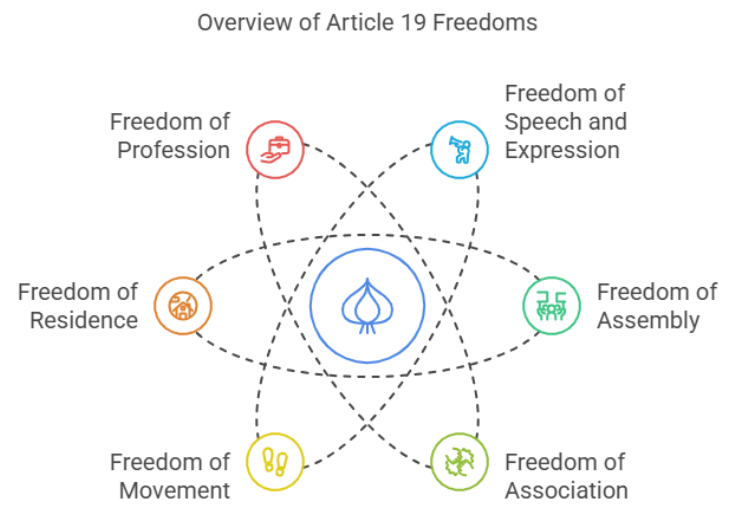
Article 19 Fundamental Freedoms Under the Right to Freedom


Article 19 grants six essential freedoms to Indian citizens:

  • Freedom of Speech and Expression – The right to express opinions freely.

  • Freedom of Assembly – The right to assemble peacefully without arms.

  • Freedom of Association – The right to form unions, groups, or cooperative societies.

  • Freedom of Movement – The right to travel freely across India.

  • Freedom of Residence – The right to settle anywhere in the country.

  • Freedom of Profession – The right to engage in any trade or occupation.

Restrictions on Article 19

The government can impose reasonable restrictions for:
  • National security and sovereignty

  • Public order and morality

  • Defamation and contempt of court

  • Incitement to violence

Judicial Rulings on Article 19 and the Right to Freedom

  • Internet and Mobile Association of India v. RBI (2020): The Supreme Court struck down RBI’s ban on cryptocurrency exchanges, stating it was a disproportionate restriction under Article 19(2).

  • The Supreme Court ruled that private entities like social media companies can also be challenged under Articles 19 and 21, expanding the Right to Freedom.

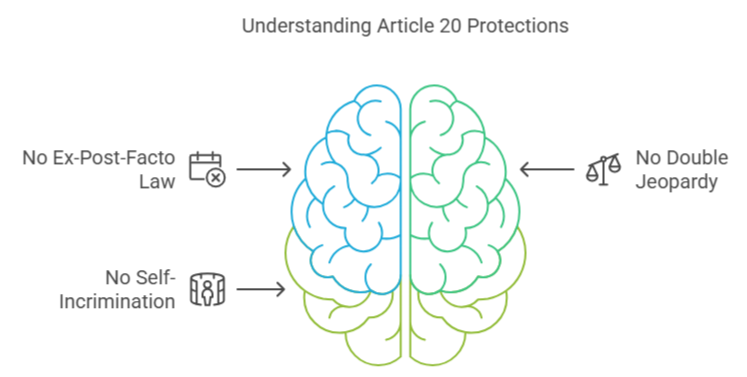
Article 20 Protection Against Unjust Conviction


Article 20 protects individuals from unfair prosecution and punishment.

Key Provisions Under Article 20

  • No Ex-Post-Facto Law – A person cannot be punished for an act that was not a crime when committed.

  • No Double Jeopardy – No individual can be punished twice for the same offense.

  • No Self-Incrimination – A person cannot be forced to testify against themselves.

Important Cases on Article 20 and the Right to Freedom

  • Nandini Satpathy v. P.L. Dani (1978): The court ruled that protection against self-incrimination applies even during police interrogations.

  • Selvi v. State of Karnataka (2010): Narco-analysis and polygraph tests were declared unconstitutional.

Article 21 Protection of Life and Personal Liberty

Article 21 states: “No person shall be deprived of his life or personal liberty except according to procedure established by law.” It is one of the broadest interpretations of the Right to Freedom.

Expansion of Article 21

The Supreme Court has expanded Article 21 to include several rights:

  • Right to Privacy – Recognized in K.S. Puttaswamy v. Union of India (2017).

  • Right to Live with Dignity – Affirmed in Francis Coralie Mullin v. UT of Delhi (1981).

  • Right to a Healthy Environment – Established in M.C. Mehta v. Kamal Nath (1996).

  • Right to Health – The Right to Health Bill (2024) in Rajasthan guarantees free healthcare.

Key Supreme Court Judgments on Article 21 and the Right to Freedom

Case Name

Significance

Menaka Gandhi v. Union of India (1978)

Introduced due process of law, ensuring fair legal procedures.

Navtej Singh Johar v. Union of India (2018)

Decriminalized homosexuality by striking down Section 377 IPC.

Joseph Shine v. Union of India (2018)

Struck down adultery law as unconstitutional.

Right to Environment and Climate Change

  • Rural Litigation & Entitlement Kendra v. UP (1988): Recognized the right to a pollution-free environment.

  • SC Ruling (2024): Failure to address climate change violates Articles 21 and 14, as environmental degradation threatens life and equality.

Article 22 Protection Against Arbitrary Arrest and Detention

Article 22 provides legal safeguards against arbitrary arrests and preventive detention.

Types of Detention Under Article 22

Type of Detention

Rights Guaranteed

Ordinary Detention

Right to be informed of arrest reasons and consult a lawyer.

Preventive Detention

A person can be detained for 3 months without an advisory board’s approval.

Concerns Over Preventive Detention and the Right to Freedom
  • Allows imprisonment without trial, leading to potential misuse.

  • Can be used against political dissenters and marginalized communities.

  • Lack of judicial review in early detention periods.

Sedition Law and Its Impact on the Right to Freedom

What Is Sedition?

Section 124A of IPC defines sedition as bringing hatred, contempt, or disaffection against the government.

Arguments for Repealing Sedition Law

  • Colonial origin – Used by the British to suppress Indian nationalists.

  • Violates Article 19 – Limits freedom of speech and criticism of the government.

  • Low conviction rate – Most sedition cases end in acquittal.

  • Global trend – Countries like UK, USA, and Australia have abolished sedition laws.

Arguments for Retaining Sedition Law

  • National security measure – Used to counter terrorism and separatist movements.

  • Supreme Court Verdict (Kedar Nath Singh v. Bihar, 1962): Upheld sedition law but limited its use to acts inciting violence.

Recent Supreme Court Cases on Sedition and the Right to Freedom

Case Name

Significance

P. Alavi v. State of Kerala (1982)

Mere sloganeering does not amount to sedition.

Rajat Sharma v. Union of India (2021)

Criticism of government policy is not sedition.

Strengthening the Right to Freedom: The Way Forward

  • Reform sedition law to prevent misuse.

  • Make sedition a bailable offense to ensure fair trials.

  • Set clear guidelines for preventive detention to avoid unjust arrests.

Conclusion

The Right to Freedom, protected under Articles 19-22, is essential for democracy and personal liberty. However, challenges like preventive detention, sedition laws, and restrictions on speech must be carefully addressed. Ensuring a balanced approach between individual rights and national security is key to upholding constitutional values.


UPSC QEP 2026 Batch 5 - English
Buy now View Details
Submit Your Details to Learn More
I agree to give my consent to receive updates through SMS/Email & WhatsApp*.

NEEV GS + CSAT Foundation 2026/27
Buy now View Details


Join theIAShub’s Mains Answer Writing Program

Refine your answer writing skills and elevate your UPSC preparation with personalized support and expert feedback.

Fill out the form to get started with the program or any other enquiries !

I agree to give my consent to receive updates through SMS/Email & WhatsApp*.

Best IAS Coaching In Delhi, UPSC Online & Offline Classes by IAShub

Are you dreaming of becoming an IAS officer? Then, IAShub can be your best guide. It is one of the Best IAS Coaching in Delhi. Many students who want to clear the UPSC exam join IAShub for learning. The institute gives both online and offline classes. Their teachers are experienced and helpful. They easily explain every topic. Students also get notes, tests, and tips to do well in the exam.

UPSC Online Classes by IAShub

IAShub is in Delhi and is trusted by many UPSC students. It offers coaching for every part of the UPSC exam – Prelims, Mains, and Interview. The classes are simple and easy to understand. The teachers are experts and guide students in the right way. IAShub is also known for its helpful notes, test series, and answer-writing practice. IAShub is the best coaching in Delhi and also gives UPSC Online Classes. This helps students from any place in India to learn. The online classes are live and also recorded. So, students can watch them anytime. These classes cover the full UPSC syllabus.

Key Offerings Provided by IAShub

Here are some important services provided by IAShub:

  • UPSC Prelims: IAShub teaches for Prelims with a focus on basics. It also gives daily current affairs and monthly magazines.
  • Classroom Courses: IAShub has classroom learning for students in Delhi. The environment is good and peaceful for study.
  • Live Classes: Students who live far can join live UPSC online classes. These classes are just like real classes.
  • QEP for Mains: The Quality Enrichment Program (QEP) is special for Mains preparation. It helps students write better and faster.
  • Answer Writing: Regular answer writing practice is given. Teachers also check answers and give tips to improve.
  • Free Resource: IAShub gives free notes by toppers and helpful Main Booster material.
  • Test Series: Test series are available for every subject. These help students know their weak points and improve.
  • Interview Guidance Session: IAShub also gives interview practice sessions with experts. These help students feel confident.

UPSC Exam Overview

The UPSC Civil Services Exam has three parts:

  • Prelims: It has two papers: General Studies and CSAT.
  • Mains: It has nine papers, including essays and optional subjects.
  • Interview: It tests the personality and confidence of the student.

This exam is tough, but with the right guidance, it becomes easy to manage. Students must study smart and stay regular.

How IAShub Helps in the UPSC Journey

IAShub supports students from the beginning to the end. It gives the right books, tests, and notes. The classes are easy to follow, and the teachers are always ready to help. Students get personal doubt sessions too. The test series and answer checking help students learn where they need to do better. Also, free study materials save time and money.
IAShub also guides students during the final stage – the interview. Experts take mock interviews and give useful tips. This full support makes IAShub one of the best IAS coaching in Delhi.

Best IAS Coaching In Delhi FAQs

Yes, IAShub offers live and recorded online classes. Students can attend from any part of India.

Classes are available in both English and Hindi, so students can choose the language they are comfortable with.

The classroom centre is located in Delhi. Students can visit and join offline batches there.

IAShub gives interview guidance sessions to help students prepare for the final round of UPSC.