


The Right To Education under the 86th Constitutional Amendment ensures free and compulsory education for children aged 6–14, changing the landscape of Indian education.
 theIASHub | 20 Aug, 2025 | 4199

Education is not just a privilege—it is a fundamental right in any progressive society. In India, this principle was formally realized through the Right To Education, especially after the 86th Constitutional Amendment Act of 2002. While education was earlier emphasized in the Directive Principles of State Policy, it lacked enforceability. The 86th Amendment changed that by granting constitutional status to the Right To Education, ensuring every child between the ages of 6 and 14 receives free and compulsory education.
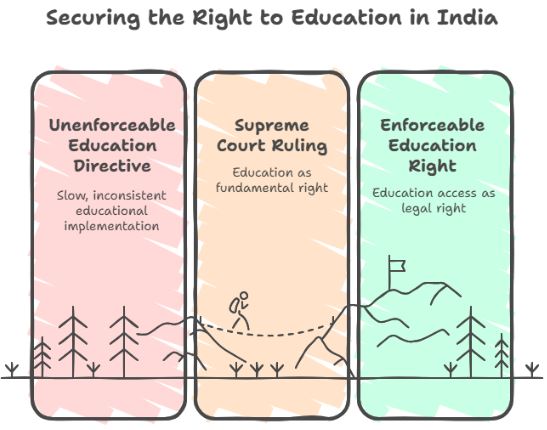
Article 45 of the original Constitution directed the State to provide free and compulsory education to all children up to the age of 14. However, since Directive Principles are not enforceable by law, actual implementation was slow and inconsistent. By the late 20th century, millions of children in India were still deprived of basic education.
In J.P. Unnikrishnan vs. State of Andhra Pradesh (1993), the Supreme Court ruled that the Right To Education is a fundamental right under Article 21 (Right to Life). This landmark decision gave legal teeth to the notion of education as a right, prompting further action by the legislature.
Passed in December 2002, the 86th Constitutional Amendment Act inserted Article 21A into the Indian Constitution. This article made the Right To Education a fundamental right.
“The State shall provide free and compulsory education to all children of the age of six to fourteen years in such manner as the State may, by law, determine.”
This provision made it mandatory for both the Central and State governments to ensure that no child within this age group is denied education.
The original Article 45 was modified to promote early childhood care and education up to the age of six, distinguishing it from the formal education guaranteed under Article 21A.
This made it a fundamental duty of parents and guardians to provide opportunities for education to their children between the ages of 6 and 14.
The Right To Education became actionable when the RTE Act was passed by Parliament in 2009 and implemented on April 1, 2010. This act provided the framework and guidelines for enforcing Article 21A.
The Right To Education Act made it illegal for schools to demand capitation fees or conduct entrance tests, making the education system more equitable and accessible.
The introduction of the Right To Education led to a significant increase in school enrollment rates, particularly among girls, rural children, and marginalized communities.
By reserving 25% seats in private schools, the RTE Act aimed at creating a level playing field for children from all economic backgrounds. This provision was a game-changer in ensuring social inclusion through education.
Under the Right To Education, School Management Committees (SMCs) were created to involve parents in school governance, ensuring greater transparency and accountability.
For the first time, parents could take legal action if their children were denied access to education, thus reinforcing education as a justiciable right.
Despite the progressive intent, many schools still lack adequate classrooms, toilets, drinking water, and qualified teachers. The Right To Education requires consistent investment to fulfill its promises.
Education being a Concurrent subject, the success of the RTE Act depends on cooperation between Central and State governments. Implementation quality varies from state to state.
While the Right To Education ensures access, the learning outcomes in government schools remain a concern. Focus must shift toward improving teaching standards, digital tools, and student engagement.
The Supreme Court’s interpretation in the J.P. Unnikrishnan case linked Right To Education with the Right to Life, underlining that a dignified life is impossible without education.
By adding Article 51A(k), the Constitution now recognizes that education is a shared responsibility, not just of the state but of parents and society at large.
The Right To Education, born out of the 86th Constitutional Amendment and realized through the RTE Act of 2009, marks a historic commitment to child welfare and nation-building. It reflects the belief that every child deserves an opportunity to learn, grow, and succeed, regardless of their socio-economic status.
However, to fully realize the goals of the Right To Education, India must:
The Right To Education is more than a law—it is the foundation of India’s democratic and developmental aspirations. As we move forward, this right must be protected, strengthened, and adapted to meet the changing needs of the 21st century.


Refine your answer writing skills and elevate your UPSC preparation with personalized support and expert feedback.
Fill out the form to get started with the program or any other enquiries !

Are you dreaming of becoming an IAS officer? Then, IAShub can be your best guide. It is one of the Best IAS Coaching in Delhi. Many students who want to clear the UPSC exam join IAShub for learning. The institute gives both online and offline classes. Their teachers are experienced and helpful. They easily explain every topic. Students also get notes, tests, and tips to do well in the exam.
IAShub is in Delhi and is trusted by many UPSC students. It offers coaching for every part of the UPSC exam – Prelims, Mains, and Interview. The classes are simple and easy to understand. The teachers are experts and guide students in the right way. IAShub is also known for its helpful notes, test series, and answer-writing practice. IAShub is the best coaching in Delhi and also gives UPSC Online Classes. This helps students from any place in India to learn. The online classes are live and also recorded. So, students can watch them anytime. These classes cover the full UPSC syllabus.
Here are some important services provided by IAShub:
The UPSC Civil Services Exam has three parts:
This exam is tough, but with the right guidance, it becomes easy to manage. Students must study smart and stay regular.
IAShub supports students from the beginning to the end. It gives the right books, tests, and notes. The classes are easy to follow, and the teachers are always ready to help. Students get personal doubt sessions too. The test series and answer checking help students learn where they need to do better. Also, free study materials save time and money.
IAShub also guides students during the final stage – the interview. Experts take mock interviews and give useful tips. This full support makes IAShub one of the best IAS coaching in Delhi.
Join 39,000+ UPSC Aspirants! 🚀
Get Free UPSC/State PSC Study Materials, Daily Current Affairs Question & Exam Updates.
Join Telegram Channel
