


Rabindranath Tagore, poet and philosopher, inspired cultural nationalism, founded Visva-Bharati University, and redefined education, unity, and freedom in India.
 theIASHub | 24 Sep, 2025 | 2028

Rabindranath Tagore, a poet, philosopher, educationist, and Nobel laureate, was one of the greatest cultural icons of India. His contributions were not confined to literature but extended to nationalism, education, cultural revival, and interfaith harmony. Tagore believed in nurturing the soul of the nation through creativity, inclusivity, and intellectual awakening. While other freedom leaders sought political independence through direct confrontation, Rabindranath Tagore envisioned a more holistic path where culture, education, and humanity formed the core of true freedom.
This article explores Rabindranath Tagore’s contributions to Indian nationalism, his educational reforms, his rejection of colonial honors, and his ideological differences with Mahatma Gandhi.
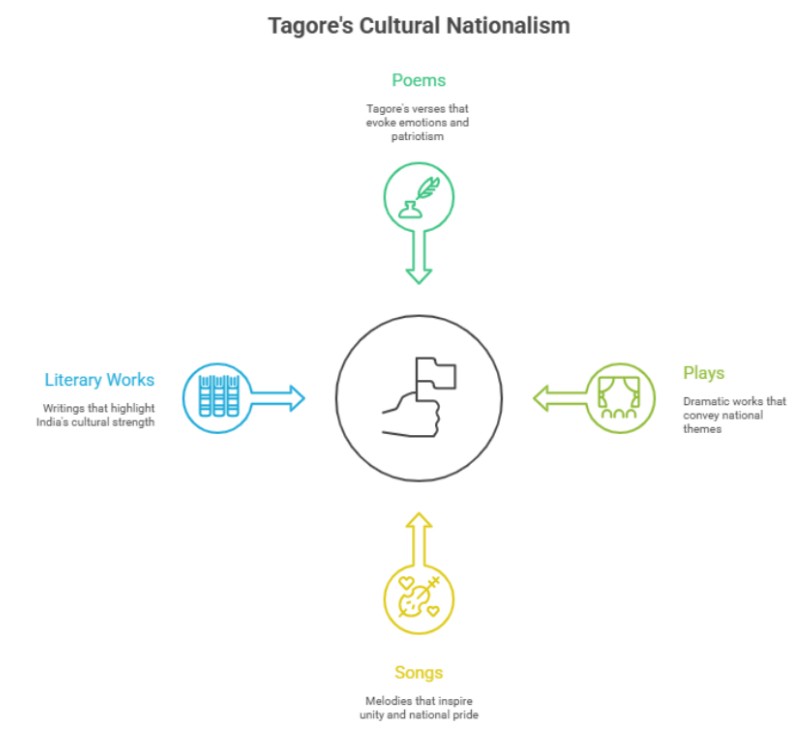
Rabindranath Tagore inspired cultural nationalism through his poems, plays, and songs, which touched the hearts of millions of Indians. His iconic composition “Jana Gana Mana”, which later became India’s national anthem, reflected his deep patriotism and vision of a united India.
Through his works such as Gitanjali, The Home and the World, and Ghare-Baire, Rabindranath Tagore ignited a sense of national consciousness. His writings not only highlighted India’s struggle but also projected India’s spiritual and cultural strength to the world.
One of the most remarkable contributions of Rabindranath Tagore was the establishment of Visva-Bharati University at Santiniketan in 1921. Unlike the colonial education system that promoted rote learning and subservience, Tagore’s vision was holistic and creative.
Visva-Bharati soon became a hub of cultural and intellectual exchange, where students from across the world came to learn. This institution reflected Rabindranath Tagore’s idea of blending Indian traditions with global perspectives.
Rabindranath Tagore’s Protest Against British Brutality
In 1915, Rabindranath Tagore was awarded knighthood by the British government. However, after the Jallianwala Bagh massacre of 1919, he renounced this honor as a mark of protest.
Rabindranath Tagore was a strong supporter of the Swadeshi Movement. He encouraged Indians to boycott British goods and revive indigenous industries.
Rabindranath Tagore stood for unity and inclusiveness. He believed India’s strength lay in its diversity. At a time when the British promoted divide-and-rule policies, Tagore spoke about the importance of interfaith harmony.
His nationalism was never aggressive or narrow. Instead, he envisioned an India where all religions, castes, and communities would coexist peacefully. This vision made him a global thinker, not just a national leader.
Mahatma Gandhi’s Nai Talim
Rabindranath Tagore’s Holistic Education
Mahatma Gandhi’s Nationalism
Rabindranath Tagore’s Internationalist Nationalism
Rabindranath Tagore remains an eternal symbol of India’s cultural and intellectual awakening. His contributions in literature, education, and philosophy continue to inspire the world.
Rabindranath Tagore was not just a poet but also a visionary philosopher, reformer, and nationalist who redefined the idea of freedom. His contributions in literature, cultural revival, and education left a lasting imprint on India’s journey towards independence. Unlike many leaders who focused solely on political freedom, Rabindranath Tagore stressed the importance of intellectual, cultural, and spiritual liberation.
His vision of nationalism was humane, inclusive, and global. By rejecting British honors, founding Visva-Bharati University, and inspiring people through literature, he became a true guiding light of India. Even today, Rabindranath Tagore stands tall as one of the greatest minds who combined tradition with modernity and nationalism with universalism.


Refine your answer writing skills and elevate your UPSC preparation with personalized support and expert feedback.
Fill out the form to get started with the program or any other enquiries !

Are you dreaming of becoming an IAS officer? Then, IAShub can be your best guide. It is one of the Best IAS Coaching in Delhi. Many students who want to clear the UPSC exam join IAShub for learning. The institute gives both online and offline classes. Their teachers are experienced and helpful. They easily explain every topic. Students also get notes, tests, and tips to do well in the exam.
IAShub is in Delhi and is trusted by many UPSC students. It offers coaching for every part of the UPSC exam – Prelims, Mains, and Interview. The classes are simple and easy to understand. The teachers are experts and guide students in the right way. IAShub is also known for its helpful notes, test series, and answer-writing practice. IAShub is the best coaching in Delhi and also gives UPSC Online Classes. This helps students from any place in India to learn. The online classes are live and also recorded. So, students can watch them anytime. These classes cover the full UPSC syllabus.
Here are some important services provided by IAShub:
The UPSC Civil Services Exam has three parts:
This exam is tough, but with the right guidance, it becomes easy to manage. Students must study smart and stay regular.
IAShub supports students from the beginning to the end. It gives the right books, tests, and notes. The classes are easy to follow, and the teachers are always ready to help. Students get personal doubt sessions too. The test series and answer checking help students learn where they need to do better. Also, free study materials save time and money.
IAShub also guides students during the final stage – the interview. Experts take mock interviews and give useful tips. This full support makes IAShub one of the best IAS coaching in Delhi.
Join 39,000+ UPSC Aspirants! 🚀
Get Free UPSC/State PSC Study Materials, Daily Current Affairs Question & Exam Updates.
Join Telegram Channel
