


Learn about public policy, its types, significance, stages, and evolution in India, along with challenges and real-life policy examples.
 theIASHub | 15 May, 2025 | 3582

Public Policy refers to a set of decisions and actions taken by the government to address public issues and promote social and economic welfare. The term "public" originates from the Latin word publicus, meaning people or community. Therefore, public policy is essentially a governmental strategy aimed at managing the affairs of the state and ensuring the welfare of its people. It includes goals, procedures, and instruments used to solve societal problems. Public policy operates within a political setting and is influenced by organizational politics, personal interests, and rational decision-making.
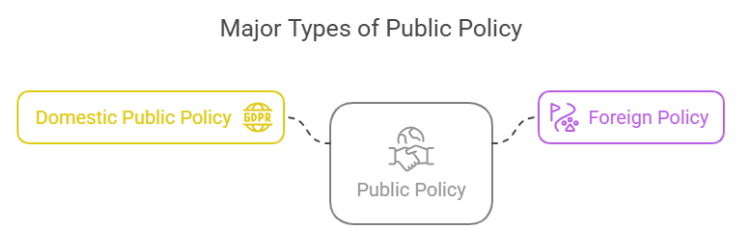
Public policy can be categorized based on its geographical reach into domestic and foreign policy.
Domestic public policy impacts the internal matters of a country and covers various fields:
These control individual or group behaviors to align with societal norms. Example: Anti-dumping duties, SEBI, RBI.
These policies shape the financial structure of the country. Examples include LPG reforms, Mudra Yojana, and Atmanirbhar Bharat. They include fiscal, monetary, trade, and industrial policies.
Focused on improving societal conditions and promoting change. Examples: Poshan Abhiyan, MGNREGA, National Nutrition Policy.
Foreign public policy is India’s strategy for dealing with other nations. It ensures national interest and promotes peaceful international relations. Examples: Non-Aligned Movement (NAM), Gujral Doctrine, Neighbourhood First Policy.
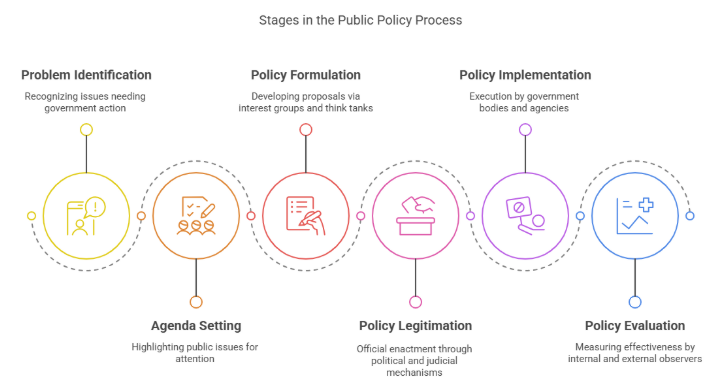
Thomas Dye outlines six key stages in the public policy process:
Public policy is vital in ensuring:
Issues like environmental protection vs. development are hard to balance.
Insufficient funds and manpower affect implementation.
Populism and political compromises dilute public policy effectiveness.
Corruption and poor coordination delay or derail policies.
Low citizen engagement can make public policy irrelevant to actual needs.
International obligations like WTO rules affect domestic public policy.
Rapid tech growth outpaces regulation—e.g., data privacy challenges.
After independence, India adopted planned development. The Planning Commission guided major public policy initiatives via Five-Year Plans.
Power decentralization began with the 73rd and 74th Amendments, strengthening local governance.
Today’s public policy is shaped by cooperative and competitive federalism. Institutions like NITI Aayog, NCERT, ICSSR, and IIPA play vital roles in research and policy formulation.
Public policy remains a cornerstone of democratic governance. Its evolution in India reflects changing socio-economic needs, political realities, and global developments. Addressing challenges and promoting inclusive, well-researched policies is key to a stable and progressive nation.


Refine your answer writing skills and elevate your UPSC preparation with personalized support and expert feedback.
Fill out the form to get started with the program or any other enquiries !

Are you dreaming of becoming an IAS officer? Then, IAShub can be your best guide. It is one of the Best IAS Coaching in Delhi. Many students who want to clear the UPSC exam join IAShub for learning. The institute gives both online and offline classes. Their teachers are experienced and helpful. They easily explain every topic. Students also get notes, tests, and tips to do well in the exam.
IAShub is in Delhi and is trusted by many UPSC students. It offers coaching for every part of the UPSC exam – Prelims, Mains, and Interview. The classes are simple and easy to understand. The teachers are experts and guide students in the right way. IAShub is also known for its helpful notes, test series, and answer-writing practice. IAShub is the best coaching in Delhi and also gives UPSC Online Classes. This helps students from any place in India to learn. The online classes are live and also recorded. So, students can watch them anytime. These classes cover the full UPSC syllabus.
Here are some important services provided by IAShub:
The UPSC Civil Services Exam has three parts:
This exam is tough, but with the right guidance, it becomes easy to manage. Students must study smart and stay regular.
IAShub supports students from the beginning to the end. It gives the right books, tests, and notes. The classes are easy to follow, and the teachers are always ready to help. Students get personal doubt sessions too. The test series and answer checking help students learn where they need to do better. Also, free study materials save time and money.
IAShub also guides students during the final stage – the interview. Experts take mock interviews and give useful tips. This full support makes IAShub one of the best IAS coaching in Delhi.
 Detailed Solutions & Explanations
Improve Your Answer Writing & Strategy
Detailed Solutions & Explanations
Improve Your Answer Writing & Strategy

