


PUBLIC INTEREST LITIGATION empowers citizens to seek justice for the public good. Learn its impact, challenges, and solutions to prevent misuse.
 theIASHub | 10 May, 2025 | 117


Public Interest Litigation (PIL) is a significant judicial innovation in India, allowing individuals and organizations to seek justice for the larger public good. It is available under Article 32 and Article 226 of the Indian Constitution, enabling direct access to the Supreme Court and High Courts. Initially conceptualized by Justice P.N. Bhagwati and Justice Krishna Iyer, PIL serves as a medium for enforcing fundamental rights and promoting social justice.
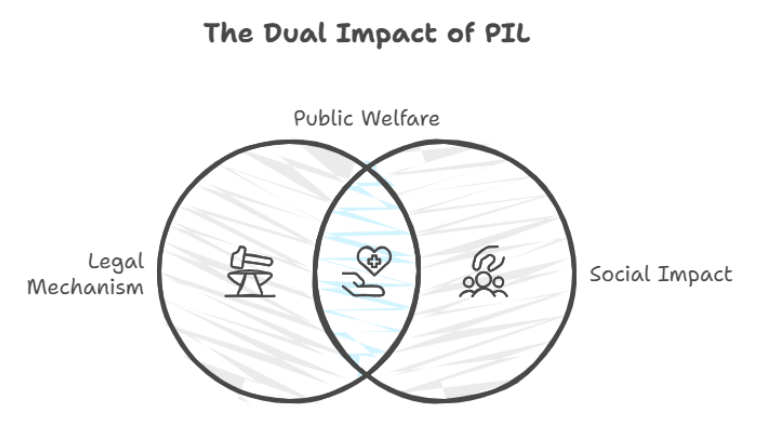
Public Interest Litigation refers to legal action undertaken for public welfare rather than personal gain. It allows any socially conscious person or organization to file a petition on behalf of disadvantaged individuals who cannot approach the court themselves. PIL has played a vital role in strengthening democracy, ensuring accountability of government actions, and promoting social change.
One of the core objectives of Public Interest Litigation is to safeguard fundamental rights. By filing a PIL under Article 32 and Article 226, individuals can directly seek relief from the Supreme Court or High Courts.
PIL aligns with Article 39A, which promotes equal justice and free legal aid. Courts have proactively used PILs to address economic and social disparities, ensuring that marginalized communities receive legal protection.
PIL empowers the judiciary to take suo motu cognizance of cases that require urgent attention. It has been instrumental in addressing government inaction, corruption, and human rights violations.
During the Covid-19 pandemic, the Supreme Court intervened to review the government’s vaccination policy, ensuring better access to vaccines.
Unlike traditional legal procedures, Public Interest Litigation involves minimal expenses. Courts have even accepted letters, newspaper reports, and postcards as PIL petitions.
In Veena Sethi v. State of Bihar, a simple letter led to judicial intervention, ensuring justice for mentally ill undertrial prisoners in Hazaribagh Jail.
PIL enables NGOs and activists to become active stakeholders in governance. Cases such as the Sabarimala Temple verdict and LGBTQ+ rights (Naz Foundation case) highlight the impact of PIL in promoting social inclusion.
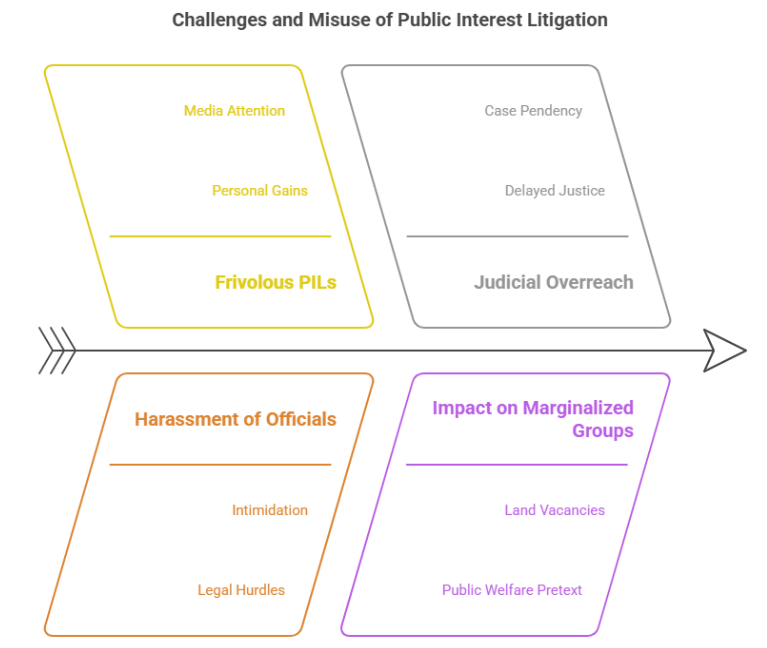
Some individuals misuse Public Interest Litigation for personal gains and media attention. Courts have condemned such PILs as a sheer abuse of the judicial process.
The Bombay High Court dismissed a PIL challenging a government tender, calling it an attempt to pollute the PIL mechanism.
Certain PILs are filed to intimidate bureaucrats and politicians, affecting their decision-making capabilities and creating unnecessary legal hurdles.
The increasing number of Public Interest Litigation cases has led to a strain on the judicial system, contributing to delayed justice and case pendency. With over 5 crore pending cases, courts struggle to balance PILs and regular litigation.
Excessive judicial interference through PILs can disrupt the balance between the executive, legislature, and judiciary. Despite landmark PIL verdicts, some social issues remain unresolved.
The plight of undertrial prisoners persists despite several PILs addressing the issue over the past 40 years.
At times, Public Interest Litigation has been used against poor farmers and slum dwellers, forcing them to vacate land under the pretext of public welfare.
The Supreme Court has established clear guidelines to ensure that Public Interest Litigation is not misused. Courts should only entertain PILs where access to justice is compromised due to social or economic constraints.
Courts should impose financial penalties on those filing frivolous PILs to discourage misuse.
A fixed time frame for PIL verdicts will prevent delays and ensure faster resolution of public issues.
While Public Interest Litigation has revolutionized access to justice, its misuse must be controlled. Proper regulation, judicial restraint, and adherence to guidelines can ensure that PIL remains a powerful tool for social change rather than a mechanism for personal agendas.




Refine your answer writing skills and elevate your UPSC preparation with personalized support and expert feedback.
Fill out the form to get started with the program or any other enquiries !





Are you dreaming of becoming an IAS officer? Then, IAShub can be your best guide. It is one of the Best IAS Coaching in Delhi. Many students who want to clear the UPSC exam join IAShub for learning. The institute gives both online and offline classes. Their teachers are experienced and helpful. They easily explain every topic. Students also get notes, tests, and tips to do well in the exam.
IAShub is in Delhi and is trusted by many UPSC students. It offers coaching for every part of the UPSC exam – Prelims, Mains, and Interview. The classes are simple and easy to understand. The teachers are experts and guide students in the right way. IAShub is also known for its helpful notes, test series, and answer-writing practice. IAShub is the best coaching in Delhi and also gives UPSC Online Classes. This helps students from any place in India to learn. The online classes are live and also recorded. So, students can watch them anytime. These classes cover the full UPSC syllabus.
Here are some important services provided by IAShub:
The UPSC Civil Services Exam has three parts:
This exam is tough, but with the right guidance, it becomes easy to manage. Students must study smart and stay regular.
IAShub supports students from the beginning to the end. It gives the right books, tests, and notes. The classes are easy to follow, and the teachers are always ready to help. Students get personal doubt sessions too. The test series and answer checking help students learn where they need to do better. Also, free study materials save time and money.
IAShub also guides students during the final stage – the interview. Experts take mock interviews and give useful tips. This full support makes IAShub one of the best IAS coaching in Delhi.
 Detailed Solutions & Explanations
Improve Your Answer Writing & Strategy
Detailed Solutions & Explanations
Improve Your Answer Writing & Strategy

