


Explore the pros and cons of Privatisation of School Education in India. Learn how it impacts access, equity, and quality. Can private schools support public education?
 theIASHub | 06 Jun, 2025 | 4591

The Privatisation of School Education has become a major topic in India’s education discourse. As public institutions struggle to keep pace with growing demands, private players are increasingly stepping in. However, while private schools bring innovation and investment, they also raise concerns about equity, affordability, and accessibility. A balanced approach is needed to harness the benefits while mitigating the drawbacks of Privatisation of School Education.
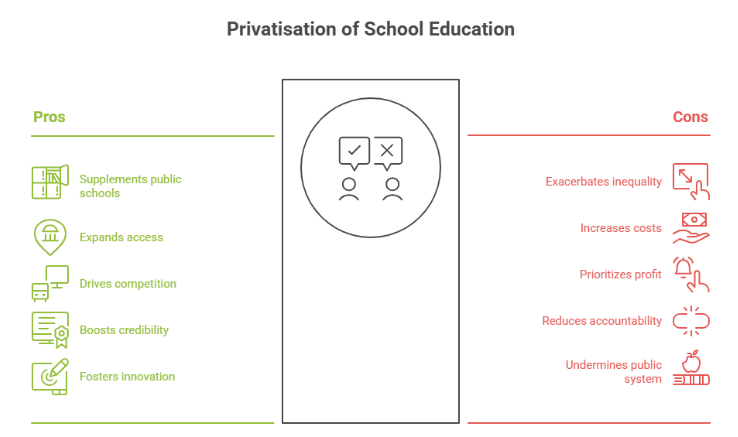
India’s public education system is under immense pressure. With limited infrastructure, outdated resources, and overpopulated classrooms, Privatisation of School Education helps bridge the gap by offering additional capacity. Private schools often establish institutions where public schools are either absent or inadequate.
Private institutions play a significant role in increasing access to education, especially in urban, semi-urban, and even some rural regions. Their ability to scale rapidly and establish schools where public institutions are yet to reach supports the broader goal of universal education.
The Privatisation of School Education introduces competition that can drive public schools to improve their quality. Increased choice for parents compels all schools—public or private—to enhance teaching standards, adopt innovative practices, and remain accountable.
Many parents perceive private schools as more efficient and reliable compared to government-run institutions. The rising number of enrolments in private schools is a clear indicator of public preference, often driven by perceptions of better discipline, outcomes, and teaching quality.
Private schools frequently experiment with modern teaching methods, digital tools, and value-added programs. The flexibility of private institutions allows for faster adoption of EdTech, project-based learning, and multilingual education, aligned with NEP 2020.
While Privatisation of School Education is often celebrated for improving quality, research evidence remains mixed. Multiple studies show no consistent advantage in learning outcomes between students of private and public schools when socio-economic backgrounds are accounted for.
One of the most significant drawbacks is the exclusion of marginalized children. Under the Right to Education (RTE) Act, private schools are required to reserve 25% of seats for children from socially and economically backward communities. However, compliance remains low, with only 20% of eligible seats filled, highlighting systemic loopholes.
The Privatisation of School Education has led to high tuition fees, capitation charges, and other forms of commercialization. Education in many private schools is increasingly treated as a business venture, raising concerns about affordability and ethical governance.
Many budget private schools operate with inadequate infrastructure, under-qualified teachers, and poor facilities. The lack of a robust regulatory and certification mechanism means that quality remains highly variable and often substandard.
The Privatisation of School Education should be viewed as supplementary to the public system, not a replacement. With over 65% of Indian students still enrolled in government schools, strengthening the public system must remain the national priority.
A well-structured regulatory framework is essential to monitor private schools. This includes ensuring compliance with RTE norms, regulating fee structures, and ensuring that schools maintain minimum infrastructure standards.
The National Education Policy (NEP) 2020 provides a comprehensive roadmap for improving both public and private school systems. Its focus on foundational literacy, teacher training, and technology integration must be adopted in letter and spirit by all stakeholders.
Effective PPP models can combine the reach of government with the efficiency of the private sector. These partnerships must be structured to ensure that they deliver quality education to all, not just the privileged.
Private institutions must be encouraged to take greater responsibility for social inclusion. Incentives and penalties can be introduced to ensure full implementation of the 25% RTE reservation and support for underprivileged children.
The Privatisation of School Education in India brings both opportunities and challenges. While it can help expand access, improve infrastructure, and bring innovation, it must be regulated to ensure that education remains a right and not a commodity. The goal must be to create an inclusive, affordable, and quality-driven education system where public and private sectors work in harmony. As India moves toward becoming a knowledge-based economy, the role of education—private or public—must be centered on equity, excellence, and ethics.


Refine your answer writing skills and elevate your UPSC preparation with personalized support and expert feedback.
Fill out the form to get started with the program or any other enquiries !

Are you dreaming of becoming an IAS officer? Then, IAShub can be your best guide. It is one of the Best IAS Coaching in Delhi. Many students who want to clear the UPSC exam join IAShub for learning. The institute gives both online and offline classes. Their teachers are experienced and helpful. They easily explain every topic. Students also get notes, tests, and tips to do well in the exam.
IAShub is in Delhi and is trusted by many UPSC students. It offers coaching for every part of the UPSC exam – Prelims, Mains, and Interview. The classes are simple and easy to understand. The teachers are experts and guide students in the right way. IAShub is also known for its helpful notes, test series, and answer-writing practice. IAShub is the best coaching in Delhi and also gives UPSC Online Classes. This helps students from any place in India to learn. The online classes are live and also recorded. So, students can watch them anytime. These classes cover the full UPSC syllabus.
Here are some important services provided by IAShub:
The UPSC Civil Services Exam has three parts:
This exam is tough, but with the right guidance, it becomes easy to manage. Students must study smart and stay regular.
IAShub supports students from the beginning to the end. It gives the right books, tests, and notes. The classes are easy to follow, and the teachers are always ready to help. Students get personal doubt sessions too. The test series and answer checking help students learn where they need to do better. Also, free study materials save time and money.
IAShub also guides students during the final stage – the interview. Experts take mock interviews and give useful tips. This full support makes IAShub one of the best IAS coaching in Delhi.
Join 39,000+ UPSC Aspirants! 🚀
Get Free UPSC/State PSC Study Materials, Daily Current Affairs Question & Exam Updates.
Join Telegram Channel
