


Explore the history of princely states in India, British policies, their impacts, and significance in shaping India’s political and cultural legacy.
 theIASHub | 24 Sep, 2025 | 4350

The princely states in India formed a crucial part of the subcontinent’s political and social history under British colonial rule. Unlike directly annexed territories, these states were ruled by local monarchs but functioned under British supervision and control. The policies framed by the East India Company and later the British Crown shaped their destiny in profound ways. To understand how the princely states in India evolved, it is important to explore the policies adopted by the British, their positive and negative impacts, and their lasting significance in Indian history.
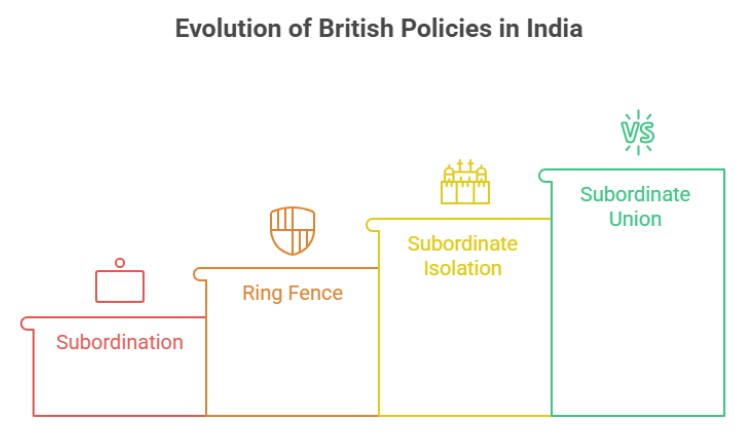
The princely states in India did not exist in isolation but were deeply tied to the larger colonial strategy of control. The British adopted several phases of policy towards them, ranging from subordination to union under the Crown.
Initially, the East India Company itself was subordinate to Indian rulers, but over time it asserted political dominance. The capture of Arcot in 1751 and the decisive Battle of Plassey in 1757 marked the rise of the Company as a major power. By securing the Diwani rights of Bengal, Bihar, and Orissa in 1765, the Company gained direct control over revenue, laying the foundation for dominance over the princely states in India.
The Policy of Ring Fence was introduced under Warren Hastings. This approach aimed at creating buffer zones to safeguard Company-controlled areas from external threats. Through wars with the Marathas and Mysore, the Company attempted to ensure that the princely states in India acted as protective shields for British territories.
Under this policy, the princely states in India were expected to acknowledge British supremacy. While they retained control over internal administration, they lost all rights of external sovereignty such as foreign relations and military alliances. This made them politically dependent on the British, though outwardly they continued to appear sovereign.
After the Revolt of 1857, which shook British authority, the Crown decided to change its approach. With the Government of India Act 1858, direct control passed to the British Crown. The policy of subordinate union ended the annexation practices that had earlier prevailed, largely because the princely states in India had shown loyalty during the revolt.
The Crown emerged as the paramount power, with the right to decide issues of succession, intervene in internal matters, and oversee administration in the name of public welfare. The Mughal emperor’s symbolic authority was completely abolished, and the British monarch became the ultimate sovereign of India.
Although the British policies curtailed the autonomy of rulers, they also introduced several reforms that had a lasting impact on the governance and administration of the princely states in India.
The annexation of territories and subordination of rulers led to the development of a centralized administrative system. This helped reduce internal rivalries and conflicts among the princely states in India, promoting a more uniform structure of governance.
One major positive legacy of British rule was the introduction of modern infrastructure. Railways, roads, postal systems, and telegraphs were extended to many princely states in India, creating better connectivity and laying the foundation for modernization.
The British also established courts, hospitals, and schools in several regions. These modern institutions transformed the socio-economic life of the princely states in India, gradually introducing Western education, legal reforms, and healthcare.
Many of the princely states in India were under autocratic rulers whose inefficiency harmed their subjects. By intervening, the British replaced or restricted such rulers, providing relatively more stable governance in several areas.
While there were certain positive outcomes, the negative impacts of British policies on the princely states in India were far greater. These policies led to loss of sovereignty, exploitation, and unrest.
The most significant outcome was the complete erosion of sovereignty. The princely states in India lost their independence in terms of foreign policy, military control, and succession rights. Even internal matters could be interfered with at the Crown’s discretion.
The wealth and resources of the princely states in India were systematically exploited for British benefit. Heavy taxation, land revenue systems, and extraction of natural resources drained the economic strength of these states, making them dependent on colonial authorities.
The British often interfered in social and cultural practices of the princely states in India, undermining traditional institutions. Local identities and cultural continuity suffered as Western ideas and practices were imposed.
The dissatisfaction caused by British interference led to widespread resistance. The Revolt of 1857 itself saw participation from discontented rulers and soldiers from the princely states in India. Later, many nationalist movements also found support within these states.
The princely states in India played a dual role during British colonial rule. On one hand, their loyalty helped the Crown consolidate power. On the other hand, their people became active participants in India’s freedom struggle. By the time of independence in 1947, there were over 560 princely states in India, each of which had to be integrated into the Indian Union.
The legacy of these states demonstrates how British policies transformed local politics, reshaped sovereignty, and left behind a complex administrative and cultural structure.
The history of the princely states in India reflects a journey from partial autonomy to complete subordination under the British. Through policies such as subordination, ring fence, subordinate isolation, and subordinate union, the British established paramount authority over Indian rulers. While infrastructure, education, and modernization brought some benefits, the loss of sovereignty, economic exploitation, and cultural erosion had long-lasting negative effects.
Ultimately, the princely states in India became a vital component of colonial governance and later, the national movement for independence. Their legacy remains central to understanding the colonial and post-colonial history of India.


Refine your answer writing skills and elevate your UPSC preparation with personalized support and expert feedback.
Fill out the form to get started with the program or any other enquiries !

Are you dreaming of becoming an IAS officer? Then, IAShub can be your best guide. It is one of the Best IAS Coaching in Delhi. Many students who want to clear the UPSC exam join IAShub for learning. The institute gives both online and offline classes. Their teachers are experienced and helpful. They easily explain every topic. Students also get notes, tests, and tips to do well in the exam.
IAShub is in Delhi and is trusted by many UPSC students. It offers coaching for every part of the UPSC exam – Prelims, Mains, and Interview. The classes are simple and easy to understand. The teachers are experts and guide students in the right way. IAShub is also known for its helpful notes, test series, and answer-writing practice. IAShub is the best coaching in Delhi and also gives UPSC Online Classes. This helps students from any place in India to learn. The online classes are live and also recorded. So, students can watch them anytime. These classes cover the full UPSC syllabus.
Here are some important services provided by IAShub:
The UPSC Civil Services Exam has three parts:
This exam is tough, but with the right guidance, it becomes easy to manage. Students must study smart and stay regular.
IAShub supports students from the beginning to the end. It gives the right books, tests, and notes. The classes are easy to follow, and the teachers are always ready to help. Students get personal doubt sessions too. The test series and answer checking help students learn where they need to do better. Also, free study materials save time and money.
IAShub also guides students during the final stage – the interview. Experts take mock interviews and give useful tips. This full support makes IAShub one of the best IAS coaching in Delhi.
Join 39,000+ UPSC Aspirants! 🚀
Get Free UPSC/State PSC Study Materials, Daily Current Affairs Question & Exam Updates.
Join Telegram Channel
