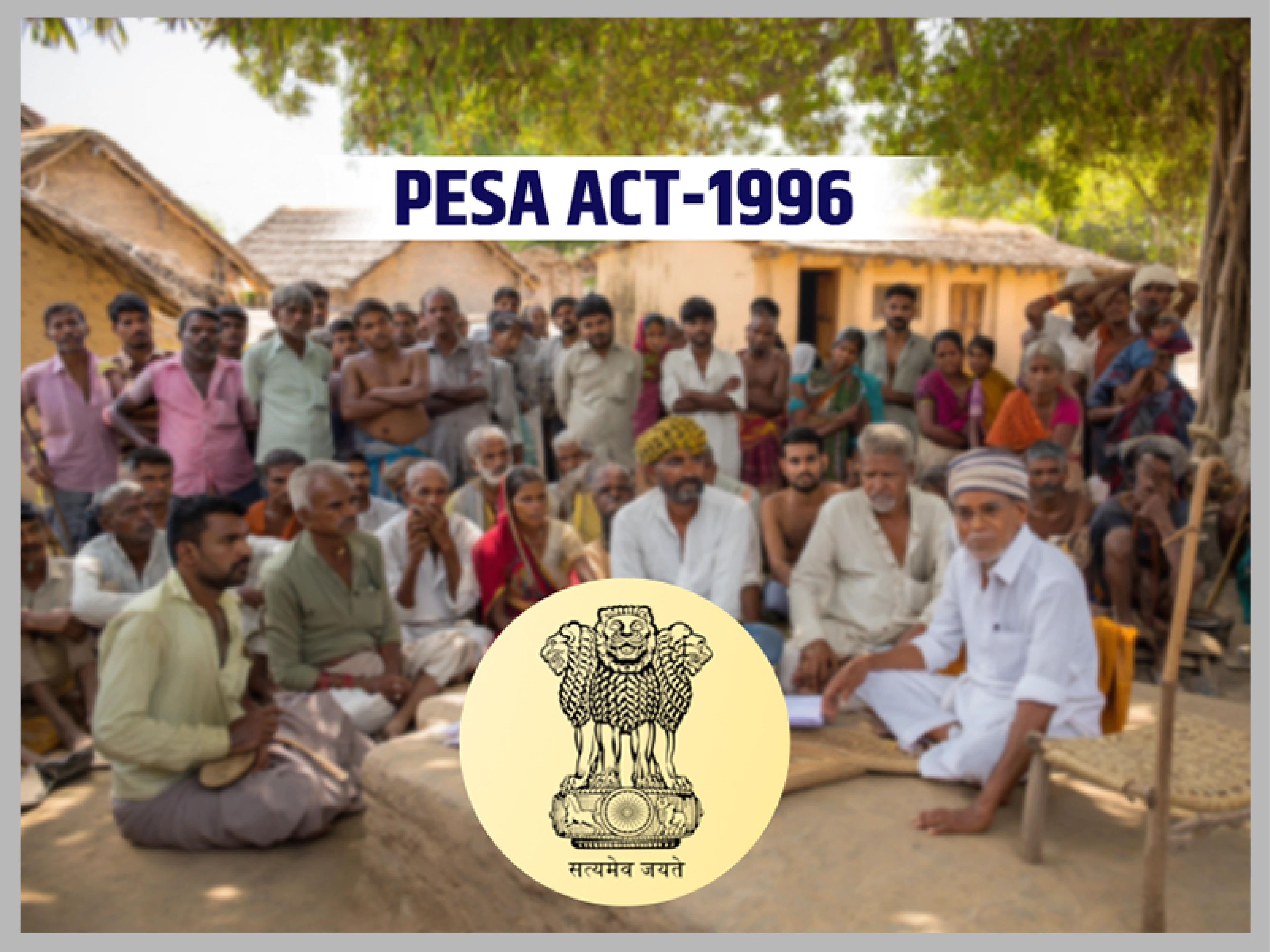
Panchayats (Extension to the Scheduled Areas) Act, 1996 (PESA)

PESA Act 1996 empowers Gram Sabhas in Scheduled Areas, ensuring tribal governance, resource control, and self-rule while safeguarding tribal rights and culture.

THEIASHUB
Get an Instant Call Back from Our Expert Mentors Now!
+91

The Panchayats (Extension to the Scheduled Areas) Act, 1996 (PESA Act) was enacted to empower tribal communities by extending the provisions of Part IX of the Constitution to Fifth Schedule Areas. It was based on the recommendations of the Bhuria Commission and aims to preserve tribal culture, promote self-governance, and safeguard natural resources.

Key Features of the PESA Act

  • Applies to 10 states: Andhra Pradesh, Chhattisgarh, Gujarat, Himachal Pradesh, Jharkhand, Madhya Pradesh, Maharashtra, Odisha, Rajasthan, and Telangana.
  • Empowers Gram Sabhas to approve development projects, manage village markets, control local resources, and prevent land alienation.
  • Ensures tribal control over minor forest produce, water bodies, minerals, and community resources.
  • Respects tribal traditions and customs, making Gram Sabhas responsible for safeguarding their cultural identity.
  • Limits state intervention, ensuring that higher-level Panchayats cannot take over powers of lower-level Panchayats.
  • Reserves 50% of Panchayat seats for Scheduled Tribes (STs) and mandates 100% reservation for Chairperson positions in tribal areas.
  • Helps prevent extremism by strengthening tribal governance and ensuring local participation in development.

Significance of the PESA Act

1. Strengthening Tribal Self-Governance

The PESA Act enables genuine grassroots democracy by giving Gram Sabhas decision-making powers over:

  • Development projects (ensuring they benefit local communities).
  • Land alienation prevention (protecting tribal land from exploitation).
  • Money lending regulation (preventing debt traps for tribals).
  • Village markets and local economy (reducing external exploitation).
  • Management of minor forest produce and natural resources (ensuring local benefits).

Example: Kamayyapeta, Andhra Pradesh – "Adivasi Mitra," a community-led initiative, successfully implemented PESA for self-governance through Gram Sabha decisions.

2. Protection of Tribal Rights & Resources

  • Ensures community ownership over water resources, common land, minor minerals, and forests.
  • Protects traditional tribal practices and ensures their inclusion in governance.

3. Democratic Decentralization

  • Makes Gram Sabhas the primary decision-making bodies in tribal areas.
  • Stops higher-level Panchayats from interfering in local governance.
  • Strengthens political representation for Scheduled Tribes.

4. Curbing Extremism & Social Unrest

  • By giving tribals control over their resources and governance, PESA reduces alienation and resentment, preventing extremism.
  • Encourages development through self-governance, reducing dependency on external agencies.

Challenges in PESA Implementation

1. Reluctance of States to Implement PESA

  • Many states have not framed rules for PESA implementation.
  • 4 out of 10 states (Chhattisgarh, Jharkhand, MP, Odisha) have failed to operationalize PESA, even after 25 years.

2. Conflict Between State Laws & PESA

  • Several state laws on land acquisition, forest produce, minerals, and markets contradict PESA.
  • Example: Andhra Pradesh, Telangana, and Maharashtra have not aligned their laws with PESA, limiting its impact.

3. Weak Gram Sabhas

  • State governments have diluted PESA provisions, giving more power to Panchayats instead of Gram Sabhas.
  • Expansion of Gram Sabha functions has not been supported with necessary funds or staff.
  • Local elites dominate Gram Sabha meetings, excluding women and weaker sections.

4. Violation of Tribal Land & Forest Rights

  • Gram Sabha consent is frequently ignored in land acquisition cases.
  • Example: Essar Mining Case, Keonjhar (Odisha) – Tribal lands were illegally diverted despite PESA provisions.

5. Overlapping Administrative Control

  • Two ministries (Ministry of Panchayati Raj & Ministry of Tribal Affairs) oversee PESA, leading to coordination issues.
  • Lack of clarity on roles and responsibilities between central and state governments.

6. Low Awareness Among Tribals

  • Many tribal communities are unaware of their rights under PESA.
  • Government officials lack knowledge of tribal customs and governance practices.

Way Forward

1. Align State Laws with PESA (Recommended by 2nd ARC & XAXA Committee)

  • Ensure all state laws comply with PESA to fully empower Gram Sabhas.
  • States must show political commitment to transfer power to Gram Sabhas.

2. Establish Central Oversight

  • Create a national-level forum to monitor PESA implementation and ensure compliance by states.

3. Strengthen Gram Sabhas

  • Make state departments accountable to Gram Sabhas through legislative backing.
  • Allocate sufficient funds and functionaries to improve Gram Sabha efficiency.

4. Raise Awareness Among Tribals

  • Conduct mass awareness campaigns on PESA rights and governance.
  • Capacity-building programs for Gram Sabha members to enhance participation.

5. Improve Coordination Between Government Bodies

  • Define clear roles for the Ministry of Panchayati Raj and the Ministry of Tribal Affairs to avoid administrative overlap.

6. Reduce Trust Deficit Between Tribals & Government

  • Organize special Gram Sabhas with government officials to address tribal concerns.
  • Ensure development programs align with local tribal needs.

7. Promote Tribal Knowledge for Sustainable Development

  • Use tribal knowledge for forest conservation, Ayurveda medicine, and handicrafts to promote local economy.

Success Stories of PESA Implementation

1. Odisha Bauxite Mining Case (2013)

  • Supreme Court upheld Gram Sabha’s authority over mining projects in Kalahandi & Rayagada districts.
  • Set a precedent for tribal self-governance and environmental protection.

2. Chhattisgarh Coal Mining Protest (Korba District)

  • Tribals opposed land acquisition under the Coal Bearing Act, 1957, arguing it violated PESA provisions.
  • Government revised its approach to comply with PESA.

3. Telangana – Tribal Resistance Against Liquor Shops

  • Tribals in Adilabad, Mancherial, and Asifabad districts passed Gram Sabha resolutions to stop liquor shop openings in villages.
  • Training by the Integrated Tribal Development Agency helped tribals use PESA for self-governance.

4. Jharkhand’s Resistance to Land Law Amendments (2016)

  • Tribal communities mobilized against amendments to the Chota Nagpur Tenancy Act & Santhal Pargana Tenancy Act.
  • Used PESA provisions to protect tribal land rights from government takeover.

Conclusion

The PESA Act is a landmark legislation that recognizes tribal self-governance and their rights over natural resources. However, lack of implementation by states, conflicting state laws, and weak Gram Sabhas continue to undermine its effectiveness.

To realize the true potential of PESA, the government must ensure:
Full compliance by states
Awareness among tribal communities
Strong Gram Sabha participation
Protection of tribal land and culture

A truly empowered Gram Sabha can make PESA a tool for grassroots democracy, sustainable development, and social justice in tribal areas.




UPSC QEP 2026 Batch 5 - English
UP-PCS 2026 Pre+Mains Integrated Program (English Batch-2)
View Details
Submit Your Details to Learn More
I agree to give my consent to receive updates through SMS/Email & WhatsApp*.

UPSC QEP 2026 Batch 5 - English
UP-PCS 2026 Pre+Mains Integrated Program (Hindi Batch-2)
View Details


Join theIAShub’s Mains Answer Writing Program

Refine your answer writing skills and elevate your UPSC preparation with personalized support and expert feedback.

Fill out the form to get started with the program or any other enquiries !

I agree to give my consent to receive updates through SMS/Email & WhatsApp*.

Best IAS Coaching In Delhi, UPSC Online & Offline Classes by IAShub

Are you dreaming of becoming an IAS officer? Then, IAShub can be your best guide. It is one of the Best IAS Coaching in Delhi. Many students who want to clear the UPSC exam join IAShub for learning. The institute gives both online and offline classes. Their teachers are experienced and helpful. They easily explain every topic. Students also get notes, tests, and tips to do well in the exam.

UPSC Online Classes by IAShub

IAShub is in Delhi and is trusted by many UPSC students. It offers coaching for every part of the UPSC exam – Prelims, Mains, and Interview. The classes are simple and easy to understand. The teachers are experts and guide students in the right way. IAShub is also known for its helpful notes, test series, and answer-writing practice. IAShub is the best coaching in Delhi and also gives UPSC Online Classes. This helps students from any place in India to learn. The online classes are live and also recorded. So, students can watch them anytime. These classes cover the full UPSC syllabus.

Key Offerings Provided by IAShub

Here are some important services provided by IAShub:

  • UPSC Prelims: IAShub teaches for Prelims with a focus on basics. It also gives daily current affairs and monthly magazines.
  • Classroom Courses: IAShub has classroom learning for students in Delhi. The environment is good and peaceful for study.
  • Live Classes: Students who live far can join live UPSC online classes. These classes are just like real classes.
  • QEP for Mains: The Quality Enrichment Program (QEP) is special for Mains preparation. It helps students write better and faster.
  • Answer Writing: Regular answer writing practice is given. Teachers also check answers and give tips to improve.
  • Free Resource: IAShub gives free notes by toppers and helpful Main Booster material.
  • Test Series: Test series are available for every subject. These help students know their weak points and improve.
  • Interview Guidance Session: IAShub also gives interview practice sessions with experts. These help students feel confident.

UPSC Exam Overview

The UPSC Civil Services Exam has three parts:

  • Prelims: It has two papers: General Studies and CSAT.
  • Mains: It has nine papers, including essays and optional subjects.
  • Interview: It tests the personality and confidence of the student.

This exam is tough, but with the right guidance, it becomes easy to manage. Students must study smart and stay regular.

How IAShub Helps in the UPSC Journey

IAShub supports students from the beginning to the end. It gives the right books, tests, and notes. The classes are easy to follow, and the teachers are always ready to help. Students get personal doubt sessions too. The test series and answer checking help students learn where they need to do better. Also, free study materials save time and money.
IAShub also guides students during the final stage – the interview. Experts take mock interviews and give useful tips. This full support makes IAShub one of the best IAS coaching in Delhi.

Best IAS Coaching In Delhi FAQs

Yes, IAShub offers live and recorded online classes. Students can attend from any part of India.

Classes are available in both English and Hindi, so students can choose the language they are comfortable with.

The classroom centre is located in Delhi. Students can visit and join offline batches there.

IAShub gives interview guidance sessions to help students prepare for the final round of UPSC.