


Explore the history of peasant movements in India (1857–1947), their causes, limitations, and contribution to India’s freedom struggle.
 theIASHub | 24 Sep, 2025 | 4671

Peasant movements in India played a very crucial role in shaping the history of colonial resistance. These movements reflected the anger, struggle, and determination of Indian farmers against British colonial exploitation, oppressive landlords, and exploitative revenue policies. Between 1857 and 1947, peasant movements in India were one of the most significant forces that laid the foundation for the Indian freedom struggle.
This article will provide a detailed explanation of the peasant movements in India, their background, nature, limitations, and contribution to the freedom struggle.
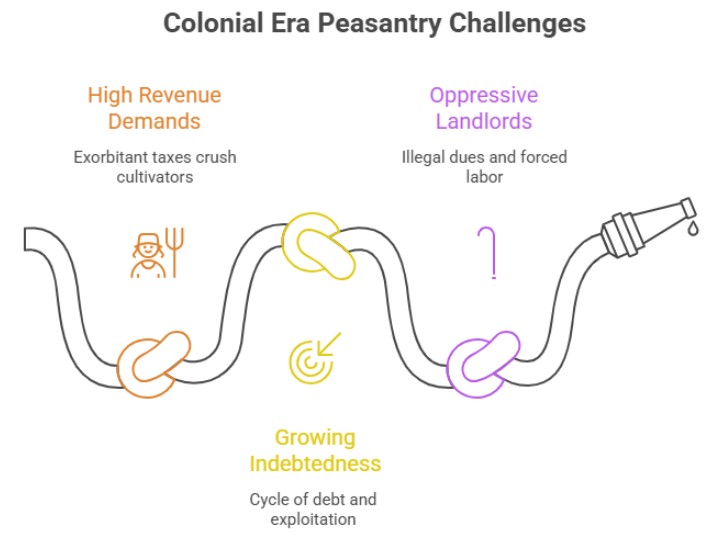
The peasants in colonial India were crushed under the weight of high revenue demands, oppressive zamindari systems, and unfair land tenures. The British introduced systems like the Permanent Settlement, Ryotwari, and Mahalwari, which often favored landlords and revenue collectors instead of the cultivators. As a result, peasants had to pay exorbitant taxes, irrespective of whether crops failed due to famine or natural disasters.
Peasant movements in India were also driven by growing indebtedness. Since cultivators often had to borrow from moneylenders to pay taxes, they ended up in a cycle of debt and exploitation. Many farmers lost their land, which added to rural distress and resentment.
In many regions, landlords, moneylenders, and colonial agents exploited peasants by charging high rents, extracting illegal dues, and engaging in forced labor practices. This constant exploitation made revolts inevitable.
The Indigo Revolt in Bengal marked one of the first organized peasant movements in India. Farmers protested against European planters who forced them to grow indigo instead of food crops. The movement gained widespread support, and intellectuals like Dinabandhu Mitra highlighted their plight in works like Nil Darpan.
In Bengal’s Pabna district, peasants revolted against zamindars who demanded illegal cesses and levies. The movement was mostly non-violent but showed how peasants could organize themselves to resist exploitation.
The Deccan Riots broke out in Maharashtra when peasants rose against moneylenders who seized their lands and cattle. Villagers attacked moneylenders’ houses and burned debt bonds. This was a strong statement against rural debt bondage.
Under the leadership of Mahatma Gandhi, the Champaran Satyagraha was launched against the tinkathia system, where indigo planters forced peasants to cultivate indigo on a portion of their land. This marked the entry of Gandhi into Indian politics and was a turning point in peasant movements in India.
In Gujarat, peasants launched the Kheda Satyagraha under Gandhi and Sardar Patel. They refused to pay taxes during crop failure. This movement highlighted the strength of non-violent resistance in peasant struggles.
Led by Sardar Vallabhbhai Patel, the Bardoli Satyagraha was against unjust revenue hikes in Gujarat. It was successful and earned Patel the title of “Sardar.”
The Tebhaga Movement in Bengal was led by sharecroppers who demanded two-thirds of the produce instead of one-half. It highlighted the problems of tenant farmers and the demand for equitable land reforms.
Despite their importance, the peasant movements in India had certain limitations:
The peasant movements in India between 1857 and 1947 were not just localized struggles but part of a larger awakening against colonial exploitation. They challenged oppressive revenue systems, inspired leadership in the national movement, and laid the groundwork for agrarian reforms after independence.
Though many of these movements faced brutal suppression, they succeeded in uniting farmers, spreading political awareness, and contributing significantly to India’s independence. The history of peasant movements in India is, therefore, a story of resilience, courage, and the quest for justice.


Refine your answer writing skills and elevate your UPSC preparation with personalized support and expert feedback.
Fill out the form to get started with the program or any other enquiries !

Are you dreaming of becoming an IAS officer? Then, IAShub can be your best guide. It is one of the Best IAS Coaching in Delhi. Many students who want to clear the UPSC exam join IAShub for learning. The institute gives both online and offline classes. Their teachers are experienced and helpful. They easily explain every topic. Students also get notes, tests, and tips to do well in the exam.
IAShub is in Delhi and is trusted by many UPSC students. It offers coaching for every part of the UPSC exam – Prelims, Mains, and Interview. The classes are simple and easy to understand. The teachers are experts and guide students in the right way. IAShub is also known for its helpful notes, test series, and answer-writing practice. IAShub is the best coaching in Delhi and also gives UPSC Online Classes. This helps students from any place in India to learn. The online classes are live and also recorded. So, students can watch them anytime. These classes cover the full UPSC syllabus.
Here are some important services provided by IAShub:
The UPSC Civil Services Exam has three parts:
This exam is tough, but with the right guidance, it becomes easy to manage. Students must study smart and stay regular.
IAShub supports students from the beginning to the end. It gives the right books, tests, and notes. The classes are easy to follow, and the teachers are always ready to help. Students get personal doubt sessions too. The test series and answer checking help students learn where they need to do better. Also, free study materials save time and money.
IAShub also guides students during the final stage – the interview. Experts take mock interviews and give useful tips. This full support makes IAShub one of the best IAS coaching in Delhi.
Join 39,000+ UPSC Aspirants! 🚀
Get Free UPSC/State PSC Study Materials, Daily Current Affairs Question & Exam Updates.
Join Telegram Channel
