


The Partition of Vietnam in 1954 divided the country at the 17th parallel, triggering the Vietnam War and shaping Cold War politics. Explore its causes, impacts, and global significance, from colonial roots to ideological battles between East and West.
 theIASHub | 20 Jun, 2025 | 4357

The Partition of Vietnam marked a critical turning point in the history of Southeast Asia and in the global Cold War landscape. In 1954, after nearly a century of colonial domination and years of struggle for independence, Vietnam was divided into two parts—North Vietnam and South Vietnam—at the 17th parallel, as outlined in the Geneva Accords. This partition was initially considered temporary, but it soon evolved into a long-standing division that led to the Vietnam War, shaping international relations and affecting millions of lives.
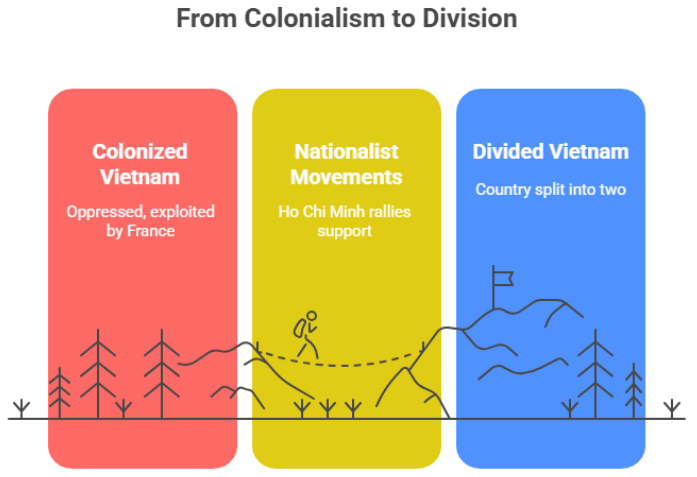
Before the Partition of Vietnam, the country had endured over six decades of French colonial rule, which began in the mid-19th century. The French exploited Vietnam's natural resources and suppressed Vietnamese culture and identity, creating deep resentment among the local population.
The early 20th century saw the emergence of strong nationalist movements in Vietnam, with leaders like Ho Chi Minh rallying support to end colonial rule. This growing nationalism played a crucial role in challenging French authority and eventually leading to Vietnam’s division.
The Partition of Vietnam was the result of a combination of colonial, ideological, and geopolitical factors. Let’s explore the main causes:
Post-World War II, countries across Asia and Africa began demanding independence. In Vietnam, the First Indochina War (1946–1954) broke out between the Viet Minh (communist-led nationalist forces) and the French colonial army. The Viet Minh’s victory at Dien Bien Phu in 1954 forced France to negotiate peace.
The Geneva Conference was held in 1954 to address the crisis in Indochina. As part of the agreements:
This formalized the Partition of Vietnam.
The Partition of Vietnam must be viewed within the broader context of the Cold War:
Vietnam’s location made it geopolitically important. Both the U.S. and the Soviet Union saw Vietnam as key to influencing Asia’s political landscape. The Partition of Vietnam allowed both superpowers to establish their ideological presence in the region.
The Partition of Vietnam had wide-ranging implications, not only for the Vietnamese people but also for global politics and the entire Southeast Asian region.
The differing systems intensified the division created by the Partition of Vietnam.
The failure to hold reunification elections and increasing hostility led to the Vietnam War (1955–1975). North Vietnam, supported by the Viet Cong, aimed to reunify the country by overthrowing the South's government. This civil war became one of the most devastating proxy wars of the Cold War era.
The Partition of Vietnam ultimately resulted in decades of warfare. Millions of Vietnamese civilians and soldiers died, and the infrastructure in both North and South Vietnam was severely damaged.
The conflict spread beyond Vietnam, affecting Cambodia and Laos, which also faced civil wars and external interventions. The Partition of Vietnam thus destabilized the entire Indochina region.
The U.S. intervention in South Vietnam shaped its foreign policy for decades. The failure to prevent the rise of communism in Vietnam led to a more cautious and critical evaluation of U.S. military involvement abroad, especially after its withdrawal in 1973.
With the fall of Saigon in 1975, the Partition of Vietnam ended, and the country was officially reunified under a communist government. This was viewed as a symbolic and strategic victory for the global communist movement during the Cold War.
The Partition of Vietnam was legally rooted in the Geneva Accords, which aimed to bring peace to Indochina. The 17th parallel served as a temporary military demarcation line, but it effectively became a political and ideological boundary between two competing visions of Vietnam's future.
Even after reunification, the scars of the Partition of Vietnam remained. Political repression, lack of civil liberties, and economic challenges persisted in unified Vietnam.
The Partition of Vietnam continues to be analyzed in historical and political studies as a key moment in Cold War history and international diplomacy.
The Vietnamese diaspora, especially from the South, contributed to cultural exchanges in countries like the U.S., France, and Australia. These migrations were a direct result of the unrest caused by the Partition of Vietnam and the ensuing war.
The Partition of Vietnam in 1954 was more than just a geopolitical rearrangement; it was the result of decades of colonization, nationalism, and Cold War power struggles. The temporary division became a prolonged separation that triggered a major war, influenced global politics, and reshaped Southeast Asia. While the physical division ended with reunification in 1975, the political, social, and historical consequences of the Partition of Vietnam are still deeply felt today.


Refine your answer writing skills and elevate your UPSC preparation with personalized support and expert feedback.
Fill out the form to get started with the program or any other enquiries !

Are you dreaming of becoming an IAS officer? Then, IAShub can be your best guide. It is one of the Best IAS Coaching in Delhi. Many students who want to clear the UPSC exam join IAShub for learning. The institute gives both online and offline classes. Their teachers are experienced and helpful. They easily explain every topic. Students also get notes, tests, and tips to do well in the exam.
IAShub is in Delhi and is trusted by many UPSC students. It offers coaching for every part of the UPSC exam – Prelims, Mains, and Interview. The classes are simple and easy to understand. The teachers are experts and guide students in the right way. IAShub is also known for its helpful notes, test series, and answer-writing practice. IAShub is the best coaching in Delhi and also gives UPSC Online Classes. This helps students from any place in India to learn. The online classes are live and also recorded. So, students can watch them anytime. These classes cover the full UPSC syllabus.
Here are some important services provided by IAShub:
The UPSC Civil Services Exam has three parts:
This exam is tough, but with the right guidance, it becomes easy to manage. Students must study smart and stay regular.
IAShub supports students from the beginning to the end. It gives the right books, tests, and notes. The classes are easy to follow, and the teachers are always ready to help. Students get personal doubt sessions too. The test series and answer checking help students learn where they need to do better. Also, free study materials save time and money.
IAShub also guides students during the final stage – the interview. Experts take mock interviews and give useful tips. This full support makes IAShub one of the best IAS coaching in Delhi.
Join 39,000+ UPSC Aspirants! 🚀
Get Free UPSC/State PSC Study Materials, Daily Current Affairs Question & Exam Updates.
Join Telegram Channel
