Partition of Bengal (1905): Causes, Impact and Legacy in Indian Nationalism

Explore the Partition of Bengal (1905): its causes, nationalist impact, the rise of communalism, Swadeshi Movement, and legacy in India’s freedom struggle.

THEIASHUB
Get an Instant Call Back from Our Expert Mentors Now!
+91

The partition of Bengal in 1905 stands as a watershed moment in India's fight against colonial rule, symbolizing the spirit of resilience, unity, and the unyielding pursuit of freedom. It was announced by Lord Curzon, the viceroy of India at the time, on July 20th, 1905, and went into effect on October 16th, 1905, only to be reversed six years later.
Causes of Bengal Partition

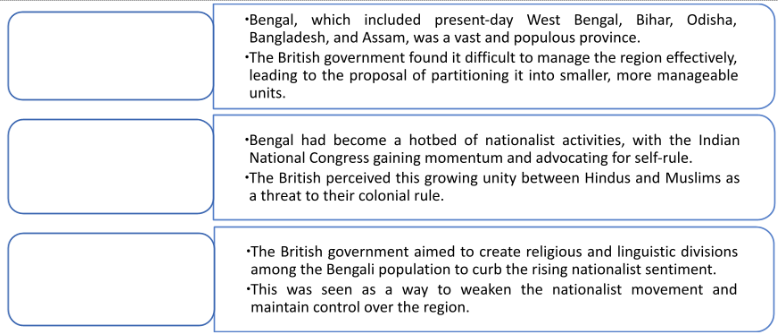
  • Bengal, which included present-day West Bengal, Bihar, Odisha, Bangladesh, and Assam, was a vast and populous province.
  • The British government found it difficult to manage the region effectively, leading to the proposal of partitioning it into smaller, more manageable units.
  • Bengal had become a hotbed of nationalist activities, with the Indian National Congress gaining momentum and advocating for self-rule.
  • The British perceived this growing unity between Hindus and Muslims as a threat to their colonial rule.
  • The British government aimed to create religious and linguistic divisions among the Bengali population to curb the rising nationalist sentiment.
  • This was seen as a way to weaken the nationalist movement and maintain control over the region through the Partition of Bengal.


Impact of Bengal Partition: National Awakening or Communal Division?

  • Strengthening of the Nationalist Movement: The partition of Bengal united Indians across religious and linguistic lines, fostering a sense of nationalism and collective resistance against British rule. 
  • It played a significant role in strengthening the Indian freedom movement.

  • Communal Tensions: The partition exacerbated existing tensions between Hindus and Muslims, leading to several riots and communal violence. 
  • It created a sense of separateness between the two communities, making it more difficult for them to unite in the future.

  • Swadeshi Movement: The partition fueled the Swadeshi Movement, which called for the boycott of British goods and the promotion of Indian-made products. 
  • This movement aimed to protest against the partition and foster national unity among Indians.

  • Emergence of Muslim League: The partition led to the emergence of the Muslim League in 1906, which aimed to protect the interests of Muslims in British India. 
  • This laid the foundation for the eventual demand for a separate Muslim state of Pakistan.

  • Reversal of The Position: Amidst growing protests and unrest, the British government revoked the partition of Bengal in 1911 and reunited the province. 

  • Legacy: The partition of Bengal served as a turning point in India's struggle for independence, teaching Indians the importance of unity and collective resistance against colonial rule. 
  • It also had a lasting impact on the communal harmony that had prevailed in Bengal before the partition.

  • Spread of Nationalist Sentiment: The partition helped spread nationalist sentiment beyond Bengal to other parts of India, inspiring similar movements in other provinces.

These impacts, along with the strengthening of the nationalist movement and the exacerbation of communal tensions, made the Partition of Bengal a significant event in the history of India's independence struggle.


Interesting Fact:

  • Rabindranath Tagore composed the iconic song ‘Amar Sonar Bangla’, which eventually became the national anthem of Bangladesh. 
  • The British government employed repressive measures to quell the Swadeshi Movement, including banning rallies, censoring newspapers, and imprisoning leaders. 
  • Various acts were passed to hinder the movement, such as the Seditious Meeting Act (1907), Criminal Law Amendment Act (1908), and Indian Press Act (1910).


UPSC QEP 2026 Batch 5 - English
Buy now View Details
Submit Your Details to Learn More
I agree to give my consent to receive updates through SMS/Email & WhatsApp*.

NEEV GS + CSAT Foundation 2026/27
Buy now View Details


Join theIAShub’s Mains Answer Writing Program

Refine your answer writing skills and elevate your UPSC preparation with personalized support and expert feedback.

Fill out the form to get started with the program or any other enquiries !

I agree to give my consent to receive updates through SMS/Email & WhatsApp*.

Best IAS Coaching In Delhi, UPSC Online & Offline Classes by IAShub

Are you dreaming of becoming an IAS officer? Then, IAShub can be your best guide. It is one of the Best IAS Coaching in Delhi. Many students who want to clear the UPSC exam join IAShub for learning. The institute gives both online and offline classes. Their teachers are experienced and helpful. They easily explain every topic. Students also get notes, tests, and tips to do well in the exam.

UPSC Online Classes by IAShub

IAShub is in Delhi and is trusted by many UPSC students. It offers coaching for every part of the UPSC exam – Prelims, Mains, and Interview. The classes are simple and easy to understand. The teachers are experts and guide students in the right way. IAShub is also known for its helpful notes, test series, and answer-writing practice. IAShub is the best coaching in Delhi and also gives UPSC Online Classes. This helps students from any place in India to learn. The online classes are live and also recorded. So, students can watch them anytime. These classes cover the full UPSC syllabus.

Key Offerings Provided by IAShub

Here are some important services provided by IAShub:

  • UPSC Prelims: IAShub teaches for Prelims with a focus on basics. It also gives daily current affairs and monthly magazines.
  • Classroom Courses: IAShub has classroom learning for students in Delhi. The environment is good and peaceful for study.
  • Live Classes: Students who live far can join live UPSC online classes. These classes are just like real classes.
  • QEP for Mains: The Quality Enrichment Program (QEP) is special for Mains preparation. It helps students write better and faster.
  • Answer Writing: Regular answer writing practice is given. Teachers also check answers and give tips to improve.
  • Free Resource: IAShub gives free notes by toppers and helpful Main Booster material.
  • Test Series: Test series are available for every subject. These help students know their weak points and improve.
  • Interview Guidance Session: IAShub also gives interview practice sessions with experts. These help students feel confident.

UPSC Exam Overview

The UPSC Civil Services Exam has three parts:

  • Prelims: It has two papers: General Studies and CSAT.
  • Mains: It has nine papers, including essays and optional subjects.
  • Interview: It tests the personality and confidence of the student.

This exam is tough, but with the right guidance, it becomes easy to manage. Students must study smart and stay regular.

How IAShub Helps in the UPSC Journey

IAShub supports students from the beginning to the end. It gives the right books, tests, and notes. The classes are easy to follow, and the teachers are always ready to help. Students get personal doubt sessions too. The test series and answer checking help students learn where they need to do better. Also, free study materials save time and money.
IAShub also guides students during the final stage – the interview. Experts take mock interviews and give useful tips. This full support makes IAShub one of the best IAS coaching in Delhi.

Best IAS Coaching In Delhi FAQs

Yes, IAShub offers live and recorded online classes. Students can attend from any part of India.

Classes are available in both English and Hindi, so students can choose the language they are comfortable with.

The classroom centre is located in Delhi. Students can visit and join offline batches there.

IAShub gives interview guidance sessions to help students prepare for the final round of UPSC.


