One Nation One Election Meaning, Benefits, and Challenges

One Nation One Election aims to synchronize Lok Sabha, State, and local body elections, reducing costs and policy disruptions. Learn about its benefits and challenges.

THEIASHUB
Get an Instant Call Back from Our Expert Mentors Now!
+91

One Nation One Election refers to the idea of conducting elections for Lok Sabha, State Assemblies, and local bodies (municipalities and panchayats) simultaneously. This system aims to streamline the Indian election cycle, reducing the frequency of elections and optimizing governance efficiency. Instead of having elections multiple times across different states, voters would cast their votes for both Lok Sabha and State Assemblies on the same day.
One Nation One Election

  • Simultaneous elections do not necessarily mean voting on a single day across the country. Elections can be conducted in a phase-wise manner.

  • India followed a synchronized election system until 1967, after which frequent elections began due to state governments dissolving at different times.

Key Recommendations of the High-Level Committee


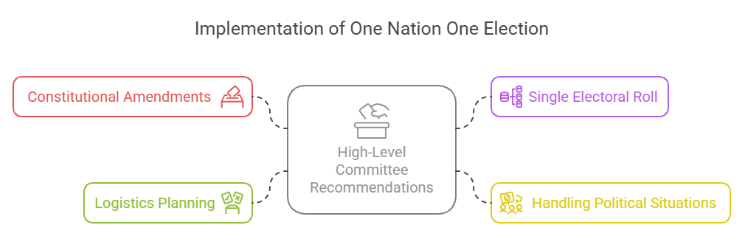
A High-Level Committee (HLC), led by Ram Nath Kovind, proposed key measures for implementing One Nation One Election through constitutional amendments.
1. Amending the Constitution

  • The process will be implemented in two steps:

  1. First Phase: Synchronizing Lok Sabha and State Assembly elections (no state ratification needed).

  2. Second Phase: Aligning municipal and panchayat elections within 100 days (requires ratification by at least half of the states).

2. Single Electoral Roll and Election ID

  • The Election Commission of India (ECI) will prepare a single electoral roll in consultation with State Election Commissions.

  • This amendment also requires ratification by at least half of the states.

3. Handling Hung Assemblies and No-Confidence Motions

  • If a hung assembly, no-confidence motion, or early dissolution occurs, fresh elections will be held only for the remaining tenure instead of a full five-year term.

4. Logistics Planning

  • The Election Commission of India (ECI) will coordinate with State Election Commissions to ensure smooth and free elections at all levels.

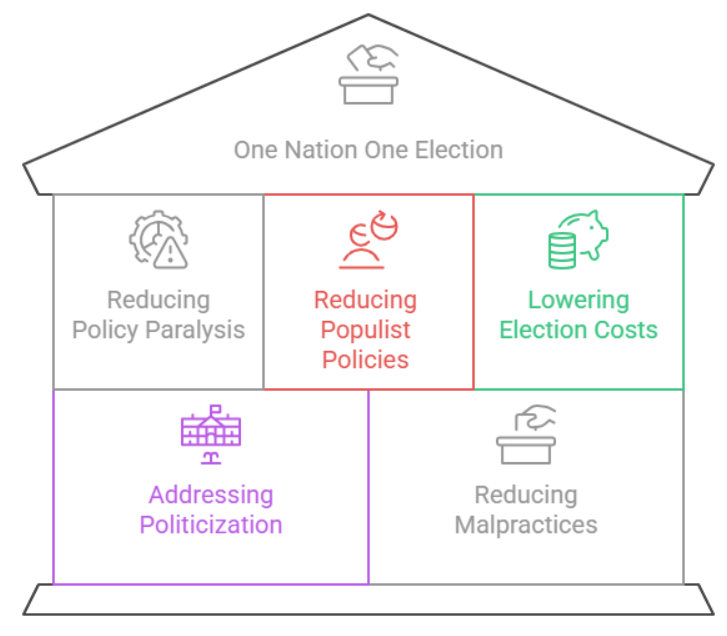
Need for One Nation One Election


1. Reducing Policy Paralysis

  • Frequent elections lead to the Model Code of Conduct (MCC) being enforced multiple times, delaying policy implementation and governance.

2. Reducing Populist Policies

  • Continuous election cycles push governments to prioritize short-term populist measures over long-term developmental goals.

3. Lowering Election Costs

  • Conducting separate elections incurs huge financial and administrative costs. One Nation One Election will reduce expenses through shared resources.

4. Addressing Politicization of Governance

  • Frequent elections turn parliamentary proceedings into political battlegrounds, leading to deadlocks on crucial bills such as agricultural and labor reforms.

5. Reducing Social and Electoral Malpractices

  • Continuous elections intensify communalism, casteism, corruption, and vote-buying. Holding elections simultaneously may reduce these issues.

International Examples of Simultaneous Elections

  • South Africa: National and provincial elections are conducted together every five years, while municipal elections occur two years later.

  • Sweden: Elections for the national legislature (Riksdag), provincial councils, and municipal assemblies are held on a fixed date every four years.

Challenges of One Nation One Election

1. Implementation Issues

  • Adjusting the tenure of existing assemblies and Lok Sabha requires consensus from multiple political parties.

2. Constitutional Conflicts

  • The no-confidence motion provision allows early dissolution, contradicting the fixed-term One Nation One Election model.

  • Any extension or reduction in tenure for synchronization may face constitutional and legal challenges.

3. Federalism Concerns

  • Local and national issues could get mixed up, influencing voter priorities and potentially leading to single-party dominance.

4. Reduced Political Accountability

  • Frequent elections ensure continuous accountability of politicians. A single election every five years may reduce this pressure.

5. Weakening Politician-Citizen Connection

  • Multiple elections keep politicians engaged with public concerns. Reducing elections may limit public engagement and responsiveness.

6. Administrative Challenges

  • Conducting elections at all levels simultaneously requires massive logistical, security, and human resource coordination, making execution difficult.

Way Forward

  • Consensus Building: A national discussion among political parties, constitutional experts, and the Election Commission is essential.

  • Phase-Wise Implementation: As suggested by the Law Commission, a step-by-step approach could help gradually align election cycles.

  • Holistic Electoral Reforms: The real solution lies in a comprehensive electoral reform, including funding transparency, governance stability, and fair representation.

Conclusion

One Nation One Election is an ambitious reform aimed at streamlining the electoral process, reducing governance disruptions, and minimizing election costs. However, constitutional challenges, political resistance, and logistical hurdles need to be addressed before its successful implementation. A balanced, phased approach, with inputs from all stakeholders, is the key to ensuring a stable, democratic electoral system in India.



UPSC QEP 2026 Batch 5 - English
Buy now View Details
Submit Your Details to Learn More
I agree to give my consent to receive updates through SMS/Email & WhatsApp*.

NEEV GS + CSAT Foundation 2026/27
Buy now View Details


Join theIAShub’s Mains Answer Writing Program

Refine your answer writing skills and elevate your UPSC preparation with personalized support and expert feedback.

Fill out the form to get started with the program or any other enquiries !

I agree to give my consent to receive updates through SMS/Email & WhatsApp*.

Best IAS Coaching In Delhi, UPSC Online & Offline Classes by IAShub

Are you dreaming of becoming an IAS officer? Then, IAShub can be your best guide. It is one of the Best IAS Coaching in Delhi. Many students who want to clear the UPSC exam join IAShub for learning. The institute gives both online and offline classes. Their teachers are experienced and helpful. They easily explain every topic. Students also get notes, tests, and tips to do well in the exam.

UPSC Online Classes by IAShub

IAShub is in Delhi and is trusted by many UPSC students. It offers coaching for every part of the UPSC exam – Prelims, Mains, and Interview. The classes are simple and easy to understand. The teachers are experts and guide students in the right way. IAShub is also known for its helpful notes, test series, and answer-writing practice. IAShub is the best coaching in Delhi and also gives UPSC Online Classes. This helps students from any place in India to learn. The online classes are live and also recorded. So, students can watch them anytime. These classes cover the full UPSC syllabus.

Key Offerings Provided by IAShub

Here are some important services provided by IAShub:

  • UPSC Prelims: IAShub teaches for Prelims with a focus on basics. It also gives daily current affairs and monthly magazines.
  • Classroom Courses: IAShub has classroom learning for students in Delhi. The environment is good and peaceful for study.
  • Live Classes: Students who live far can join live UPSC online classes. These classes are just like real classes.
  • QEP for Mains: The Quality Enrichment Program (QEP) is special for Mains preparation. It helps students write better and faster.
  • Answer Writing: Regular answer writing practice is given. Teachers also check answers and give tips to improve.
  • Free Resource: IAShub gives free notes by toppers and helpful Main Booster material.
  • Test Series: Test series are available for every subject. These help students know their weak points and improve.
  • Interview Guidance Session: IAShub also gives interview practice sessions with experts. These help students feel confident.

UPSC Exam Overview

The UPSC Civil Services Exam has three parts:

  • Prelims: It has two papers: General Studies and CSAT.
  • Mains: It has nine papers, including essays and optional subjects.
  • Interview: It tests the personality and confidence of the student.

This exam is tough, but with the right guidance, it becomes easy to manage. Students must study smart and stay regular.

How IAShub Helps in the UPSC Journey

IAShub supports students from the beginning to the end. It gives the right books, tests, and notes. The classes are easy to follow, and the teachers are always ready to help. Students get personal doubt sessions too. The test series and answer checking help students learn where they need to do better. Also, free study materials save time and money.
IAShub also guides students during the final stage – the interview. Experts take mock interviews and give useful tips. This full support makes IAShub one of the best IAS coaching in Delhi.

Best IAS Coaching In Delhi FAQs

Yes, IAShub offers live and recorded online classes. Students can attend from any part of India.

Classes are available in both English and Hindi, so students can choose the language they are comfortable with.

The classroom centre is located in Delhi. Students can visit and join offline batches there.

IAShub gives interview guidance sessions to help students prepare for the final round of UPSC.