


The New Education Policy 2020 aims to revolutionize Indian education by promoting holistic, inclusive, flexible, and tech-driven learning for all students.
 theIASHub | 20 Aug, 2025 | 3278

The New Education Policy 2020 is a landmark reform in India’s educational landscape. Announced on 29th July 2020, this policy replaced the National Policy on Education, 1986, after more than three decades. The New Education Policy 2020 is designed to meet the evolving educational needs of the 21st century, focusing on flexibility, inclusivity, technology, and holistic development. It lays down a transformative vision that aligns education with the skills and demands of the modern world.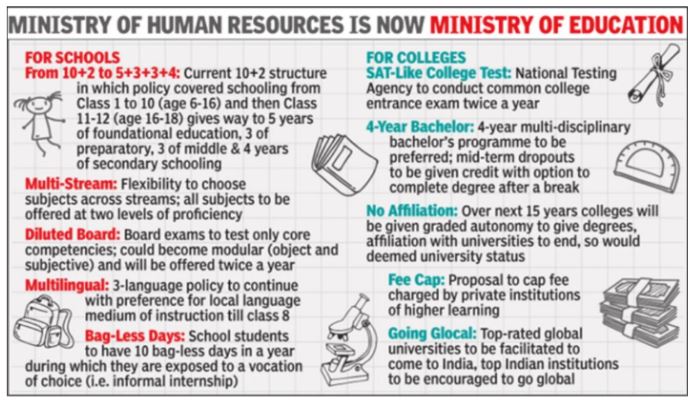
One of the major highlights of the New Education Policy 2020 is its focus on holistic education. This approach integrates academic learning with arts, sports, vocational skills, and value-based education. Students are encouraged to explore diverse interests, which helps in the overall development of personality, creativity, and emotional intelligence.
The New Education Policy 2020 removes the rigid separation between curricular, co-curricular, and extra-curricular activities, ensuring equal importance to all areas of learning. The aim is to produce multidimensional learners, not just exam scorers.
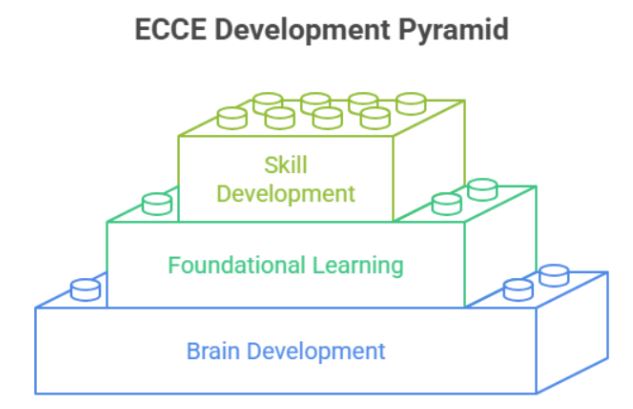
Recognizing that over 85% of brain development occurs before the age of 6, the New Education Policy 2020 lays strong emphasis on Early Childhood Care and Education (ECCE).
The policy proposes a foundational learning framework for children aged 3 to 8 years. The emphasis is on play-based, discovery-oriented learning, helping develop cognitive, physical, emotional, and social skills in young learners.
The New Education Policy 2020 identifies foundational literacy and numeracy as a national mission. By Grade 3, every child must attain basic reading, writing, and arithmetic skills.
To implement this, the policy introduces the National Initiative for Proficiency in Reading with Understanding and Numeracy (NIPUN Bharat). This ensures early intervention in schools to avoid long-term learning deficits.
The New Education Policy 2020 offers multidisciplinary learning pathways. Students can choose subjects across streams (science, commerce, humanities), and even mix them with arts and vocational courses.
Replacing the traditional 10+2 model, the policy introduces a 5+3+3+4 curricular structure:
This structure aligns with the developmental stages of a child and encourages experiential learning at each level.
The New Education Policy 2020 encourages the use of the mother tongue or regional language as the medium of instruction up to Grade 5, and preferably till Grade 8.
The policy promotes the three-language formula, including Hindi, English, and one regional language, to enhance linguistic diversity and national unity.
To modernize education, the New Education Policy 2020 places a strong emphasis on technology. It advocates for:
The NETF will be established as a central hub to promote technological advancements in teaching, learning, planning, and administration.
Teachers are at the heart of education. The New Education Policy 2020 aims to improve teacher training through:
To maintain uniform quality across the country, NPST will define the roles, expectations, and benchmarks for Indian teachers.
The New Education Policy 2020 moves away from high-stakes board exams and rote memorization. Instead, it promotes:
A new body, Performance Assessment, Review, and Analysis of Knowledge for Holistic Development (PARAKH), will be set up to regulate and standardize school assessments.
The New Education Policy 2020 outlines major reforms in higher education, including:
The policy proposes multiple exit and entry points for undergraduate courses. Students can earn a certificate, diploma, or degree based on the number of years completed.
The New Education Policy 2020 is committed to making education equitable and inclusive, especially for:
These will be established in underrepresented regions to ensure better access to quality education for disadvantaged groups.
The New Education Policy 2020 marks a paradigm shift in Indian education. It envisions an education system rooted in Indian ethos that contributes directly to transforming India into an equitable and vibrant knowledge society. By promoting flexibility, inclusivity, technological integration, and teacher empowerment, the New Education Policy 2020 promises a learner-centric, future-ready educational framework.


Refine your answer writing skills and elevate your UPSC preparation with personalized support and expert feedback.
Fill out the form to get started with the program or any other enquiries !

Are you dreaming of becoming an IAS officer? Then, IAShub can be your best guide. It is one of the Best IAS Coaching in Delhi. Many students who want to clear the UPSC exam join IAShub for learning. The institute gives both online and offline classes. Their teachers are experienced and helpful. They easily explain every topic. Students also get notes, tests, and tips to do well in the exam.
IAShub is in Delhi and is trusted by many UPSC students. It offers coaching for every part of the UPSC exam – Prelims, Mains, and Interview. The classes are simple and easy to understand. The teachers are experts and guide students in the right way. IAShub is also known for its helpful notes, test series, and answer-writing practice. IAShub is the best coaching in Delhi and also gives UPSC Online Classes. This helps students from any place in India to learn. The online classes are live and also recorded. So, students can watch them anytime. These classes cover the full UPSC syllabus.
Here are some important services provided by IAShub:
The UPSC Civil Services Exam has three parts:
This exam is tough, but with the right guidance, it becomes easy to manage. Students must study smart and stay regular.
IAShub supports students from the beginning to the end. It gives the right books, tests, and notes. The classes are easy to follow, and the teachers are always ready to help. Students get personal doubt sessions too. The test series and answer checking help students learn where they need to do better. Also, free study materials save time and money.
IAShub also guides students during the final stage – the interview. Experts take mock interviews and give useful tips. This full support makes IAShub one of the best IAS coaching in Delhi.
Join 39,000+ UPSC Aspirants! 🚀
Get Free UPSC/State PSC Study Materials, Daily Current Affairs Question & Exam Updates.
Join Telegram Channel
