


Explore the rise of Nazism, its causes, and global consequences. Learn how Hitler’s totalitarian ideology led to World War II, the Holocaust, and shaped 20th-century history. Understand Nazism's impact on Germany and its legacy in world affairs.
 theIASHub | 20 Jun, 2025 | 11243

Nazism, also known as National Socialism, was the authoritarian and extremist ideology of the National Socialist German Workers' Party (NSDAP) led by Adolf Hitler. Originating in Germany in the early 1920s, Nazism combined intense nationalism, racial supremacy, antisemitism, anti-communism, and anti-democratic sentiments to build one of the most brutal regimes in history. This ideology gave rise to Nazi Germany, led to World War II, and was responsible for the Holocaust — the mass extermination of six million Jews and millions of others.
Nazism can be defined as an ultra-nationalist, totalitarian ideology that sought to reshape German society based on racial purity, authoritarian rule, and military power. At its core, Nazism rejected democracy, promoted the idea of Aryan racial superiority, and aimed to establish a new order based on German dominance.
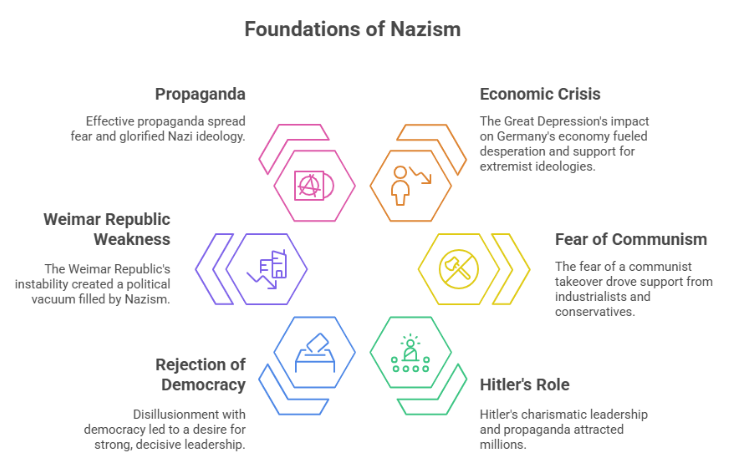
The rise of Nazism was not sudden—it was a result of multiple economic, political, and social factors that created a fertile ground for Hitler and his ideology to flourish in Germany.
The Great Depression of 1929 had a catastrophic impact on Germany’s already fragile economy. Unemployment skyrocketed, banks collapsed, and inflation soared. The economic despair made people vulnerable to extremist ideologies, and Nazism provided hope by promising recovery, jobs, and national revival.
The success of the Russian Revolution and the rise of communism alarmed the German middle and upper classes. Many Germans feared a communist takeover. Nazism positioned itself as the only force capable of defeating communism, drawing massive support from industrialists, the military, and conservatives.
Adolf Hitler, the charismatic leader of the Nazi Party, played a crucial role in the rise of Nazism. His powerful oratory, propaganda strategies, and promises of restoring German pride attracted millions. Hitler’s personality cult turned him into a messianic figure for many Germans.
After the failure of the Weimar Republic, many Germans lost faith in democratic institutions. Parliamentary instability, frequent elections, and ineffective governance made democracy seem weak. Nazism offered a strong, decisive, one-man rule as a solution.
The Weimar Republic, established post-WWI, was plagued by internal conflicts, economic troubles, and social unrest. It was perceived as a foreign-imposed, unpopular system. The inability of the Weimar government to stabilize the country created a political vacuum that Nazism readily filled.
The Nazi Party used propaganda masterfully. With slogans like “One People, One Reich, One Leader,” they used posters, newspapers, radio, and mass rallies to spread fear of enemies and glorify Hitler and the Nazi ideology.
Nazism established a totalitarian state where the Nazi Party controlled every aspect of life—politics, economy, education, and even private lives. Civil liberties were abolished, and dissent was brutally crushed.
One of the central tenets of Nazism was the belief in the superiority of the Aryan race. It propagated racism, antisemitism, and eugenics. Jews, Roma, disabled people, and other minorities were labeled inferior and targeted for elimination.
Jews were scapegoated for Germany’s problems. Nazism institutionalized antisemitism, leading to discriminatory laws, social exclusion, ghettos, forced labor, and eventually the Holocaust, which killed six million Jews.
Nazism glorified war, rearmed Germany, and promoted the idea of Lebensraum (living space) in Eastern Europe. Hitler's territorial ambitions led directly to World War II.
Nazism viewed liberalism, socialism, and communism as threats to national unity. Trade unions were banned, and leftist political parties were destroyed.
Hitler was portrayed as Germany’s savior. Schools, books, and the media idolized him, and the Fuhrerprinzip (leader principle) made his word supreme.
Initially, Nazism revived the German economy through public works, rearmament, and state control of industries. Unemployment dropped, but freedom was sacrificed for state goals.
The Nazis burned books, banned modern art, and labeled anything non-Aryan as “degenerate.” Cultural diversity and intellectual freedom were crushed under Nazism.
The most horrific impact of Nazism was the Holocaust—the systematic extermination of Jews and other minority groups. Concentration camps, gas chambers, and mass shootings became the tools of genocide.
In 1939, Germany invaded Poland, triggering World War II. Over 60 million people died, and Europe was left in ruins—all because of Hitler’s Nazism and expansionist ambitions.
Germany allied with Italy and Japan through the Tripartite Pact, forming the Axis Powers. This alliance aimed to reshape the global order in favor of authoritarian rule and Nazism-style ideologies.
German society was turned into a militarized, ultra-loyal, and fear-driven state. Individual freedoms were erased under the weight of Nazism, and Hitler's vision dominated every aspect of public life.
After the defeat of Nazi Germany in 1945, Nazism was outlawed, and its leaders were tried at the Nuremberg Trials for crimes against humanity. The global shock over Nazi atrocities led to the creation of international laws protecting human rights and the founding of the United Nations.
Though Nazism was militarily defeated, its legacy remains a warning to the world. Neo-Nazi movements and far-right ideologies occasionally attempt to revive similar sentiments, but they are strongly condemned worldwide.
Nazism was more than just a political movement—it was a totalitarian, genocidal, and war-driven ideology that plunged the world into a catastrophic conflict. It destroyed millions of lives, reshaped global geopolitics, and stands today as a grim reminder of the dangers of hate, authoritarianism, and blind nationalism. Understanding the roots, features, and impacts of Nazism is essential to preventing the repetition of such tragedies in modern times.


Refine your answer writing skills and elevate your UPSC preparation with personalized support and expert feedback.
Fill out the form to get started with the program or any other enquiries !

Are you dreaming of becoming an IAS officer? Then, IAShub can be your best guide. It is one of the Best IAS Coaching in Delhi. Many students who want to clear the UPSC exam join IAShub for learning. The institute gives both online and offline classes. Their teachers are experienced and helpful. They easily explain every topic. Students also get notes, tests, and tips to do well in the exam.
IAShub is in Delhi and is trusted by many UPSC students. It offers coaching for every part of the UPSC exam – Prelims, Mains, and Interview. The classes are simple and easy to understand. The teachers are experts and guide students in the right way. IAShub is also known for its helpful notes, test series, and answer-writing practice. IAShub is the best coaching in Delhi and also gives UPSC Online Classes. This helps students from any place in India to learn. The online classes are live and also recorded. So, students can watch them anytime. These classes cover the full UPSC syllabus.
Here are some important services provided by IAShub:
The UPSC Civil Services Exam has three parts:
This exam is tough, but with the right guidance, it becomes easy to manage. Students must study smart and stay regular.
IAShub supports students from the beginning to the end. It gives the right books, tests, and notes. The classes are easy to follow, and the teachers are always ready to help. Students get personal doubt sessions too. The test series and answer checking help students learn where they need to do better. Also, free study materials save time and money.
IAShub also guides students during the final stage – the interview. Experts take mock interviews and give useful tips. This full support makes IAShub one of the best IAS coaching in Delhi.
Join 39,000+ UPSC Aspirants! 🚀
Get Free UPSC/State PSC Study Materials, Daily Current Affairs Question & Exam Updates.
Join Telegram Channel
