


Explore National Integration after Independence through case studies of Hyderabad, Junagadh, Manipur, and Kashmir. Learn how India unified diverse princely states post-1947 using diplomacy, military action, and constitutional measures.
 theIASHub | 28 Jun, 2025 | 2204

After gaining independence in 1947, India faced the herculean task of achieving National Integration. The British left behind not only a divided subcontinent but also over 560 princely states with the choice to join India, Pakistan, or remain independent. If India were to remain united, the first major step had to be the integration of these princely states. Leaders like Sardar Vallabhbhai Patel and V.P. Menon played a crucial role in achieving this goal. This article explores the critical case studies of Hyderabad, Manipur, Junagadh, and Kashmir to understand the real challenges and success stories of National Integration.
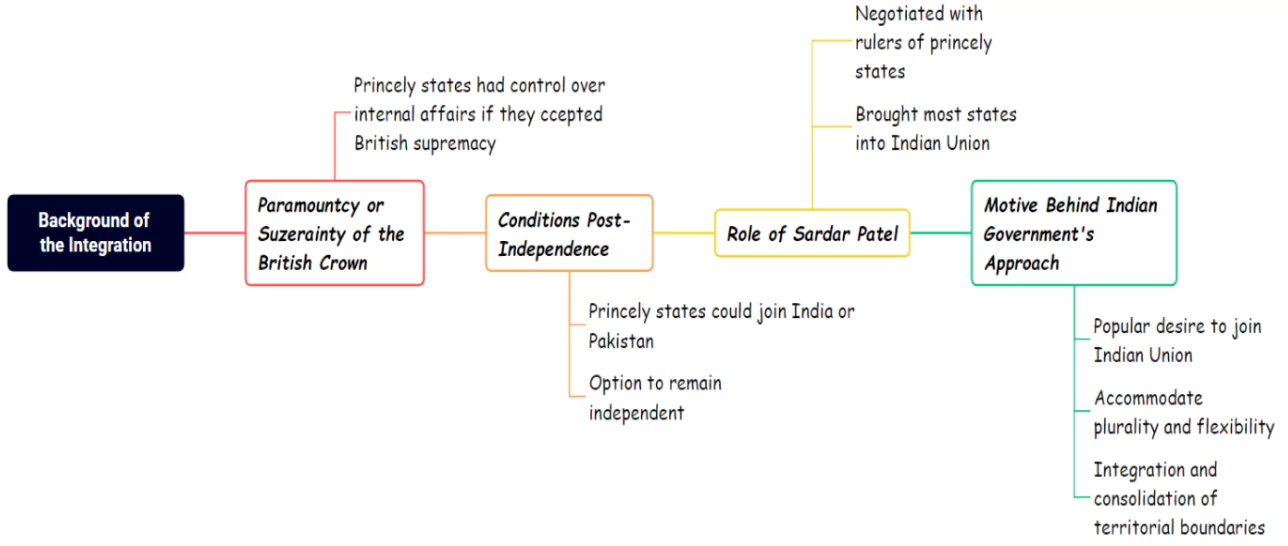
After independence, the Nizam of Hyderabad wanted his state to remain independent. In November 1947, he signed a Standstill Agreement with the Indian government to maintain the status quo. However, this agreement created a temporary arrangement rather than solving the issue.
The people of Telangana, mainly peasants, rose against the feudal and oppressive regime of the Nizam. Women also participated in large numbers. To crush this rebellion, the Nizam supported the Razakars, a private militia known for violence and communal tension. This posed a direct threat to the unity and National Integration of India.
To restore order and achieve National Integration, the Indian government launched Operation Polo in September 1948. The Indian army swiftly defeated the Razakars, and the Nizam surrendered. Hyderabad officially became part of the Indian Union, demonstrating the firm stand of India on issues concerning National Integration.
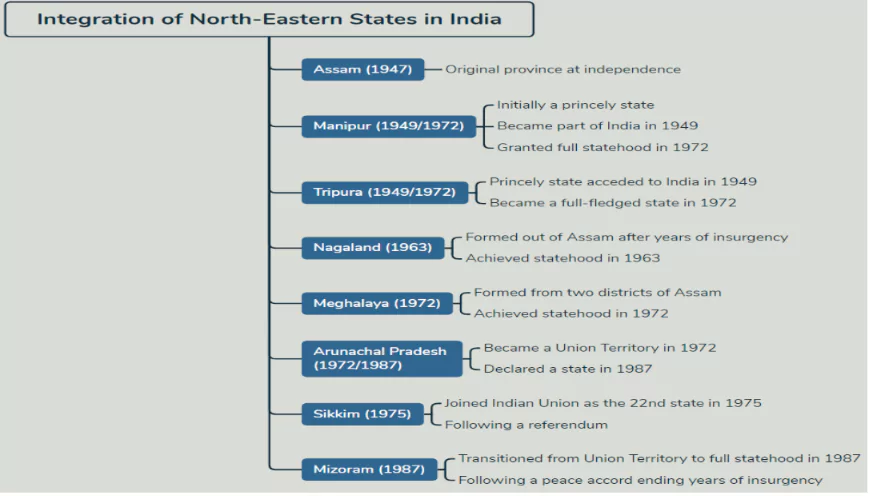
The Maharaja of Manipur, Bodhachandra Singh, signed the Instrument of Accession with India in August 1947. The agreement granted internal autonomy to the state, making it one of the first princely states to accede.
Under Indian influence, the Maharaja held elections in June 1948, leading to the creation of a constitutional monarchy in Manipur. This was a unique experiment and a step toward National Integration.
Despite internal autonomy and a functioning legislature, the Government of India exerted pressure on the Maharaja to fully merge Manipur with the Indian Union. In September 1949, the Merger Agreement was signed without consulting the Manipur Legislative Assembly. Though politically sensitive, this step was seen as essential for ensuring complete National Integration.
The Nawab of Junagadh, Muhammad Nawab Khanji III, decided to accede to Pakistan in 1947. This decision was controversial as 80% of Junagadh’s population was Hindu, and geographically, it was surrounded by Indian territory except for access via sea.
The Indian government feared that allowing Junagadh to join Pakistan would escalate communal violence in Gujarat. It rejected the Nawab’s decision and initiated steps to preserve National Integration and communal harmony.
With rising tensions and administrative failure, Junagadh’s Dewan, Sir Shah Nawaz Bhutto, invited the Indian government to take control on November 7, 1947. India organized a plebiscite, in which the overwhelming majority voted in favor of joining India. Junagadh then became part of the Saurashtra state, reinforcing India’s commitment to National Integration through democratic means.
Maharaja Hari Singh of Jammu & Kashmir offered a standstill agreement to both India and Pakistan, trying to avoid choosing sides. However, the situation took a serious turn when tribal militias from Pakistan invaded Kashmir in October 1947.
Facing an invasion, the Maharaja appealed to India for military help. In return, he signed the Instrument of Accession, allowing Indian control over defense, foreign affairs, and communications. Indian troops were airlifted to Kashmir, and the state became a crucial battleground for both physical and ideological National Integration.
In March 1948, Sheikh Abdullah was appointed as the head of an interim popular government. In 1952, the Delhi Agreement was signed, giving special constitutional status to Jammu & Kashmir under Article 370, balancing autonomy with National Integration.
On 6 February 1954, the Jammu & Kashmir constituent assembly ratified the state’s accession to India. The President of India issued a constitutional order formalizing Kashmir’s integration. Despite ongoing disputes, this moment remains a cornerstone in the history of India’s National Integration efforts.
Each of these cases—Hyderabad, Manipur, Junagadh, and Kashmir—highlights different challenges in achieving National Integration. From diplomatic agreements and military actions to political pressure and democratic plebiscites, the Indian leadership used a combination of strategies to unify the nation.
These examples are crucial for understanding how India moved from a fragmented subcontinent to a single, sovereign democratic republic. Without the successful integration of these princely states, the idea of India as one united nation would have been difficult to sustain.
The road to National Integration was not easy, but it was essential. These case studies show how India, in its early years, faced complex regional, political, and communal issues. Yet, through visionary leadership, strong constitutional backing, and decisive action, the country managed to merge diverse regions into a united whole. Today, India’s diversity remains its strength—but only because the foundation of National Integration was laid so solidly after independence.


Refine your answer writing skills and elevate your UPSC preparation with personalized support and expert feedback.
Fill out the form to get started with the program or any other enquiries !

Are you dreaming of becoming an IAS officer? Then, IAShub can be your best guide. It is one of the Best IAS Coaching in Delhi. Many students who want to clear the UPSC exam join IAShub for learning. The institute gives both online and offline classes. Their teachers are experienced and helpful. They easily explain every topic. Students also get notes, tests, and tips to do well in the exam.
IAShub is in Delhi and is trusted by many UPSC students. It offers coaching for every part of the UPSC exam – Prelims, Mains, and Interview. The classes are simple and easy to understand. The teachers are experts and guide students in the right way. IAShub is also known for its helpful notes, test series, and answer-writing practice. IAShub is the best coaching in Delhi and also gives UPSC Online Classes. This helps students from any place in India to learn. The online classes are live and also recorded. So, students can watch them anytime. These classes cover the full UPSC syllabus.
Here are some important services provided by IAShub:
The UPSC Civil Services Exam has three parts:
This exam is tough, but with the right guidance, it becomes easy to manage. Students must study smart and stay regular.
IAShub supports students from the beginning to the end. It gives the right books, tests, and notes. The classes are easy to follow, and the teachers are always ready to help. Students get personal doubt sessions too. The test series and answer checking help students learn where they need to do better. Also, free study materials save time and money.
IAShub also guides students during the final stage – the interview. Experts take mock interviews and give useful tips. This full support makes IAShub one of the best IAS coaching in Delhi.
 Detailed Solutions & Explanations
Improve Your Answer Writing & Strategy
Detailed Solutions & Explanations
Improve Your Answer Writing & Strategy

