


Explore India's National Health Policy: goals, drawbacks, global models, and future strategies to build a strong, inclusive healthcare system for all.
 theIASHub | 05 Jun, 2025 | 4373

The National Health Policy is a critical instrument of India’s healthcare vision, focusing on accessibility, affordability, and equity. The National Health Policy 2017 marks a significant shift towards strengthening the healthcare system, addressing disease burdens, improving healthcare financing, and enhancing infrastructure. It aims to deliver universal health coverage and foster economic growth by investing in the health sector. This article explores the key goals, objectives, global success examples, drawbacks, and the way forward for the National Health Policy.
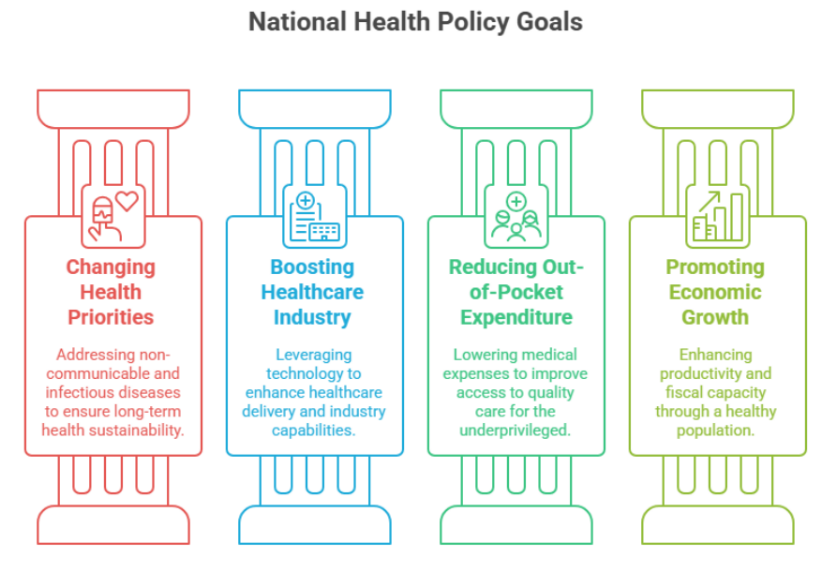
The National Health Policy 2017 was framed with an inclusive approach to ensure that health becomes a national priority. Its major goals are:
The policy seeks to address the rising burden of non-communicable and infectious diseases. This is crucial for ensuring the long-term sustainability of the health sector.
Technological advancements are a focal point of the National Health Policy, aiming to strengthen healthcare delivery and industry capabilities.
A major objective of the National Health Policy is to lower medical expenses and improve access to quality care for poor and underprivileged populations.
By building a healthy population, the policy contributes to improved productivity and economic growth, enhancing fiscal capacity.
The National Health Policy commits to upholding high professional standards and ethics. It aims to integrate transparency and sustainability in healthcare delivery.
Providing quality health services across all age groups and genders is essential to bridge the healthcare gap in rural and urban areas.
A key pillar of the National Health Policy is to ensure universal access to affordable and high-quality healthcare, reducing regional inequalities.
The policy sets a target to reduce premature mortality from major non-communicable diseases by 25% by the year 2025.
Through promotive, palliative, and rehabilitative services, the National Health Policy aims to strengthen the overall health structure.
Singapore follows a shared responsibility model with:
Canada offers a decentralized public health system known as Canadian Medicare, with each province having its own insurance plan. All necessary medical services are free at the point of use for all citizens and permanent residents.
The National Health Policy repeats ideas from previous policies and failed to establish health as a justiciable right, unlike the Right to Education Act.
The policy’s assurance-based approach replaced the 2015 draft’s radical idea of making health a legal right under the proposed National Health Rights Act.
States opposed the idea of legal health entitlements, citing weak infrastructure. Many states already provide free diagnostics and essential drugs, reducing the need for a national right.
The target of spending 2.5% of GDP on healthcare by 2025 has been repeatedly postponed, even though it was proposed as early as 2011.
The earlier idea of a health cess to generate funds was dropped, even though officials claim there’s no fund shortage.
Out-of-pocket expenditure (OOPE) is the direct payment made by households for healthcare, excluding insurance or government support.
OOPE dropped from 62.6% to 39.4% between 2014-15 and 2021-22. This success can be attributed to:
More public investment is essential. The National Health Policy must push for at least 2.5% of GDP to be allocated to health.
Strengthening primary healthcare must be central to achieving universal access and reducing preventable health issues.
Wider health insurance coverage will help reduce OOPE and enhance healthcare affordability.
Implement national quality standards and train healthcare workers to improve service delivery.
Develop robust systems for data collection to enable timely decisions and interventions.
Promoting preventive healthcare is cost-effective and reduces disease burden over time.
The National Health Policy is a progressive step toward building a healthier India. While it has commendable goals, the real success will depend on its implementation, commitment to funding, and readiness to evolve. By learning from global models and strengthening the domestic framework, India can ensure that healthcare becomes a right, not a privilege.


Refine your answer writing skills and elevate your UPSC preparation with personalized support and expert feedback.
Fill out the form to get started with the program or any other enquiries !

Are you dreaming of becoming an IAS officer? Then, IAShub can be your best guide. It is one of the Best IAS Coaching in Delhi. Many students who want to clear the UPSC exam join IAShub for learning. The institute gives both online and offline classes. Their teachers are experienced and helpful. They easily explain every topic. Students also get notes, tests, and tips to do well in the exam.
IAShub is in Delhi and is trusted by many UPSC students. It offers coaching for every part of the UPSC exam – Prelims, Mains, and Interview. The classes are simple and easy to understand. The teachers are experts and guide students in the right way. IAShub is also known for its helpful notes, test series, and answer-writing practice. IAShub is the best coaching in Delhi and also gives UPSC Online Classes. This helps students from any place in India to learn. The online classes are live and also recorded. So, students can watch them anytime. These classes cover the full UPSC syllabus.
Here are some important services provided by IAShub:
The UPSC Civil Services Exam has three parts:
This exam is tough, but with the right guidance, it becomes easy to manage. Students must study smart and stay regular.
IAShub supports students from the beginning to the end. It gives the right books, tests, and notes. The classes are easy to follow, and the teachers are always ready to help. Students get personal doubt sessions too. The test series and answer checking help students learn where they need to do better. Also, free study materials save time and money.
IAShub also guides students during the final stage – the interview. Experts take mock interviews and give useful tips. This full support makes IAShub one of the best IAS coaching in Delhi.
Join 39,000+ UPSC Aspirants! 🚀
Get Free UPSC/State PSC Study Materials, Daily Current Affairs Question & Exam Updates.
Join Telegram Channel
