


Discover how the National Education Policy 1986 aimed to provide quality, inclusive education and laid the foundation for modern educational reforms in India.
 theIASHub | 20 Aug, 2025 | 6755

The National Education Policy 1986 (NEP 1986) was a landmark reform introduced by the Government of India under Prime Minister Rajiv Gandhi. It came at a time when India's education system was in urgent need of modernization and inclusivity. The policy was designed to offer equal educational opportunities to all sections of society and to align the curriculum with emerging global trends, particularly in science and technology.
The primary goal of the National Education Policy 1986 was to create a national education system that guaranteed high-quality education irrespective of caste, creed, gender, or religion.
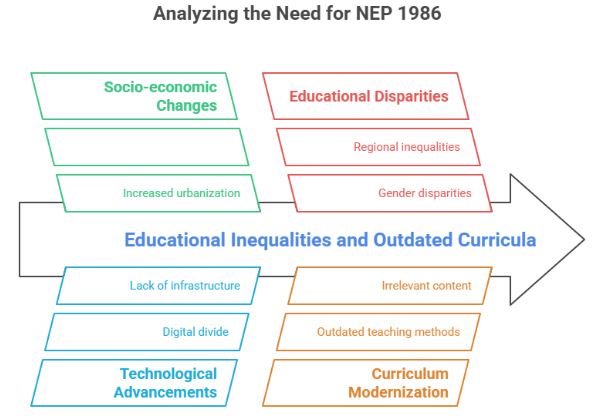
After the National Education Policy 1968, significant socio-economic and technological changes had taken place in India. However, educational inequalities and outdated curricula remained persistent issues. The government thus introduced the National Education Policy 1986 to:
The National Education Policy 1986 became a milestone in the democratization and modernization of Indian education.
One of the most important aims of the National Education Policy 1986 was to ensure that every child in India, regardless of their background, had access to high-quality education.
This emphasis on inclusive education in India laid the foundation for future reforms like the Right to Education Act (2009).
The policy strongly focused on achieving universal primary education through:
This helped lay the groundwork for mass literacy and child development, especially in underprivileged areas.
Improving the quality of education in schools was a major goal under the National Education Policy 1986. Key strategies included:
The NEP 1986 also promoted the recruitment of qualified teachers and emphasized the professional development of educators.
Recognizing the importance of technology, the National Education Policy 1986 recommended the introduction of computer education at the secondary level. This forward-looking step aimed to:
This was one of the earliest policy-level initiatives to integrate IT into school education in India.
The National Education Policy 1986 emphasized vocational education as a tool for employment and self-reliance. Schools were encouraged to:
This shift helped move Indian education away from rote learning and toward practical knowledge and application.
The National Education Policy 1986 gave special attention to empowering women through education. It acknowledged the historic disadvantages faced by girls and recommended:
The policy recognized that educating women meant empowering future generations.
To ensure cultural preservation and educational equity, the National Education Policy 1986 provided support for the educational upliftment of minorities:
This emphasis on minority education ensured that diversity was seen as a strength within the national educational system.
While continuing the three-language formula introduced in the 1968 policy, the National Education Policy 1986 encouraged:
This language policy was designed to promote national integration while respecting linguistic diversity.
Recognizing that millions of Indians remained outside the formal school system, the National Education Policy 1986 included strategies for:
This helped extend educational opportunities beyond the traditional school system.
The National Education Policy 1986 reiterated the commitment to increasing public expenditure on education, aiming for:
While this goal remained aspirational for many years, it reinforced the belief that education is a national priority.
To effectively implement its objectives, the National Education Policy 1986 led to the establishment of several schemes and institutions:
The policy also introduced Periodic Policy Reviews to assess progress and adjust strategies.
The National Education Policy 1986 was a progressive and comprehensive effort to modernize and democratize education in India. Its emphasis on:
made it a cornerstone of modern Indian educational reforms. While it faced challenges in implementation, its vision and goals significantly influenced the future direction of education policies, including the National Education Policy 2020.
The National Education Policy 1986 continues to be remembered for its ambitious goals, inclusive approach, and deep impact on educational equity and modernization in India.


Refine your answer writing skills and elevate your UPSC preparation with personalized support and expert feedback.
Fill out the form to get started with the program or any other enquiries !

Are you dreaming of becoming an IAS officer? Then, IAShub can be your best guide. It is one of the Best IAS Coaching in Delhi. Many students who want to clear the UPSC exam join IAShub for learning. The institute gives both online and offline classes. Their teachers are experienced and helpful. They easily explain every topic. Students also get notes, tests, and tips to do well in the exam.
IAShub is in Delhi and is trusted by many UPSC students. It offers coaching for every part of the UPSC exam – Prelims, Mains, and Interview. The classes are simple and easy to understand. The teachers are experts and guide students in the right way. IAShub is also known for its helpful notes, test series, and answer-writing practice. IAShub is the best coaching in Delhi and also gives UPSC Online Classes. This helps students from any place in India to learn. The online classes are live and also recorded. So, students can watch them anytime. These classes cover the full UPSC syllabus.
Here are some important services provided by IAShub:
The UPSC Civil Services Exam has three parts:
This exam is tough, but with the right guidance, it becomes easy to manage. Students must study smart and stay regular.
IAShub supports students from the beginning to the end. It gives the right books, tests, and notes. The classes are easy to follow, and the teachers are always ready to help. Students get personal doubt sessions too. The test series and answer checking help students learn where they need to do better. Also, free study materials save time and money.
IAShub also guides students during the final stage – the interview. Experts take mock interviews and give useful tips. This full support makes IAShub one of the best IAS coaching in Delhi.
Join 39,000+ UPSC Aspirants! 🚀
Get Free UPSC/State PSC Study Materials, Daily Current Affairs Question & Exam Updates.
Join Telegram Channel
